
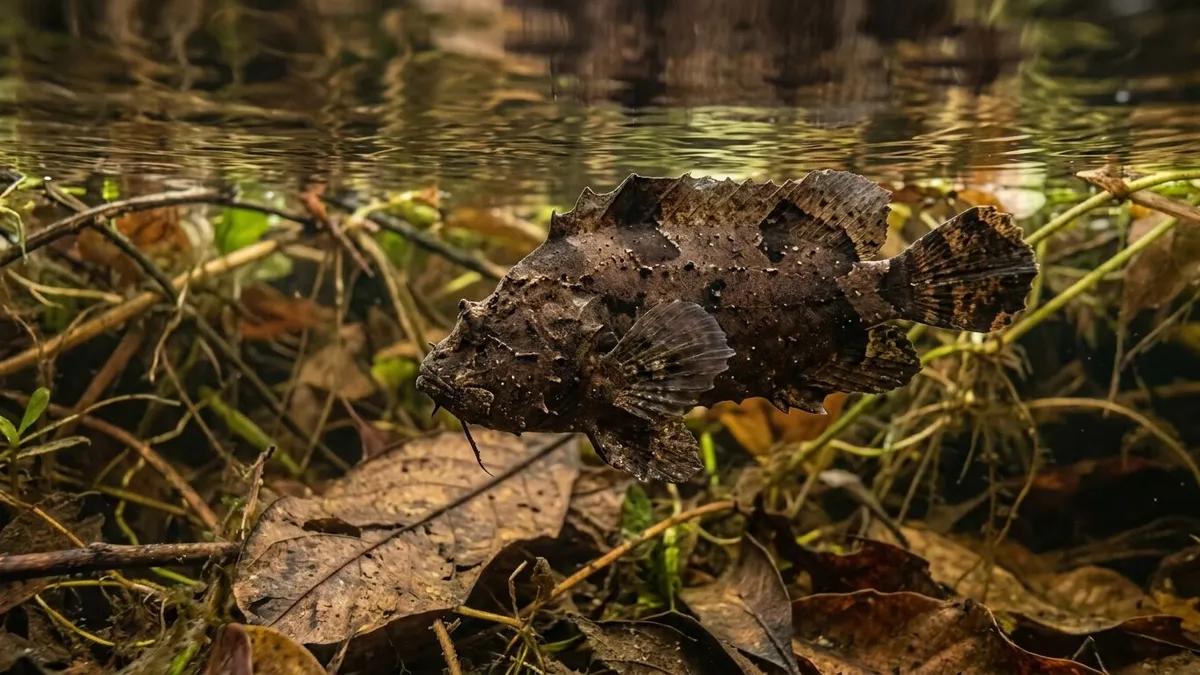
A dead leaf floats slowly, turning a little, apparently following the movement of the water. Then the scene changes. The leaf keeps approaching a prey animal, and the prey does not do what it normally does when a predator comes near: it does not flee. The object is not loose plant matter. It is a leaf fish, an animal whose camouflage reproduces the look of a decaying leaf.
Instead of rushing forward, the fish moves in slow motion, closing the distance gradually until it is exactly where it needs to be. Then the strategy changes in a fraction of a second. The protrusible mouth shoots forward, forms a suction tube and swallows the prey. The leaf, it turns out, could also catch.
A body built to pass for a leaf
The leaf fish is identified by a set of traits that turns its body into a working imitation of a dead leaf. The camouflage includes the appearance of a decaying leaf and a filament on the chin that imitates the petiole, the small stalk that joins a leaf to the stem. That detail widens the resemblance to a fragment of plant that has come loose from its parent.
This is not a single painted mark. It is a combination of shape, a coloration described as typical of a decaying leaf, and an appendage that reinforces the illusion. The result is an animal that can stay visually blended in with the material floating on the water. The point of all this is the mechanism: camouflage, movement and capture are linked from the first step to the last.
Slow motion as part of the disguise
The hunting sequence begins before the mouth opens. The fish keeps the look of a dead leaf and starts a very slow approach, without the speed that would make the prey recognize a moving predator right away. The progress is gradual, as if the body were following the drift of a plant fragment. This conduct reduces the visual change the prey perceives during the approach.
That does not mean every prey animal stays still in every situation, or that camouflage removes all risk. It means that, in the mechanism described here, slowness is part of how the fish gets close without triggering the defensive reaction that would be expected. The chin filament joins the scene as well, because it imitates a petiole and helps preserve the reading of a leaf. Body and movement work together, while the mouth stays ready for the next instant.
The strategy can be understood as three stages, each visual and mechanical. First, the animal presents itself as a decaying leaf, filament included. Next, it moves in slow motion, without the abrupt approach that usually gives a hunter away. Finally, when the prey is within reach, the protrusible mouth advances and turns into a suction tube.
Three steps, each preparing the next
The order matters because each stage sets up the following one. The camouflage helps hide the fish’s identity. The low speed preserves the appearance of material carried along by the water. The protrusible mouth carries out the capture. The animal does not need to chase its prey in an open race. It builds a discreet approach and concentrates the fast movement in the organ used to swallow.
The contrast between a slow body and a rapid mouth is the heart of the scene. For most of the sequence, nothing seems to be happening. Everything that is visible argues that the object is harmless, a piece of leaf litter on the surface. The speed arrives only at the end, and it is confined to a small part of the animal.
The suction tube concentrates the attack
The protrusible mouth is the mechanism that ends the approach. When it is projected forward, it forms a suction tube, temporarily changing the outline of the head. The tube guides the capture movement and lets the fish swallow the prey after coming close without alerting it. The central fact is functional: the mouth extends, takes a tubular shape and produces the suction used to capture.
The tube also explains why the prey does not have to be reached by a conventional bite. The leaf fish stays visually tied to plant material until the final phase, and then uses the protrusion of the mouth to shorten the distance at the decisive moment. The change is brief, but it completely alters the role of the object in the scene. What looked like a lifeless leaf starts to work as a predator that combines concealment with capture.
The evidence supports a specific description of this behavior, not a general classification of every fish that uses suction. The mechanism is concrete, and it is enough to explain the scene.
What the camouflage shows, and what it does not
The payoff of the camouflage is both visual and behavioral. The fish manages to approach looking like a dead leaf afloat, and the slowness of the approach does not set off the prey’s escape reaction. The filament on the chin adds the detail of the petiole and makes the imitation more complete. The protrusible mouth finishes the change: at the moment of the attack, the plant shape stops being only a disguise and becomes a capture position.
The camouflage, then, does not depend only on the animal sitting still. It continues during movement, because the fish keeps a rhythm compatible with that of a fragment carried by the water.
It cannot be said that the fish becomes invisible, only that the approach described does not provoke flight before the attack. The difference between hiding and disappearing is essential. What can be stated is the sequence: a decaying-leaf camouflage, a chin filament resembling a petiole, a very slow approach, no escape reaction, and capture by a protrusible mouth that forms a suction tube. When watching the scene, it is worth paying attention to the interval before the attack. The hunt begins while it still looks as if nothing is happening.
Reporting: Natália Santos / Amazonia Mag

Editor · Amazonia Mag
Anne Silva is the editor of Amazonia Mag, the English-language edition of Revista Amazônia. She curates, translates and adapts the outlet's science and environment coverage for an international audience, reporting on Amazon wildlife, flora, rivers, climate and research. Every story she edits is grounded in peer-reviewed studies, official data and on-the-ground reporting from the Revista Amazônia newsroom in Belém, Pará, Brazil. More by Anne Silva →