
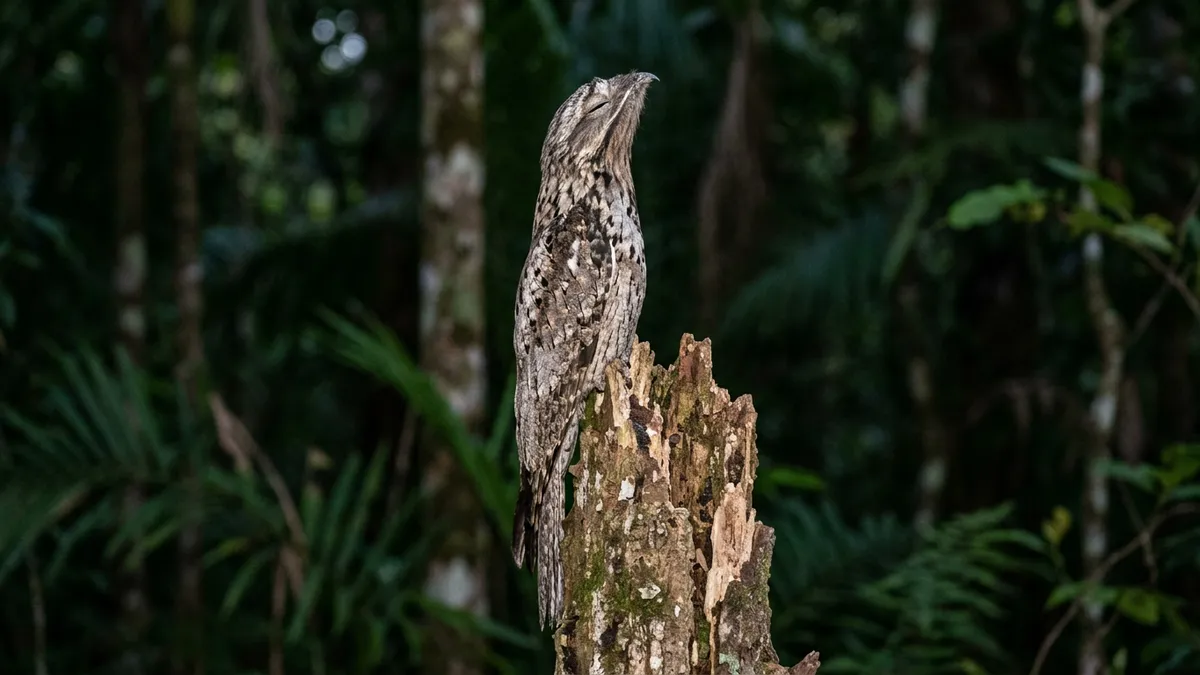
Perched on a stump, its body lined up with the axis of the wood and its bill pointed upward, the potoo looks like a broken piece of the trunk. Its plumage mixes gray, brown and white in patches that blend with bark, shadow and filtered light. The effect depends less on escaping than on not being recognized. While it holds that position, the bird cuts its movement to a minimum, even when it senses another animal approaching.
This vertical posture is a form of cryptic camouflage, a disguise that makes the body hard to identify in its surroundings. The potoo has a broad head, large eyes and a wide mouth, traits tied to a nocturnal life and to catching insects in flight. In known species of the group, the body can reach about 15 inches (38 centimeters), but size is not what stands out once the bird stretches along a branch. The outline disappears because bill, head, neck and trunk seem to form one single line.
The bill points up and the body becomes an extension of the trunk
The behavior works because the potoo picks a perch that already has a shape similar to its own body. A stump, the tip of a branch or an exposed part of a tree can all serve as a support for stillness. The bird presses its chest against the wood, keeps its feathers close to the body and tilts its head until the bill visually extends the end of the trunk. From a distance, an observer finds an irregular surface, not the typical profile of a bird.
The camouflage of the plumage completes the posture. The feathers do not need to reproduce every detail of the bark. It is enough to break up the outline and reduce the contrast between the animal and the background. That is why the potoo can stay motionless even when there is movement around it.
The disguise also depends on context. On a tree with smooth bark, the feather pattern may work less well. On irregular wood, with lichens, fissures and patches of shadow, the bird blends in better. The choice of perch and the position of the body are part of the same strategy.
A slit in the eyelid lets it watch without fully opening its eyes
Stillness does not mean the potoo stops following what happens around it. When it closes its eyes, a narrow opening in the eyelids lets it observe the environment without exposing the shine and shape of its large eyes. This anatomical detail reduces the need to move the head to check on a possible approaching predator. To anyone looking from outside, the bird still has its eyes shut. For the bird, the slit works as a limited passage for vigilance.
The solution is useful because open eyes can give away a camouflaged animal, especially one whose silhouette is meant to look like part of a trunk. The potoo therefore combines two different resources: the pattern of its feathers hides the body, while the eyelid lets it monitor risk without breaking the pose.
If danger comes very close, camouflage may no longer be enough. A predator that touches the perch or reaches the wood may discover that the motionless shape was not a branch but a bird.
At night, the same perch becomes a hunting post
When darkness falls, the potoo uses its fixed perch to look for insects. Instead of searching through foliage for hours, it watches for prey passing by and leaves its support quickly to catch them in the air. Afterward, it tends to return to the same spot or to another perch nearby. This way of hunting saves travel and fits the anatomy of the species, which has eyes adapted to low light and a large mouth for intercepting small flying animals.
Catching insects places the potoo in an important position in the night-time relationships of the forest. Moths, beetles and other insects are part of the diet of birds that hunt in flight, although the makeup of the diet varies with the environment and the availability of prey.
The bird does not have to turn the whole tree into a search territory. An elevated point offers a view, room for a short flight and the chance to return to visual cover after the strike. During the day, the perch protects. At night, it serves as a launch platform.
A strategy that protects by day and changes function after dark
The sequence is simple, but it requires coordination among behavior, anatomy and environment. First, the potoo chooses a structure that matches its shape. Then it raises its bill and aligns the body with the trunk, letting the plumage reproduce the colors of the wood. Next, it closes its eyes and uses the opening in the eyelids to follow what approaches. When night arrives, it temporarily gives up its stillness, leaves the perch to catch insects and returns to its support.
The disguise does not make the bird invisible, and it does not stop every attack. It raises the chance of going unnoticed while a predator still depends on sight to locate prey. Its effectiveness also varies with distance, lighting, wind, movement and the type of vegetation.
The behavior is known among potoos of the tropical forests of the Americas, including Brazilian areas, but the exact occurrence and frequency can change with the species and the habitat. The scene sums up an adaptation that does not depend on strength. For some hours the bird disappears into the design of the tree. Then it uses the same silence to turn a branch into a hunting post.
Reporting: Natália Santos / Amazonia Mag

Editor · Amazonia Mag
Anne Silva is the editor of Amazonia Mag, the English-language edition of Revista Amazônia. She curates, translates and adapts the outlet's science and environment coverage for an international audience, reporting on Amazon wildlife, flora, rivers, climate and research. Every story she edits is grounded in peer-reviewed studies, official data and on-the-ground reporting from the Revista Amazônia newsroom in Belém, Pará, Brazil. More by Anne Silva →