
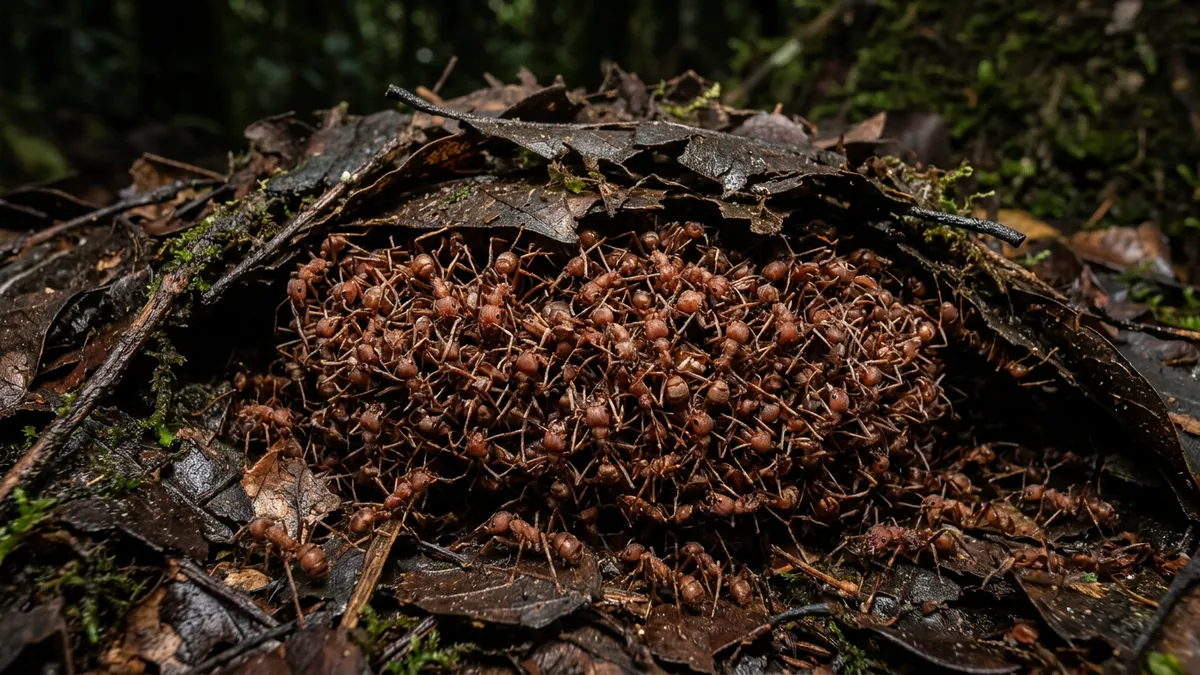
When night falls, a colony of army ants does not return to a permanent structure hidden in the soil. The workers draw close, grip one another and form a compact mass that serves as a collective shelter. The insects’ own bodies become the walls, the roof and the passages of the nest. This structure is called a bivouac: a living nest created by the interlocking of the workers.
The result changes the most common idea of an anthill. Instead of dug tunnels, stable chambers and entrances that stay in the same place, the colony assembles a structure that exists only while the bodies are joined. The shelter can be undone when the group starts moving again. The colony, in other words, carries with it the ability to build and dismantle its own nest, using the organization of the workers as both material and protection.
A colony with no permanent address
Army ants live between two phases that take turns. In one, the colony stays put and forms the bivouac. In the other, it resumes its march and advances across the environment in search of food. This is not a switch from an old anthill to a new one, as would happen in a colony that occupies fixed structures. The resting place is part of the colony’s own movement.
That alternation explains why the lack of a permanent construction does not mean a lack of organization. The unity of the group lies in the connections among the workers and in their collective ability to change shape.
During the stationary phase, the interlocking creates a shelter. During the nomadic phase, the same colony unravels into an advancing front. The nest stops being an immovable place and becomes one stage in the colony’s life cycle.
The column that stirs the leaf litter
When the colony leaves the bivouac, it spreads into a hunting column that advances through the leaf litter, the layer of fallen leaves and small plant debris on the forest floor. Many workers move in a coordinated way, and the front of the column turns over leaves, bits of vegetation and other material that has piled up on the ground. The behavior alters the surface the group crosses and exposes insects that had been hidden among the leaves.
The strength of the system lies in joint action. The workers do not depend on a lone hunter to explore the environment. The column sweeps through the litter as a moving front, pressing on the material and making fleeing insects appear. The same movement that finds food also changes the space around the colony. For a while, the forest floor stops being only a refuge for other species and becomes an area crossed by a collective search.
The colony’s movement also moves other species
The hunting column creates a scene that birds can follow. As the ants advance and insects try to escape, birds track the march and take advantage of the flight the column provokes. They do not have to lift the leaves one by one to find prey. The ants’ activity exposes animals that would normally stay protected in the litter, creating a feeding opportunity for those who tag along.
This relationship shows that the behavior of army ants does not end at the edge of the colony. The march of the workers temporarily reorganizes the environment and changes how much food is available to other animals.
The bird follows the column, the column stirs the litter and the insects in flight change position. The effect is a chain of events in which the mobile structure of the colony influences the behavior of species that take no part in building the bivouac.
A wall built to last only as long as needed
The bivouac does not have to stay assembled through the whole cycle of the colony. It appears in the stationary phase, when the workers join together to form the shelter, and it can be taken apart when the nomadic phase begins. That variable lifespan is part of the strategy. A fixed wall would be incompatible with a colony that alternates rest and travel, whereas interlocking lets the nest adapt to whatever moment the group is living through.
The workers perform different functions with the same body. Joined together, they form the structure that protects the colony during a halt. Separated and on the move, they make up the column that stirs the litter and looks for food.
Building and marching are not isolated behaviors but two expressions of one collective organization. The shelter appears without wood, mud or a prepared cavity, and it disappears without leaving anything equivalent to a conventional anthill.
What the behavior reveals about army ants
The absence of a permanent anthill can look like a shortcoming when compared with species that live in stable nests. For army ants, however, it is tied to the alternating cycle between the nomadic phase and the stationary phase. The colony does not have to choose between safety and movement as if they were incompatible conditions. It changes configuration: the bivouac concentrates the bodies at rest, and the column spreads them out during the search.
The mechanism also avoids splitting the colony’s life into independent parts. Nest, hunt and travel belong to the same system. The workers form the living wall, leave the shelter when it is time to advance and link up again at the next halt. The environment takes part in this cycle because the column searches the leaf litter and the birds take advantage of the insects that try to flee.
In army ants, each worker’s body has a role that goes beyond individual survival. It can join the hunting front, connect to other workers during the march or form part of the bivouac wall. The colony uses the closeness between individuals to create a structure that no single insect could produce. The final shape comes from the links among many bodies, not from a central piece that directs an immobile construction.
The outcome is a nest that is also a population, a shelter that is also a behavior. The living wall is more than a visual curiosity: it allows a colony with no permanent address to rest, resume its march and explore new stretches of leaf litter. There is no single date to record, because the behavior describes the natural cycle of the species in its phases of travel and pause. Each night the bivouac closes, the forest shows that a structure can exist without stone, wood or excavated soil, as long as the inhabitants themselves play the part of the wall.
Reporting: Natália Santos / Amazonia Mag

Editor · Amazonia Mag
Anne Silva is the editor of Amazonia Mag, the English-language edition of Revista Amazônia. She curates, translates and adapts the outlet's science and environment coverage for an international audience, reporting on Amazon wildlife, flora, rivers, climate and research. Every story she edits is grounded in peer-reviewed studies, official data and on-the-ground reporting from the Revista Amazônia newsroom in Belém, Pará, Brazil. More by Anne Silva →