
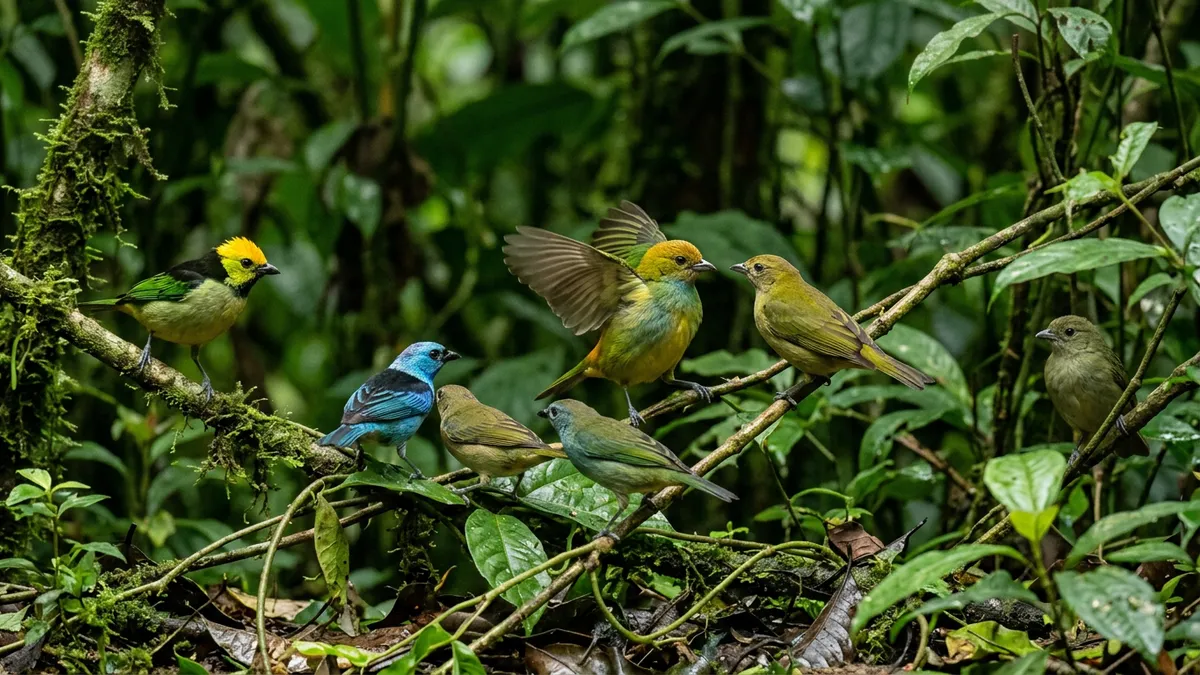
In the understory, a group of dancing manakins moves as if following a score that an observer cannot hear in full. The birds advance, retreat and repeat the same sequence in a courtship arena, while a dry snap rings out from the movement of their wings. The sound does not come from the syrinx, the vocal organ of birds. It comes from the contact and the rapid motion of the feathers during the display.
The scene brings together the two main signals of this courtship: a collective choreography and a mechanical noise made by the wings. Both unfold inside a hierarchy in which the participants do not hold equivalent positions. A young male follows the ritual before he masters the repertoire, repeating the movements for years until he is ready to take part in the performance with greater precision.
That is why the dance is not simply an automatic sequence. It depends on company, observation and long practice in a place used for choosing mates. Each of those elements deserves a closer look, starting with the stage itself.
The arena turns the understory into a courtship stage
The understory is the band of forest where light arrives filtered through the canopy and where trunks, leaves and vines form an enclosed setting. For a group display, that environment offers a bounded space in which the movements can be seen by the members of the group. The value of the spot does not lie in any built structure. It lies in repeated use, and in the chance for the birds to meet there and perform their repertoire.
The group does not dance in a disorderly way. Hierarchy guides who takes part and in what role, and it helps explain why the birds do not all play exactly the same part. Some lead the sequence, while others follow, watch and wait for the chance to advance in their command of the ritual.
This organization also corrects a simplistic reading, the idea that any movement made together amounts to a full dance. In the arena, the position of each male, the moment he enters the sequence and his ability to repeat the pattern are all part of the courtship message.
The snap comes from the wings, not from the voice
The most striking sound of the display has a mechanical origin. When the bird moves its wings at high speed, feathers and surfaces of its own flight apparatus can produce a perceptible snap. The syrinx remains the organ specialized in producing vocalizations, but it is not responsible for this particular noise.
The distinction matters because bird sounds are not always songs. Some depend on friction, impact or the vibration of body structures during fast movements.
The wings still do their usual job of generating lift and allowing short flights. During courtship, however, the gesture takes on an extra purpose: signaling. The movement has to be fast and coordinated enough to produce the sound at the expected instant of the sequence.
This turns a structure tied to flight into part of the social repertoire. The snap should not be mistaken for a vocalization, nor treated as an outside effect of the environment. It accompanies the performance and helps make the behavior recognizable inside the arena.
A young male learns before he takes a full role
The repertoire does not arrive ready-made when a young male begins to accompany the adults. He has to stay close to the group, watch the sequence and repeat its components until he has tuned his movement, speed and position. That long apprenticeship lets him recognize the order of the steps and respond to the other participants.
The practice also shows that a group display involves more than physical ability. The young male must learn a shared social convention.
The training stretches over years before he masters the dance. During that period he may take part without occupying the same position as the males above him in the hierarchy. The difference between following and leading makes the social side of courtship visible.
Instead of an isolated show, the behavior works as a repertoire passed along through company. Accumulated experience affects the quality of the performance and the place each individual holds in the arena.
What the dance says about communication in the forest
The choreography combines movement, sound and hierarchy in a single presentation. Movement shows the ability to keep up with the sequence. The snap adds an acoustic signal that comes from the body itself. And a bird’s place in the group shows that the participants do not share the same status.
These elements reinforce one another without relying on a single message. An observer can notice the noise of the wings, but the full function of the behavior only appears when coordination among the males and the learning of the young bird are considered as well.
Seen this way, the dancing manakin offers a useful lesson about how animals communicate. Courtship here is not one loud call aimed at a mate. It is a layered performance built from posture, timing, mechanics and rank, repeated in the same place until it becomes familiar to everyone who gathers there.
In the understory, the dance shows that animal communication can be built at once by the body, by sound and by social memory. It describes a courtship behavior based on a collective dance, a mechanical snap of the wings, a hierarchy and prolonged training.
Understanding it means looking past the spectacle of the snap and asking who stands where, who is still learning, and how many seasons of practice stand behind a single well-timed performance.
Reporting: Natália Santos / Amazonia Mag

Editor · Amazonia Mag
Anne Silva is the editor of Amazonia Mag, the English-language edition of Revista Amazônia. She curates, translates and adapts the outlet's science and environment coverage for an international audience, reporting on Amazon wildlife, flora, rivers, climate and research. Every story she edits is grounded in peer-reviewed studies, official data and on-the-ground reporting from the Revista Amazônia newsroom in Belém, Pará, Brazil. More by Anne Silva →