
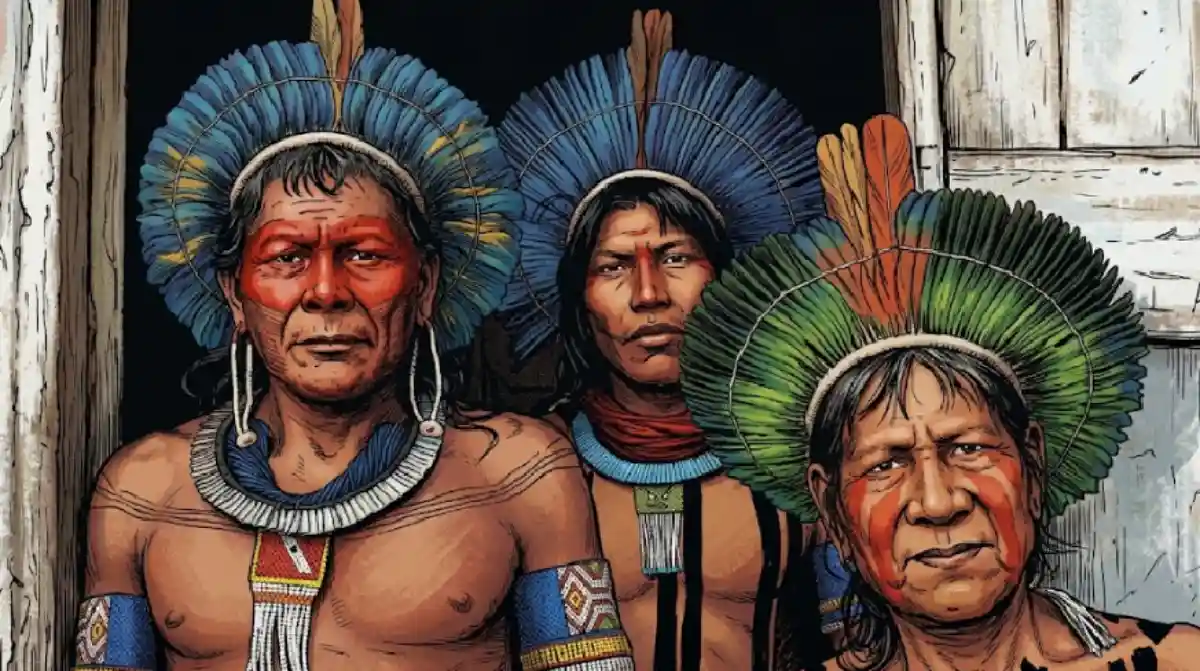
The name Pará comes from the Tupi language family and derives from the term pa’ra, whose direct translation is "sea." The word reflects the impression made by the monumental scale of the Amazon basin on the Indigenous peoples who lived along its banks, channels and estuaries.
For those communities, the mouth of the Amazon River did not resemble an ordinary watercourse. It looked like an endless ocean, a freshwater expanse so immense that its horizon seemed to have no limit. The name survived across centuries and became part of the identity of a region where freshwater and the Atlantic meet in a landscape of unique geographic proportions.
A river understood as a sea
The choice of the name Pará was not random. According to historical and linguistic records, Tupi peoples used the prefix pa-ra for large bodies of water with an open horizon. The description came from direct observation of a landscape where, at many points, it was impossible to see the opposite bank.
European colonizers would later use the expression "river-sea" for this dimension of the Amazon. The Indigenous word had already captured, in a concise form, a geographic feature that still impresses people traveling through the river’s mouth and its connected channels.
The idea of a "freshwater sea" is also reinforced by the pororoca and by the enormous sediment discharge that pushes ocean saltwater hundreds of miles inland. In this setting, the river was not merely a waterway. For Indigenous people, it was a road, a source of life and an image of infinity.
The term pa’ra brings together a physical and spiritual connection to hydrology. Water organized movement, defined landscapes and set the rhythm of existence. Studying this etymology offers a way to see how language shapes our understanding of territory while preserving the heritage of those who first named these lands.
Tupi influence on Pará’s identity
Tupi influence in Pará extends far beyond the state’s name. It is embedded in cuisine, in city names and in the customs of Pará’s people. When Indigenous communities named the region Pará, they left a mark that survived the colonization process.
The persistence of the name is evidence of the strength of Indigenous culture. Its worldview managed to leave an imprint on Brazil’s official maps, and this linguistic resistance serves as a pillar of cultural sustainability. Because of it, future generations can understand the historical roots of the land where they live.
Using the word "sea" to describe the river also points to a sophisticated classification of bodies of water. Unlike terms used for smaller rivers or igapós, Pará conveyed absolute magnitude. The word was suited to a space that exceeded ordinary categories and required an oceanic image of scale.
Today, this identity is celebrated in festivals and regional literature. The caboclo of Pará takes pride in living beside this inland ocean, while the memory of the name connects everyday life with the vastness of the waters. Valuing this etymology also means valuing Brazil’s environment, because forest and rivers are inseparable parts of Amazonian identity.
The meeting of waters and the estuary
Geographically, what ancient peoples called Pará is now the channel that runs around Marajó Island and empties into the Atlantic. This meeting of waters is one of the planet’s most dynamic settings, where currents shape the coast and sustain unparalleled marine and freshwater biodiversity.
The Indigenous understanding that this place was a sea anticipated by centuries the scientific view of estuaries as hybrid ecosystems. These environments bring together characteristics of river and marine systems, creating a complexity that challenges simple classifications.
Protecting this "freshwater sea" is essential to global sustainability. Pará contains some of the world’s largest mangrove reserves. These ecosystems serve as nurseries for countless species and as a natural barrier against coastal erosion.
Keeping the original name alive also keeps alive the memory that this system is vast and powerful, but sensitive to climate change and pollution. The ancestral wisdom contained in a two-syllable word reminds us that the river deserves the same reverence we give to oceans.
Preserving words and the landscape
Keeping the origin of the name Pará alive is a form of environmental and historical education. When a child learns that the name of the state means "sea," the Amazon River can be seen in a new way. It is no longer only a current, but a system of continental scale connected to the region’s life and future.
This emotional connection to place provides a foundation for conservation initiatives. If the river is understood as an ocean, its importance becomes even clearer, and the responsibility to keep it clean and flowing freely becomes a civic and ecological duty.
Educational and cultural institutions in Pará have worked to recover these roots through the study of Indigenous languages and their influence on the Portuguese spoken in the Amazon. This work protects cultural diversity with the same determination used to defend the biodiversity of the forests.
Sustainability, therefore, is not only biological. It is symbolic as well. A people who know the origin of their words have deeper roots from which to protect their future and their natural world.
Pará, a memory made of water
Pará is a gateway to the Amazon, and its name remains a constant reminder of the region’s monumental challenges and beauty. The concept of a "river-sea" is one of the most powerful images in Brazilian geography because it symbolizes the union of forces that sustains life across the continent.
Celebrating Tupi etymology means honoring the first cartographers and poets of these lands. They translated into sound the blue and green vastness spread before their eyes. The history of the name teaches that nature and culture move together, joined by the cycle of water.
The sea Indigenous peoples saw at the mouth of the Amazon is still there, challenging the imagination and feeding communities with its abundance. Protecting Pará means protecting a worldview in which the river is as vast as the ocean and human life is integrated with the waters through respect and admiration.
Etymology is an archaeology of words, and Pará is a jewel found in the fertile soil of Tupi memory. The name reminds us that every drop belongs to a sacred sea. For people who live in the Amazon, the river has never been only water. It has always been the horizon where the world begins and ends.
In Old Tupi, the word "Pará" was not used only for the present-day state. It also described any body of water that made it impossible to see the opposite shore. That is why similar roots appear in names such as Paraguay, Paraguá-y, "river that comes from the sea," and Paraná, Para-na, "similar to the sea."
This logic shows that hydrology was a central reference point for navigation and territorial occupation among the native peoples of South America. In a single word, the language preserved a way of seeing the landscape, recognizing its scale and organizing the relationship with water.
Reporting: Anne Silva / Amazonia Mag

Editor, English Edition — Amazonia Mag
Anne Silva is the editor of Amazonia Mag, the English-language edition of Revista Amazônia. She curates, translates and adapts the outlet's science and environment coverage for an international audience, reporting on Amazon wildlife, flora, rivers, climate and research. Every story she edits is grounded in peer-reviewed studies, official data and on-the-ground reporting from the Revista Amazônia newsroom in Belém, Pará, Brazil. More by Anne Silva →