
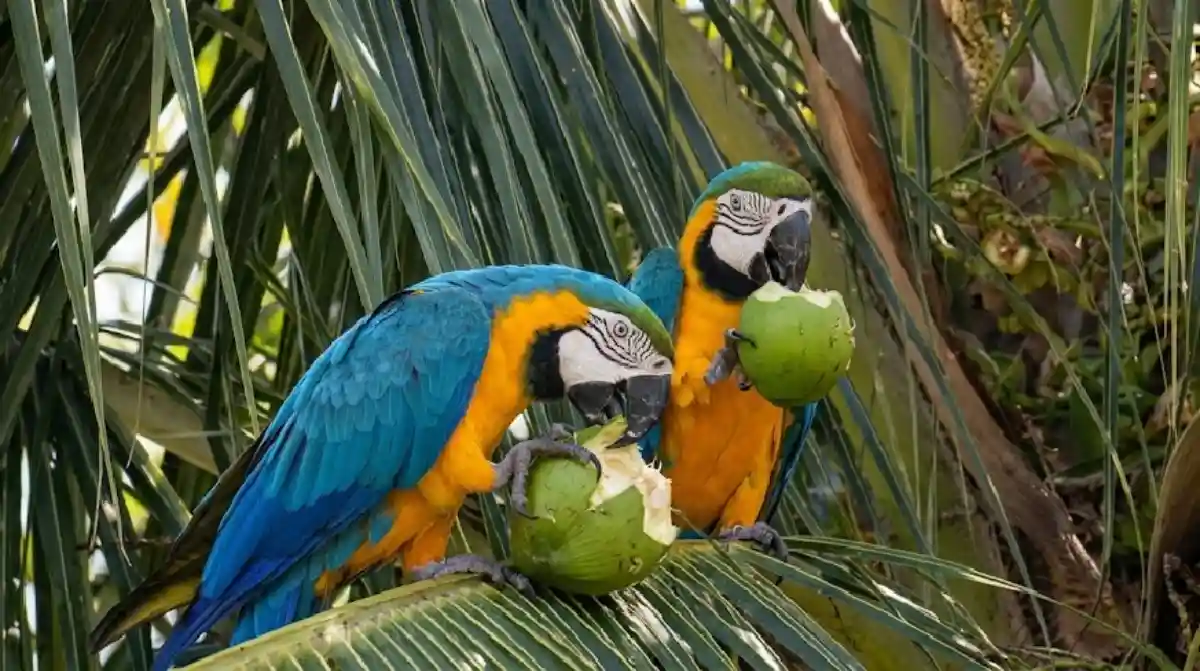
The hyacinth macaw, Anodorhynchus hyacinthinus, can use a stone as a tool to crack palm nuts. The behavior places the species among an exclusive group of animals with advanced cognitive abilities and challenges the old idea that tool use was unique to primates.
The world’s largest parrot has vivid cobalt-blue plumage and an imposing body that can reach one meter in length, or about 3.3 feet. Although it has an extraordinarily powerful bill, it does not rely on strength alone to reach its food. By adding an outside object to improve its effectiveness, the bird shows a capacity for planning and execution that fascinates biologists.
The behavior also underscores the need to protect the species and the habitat it occupies in the Amazon biome and adjacent areas. In the hyacinth macaw, intelligence is not an isolated trait. It is part of a relationship involving feeding, learning, social life, and the functioning of the ecosystem.
The stone-hammer technique
This species’ tool use is a striking example of adaptive ingenuity. Palm nuts such as licuri and catulé have extremely hard shells designed to protect the rich, energy-dense kernel inside.
For a bird, even one with a powerful macaw bill, breaking that shell can be lengthy and exhausting. The effort can also lead to injuries. Rather than depending only on repeated blows from its bill, the bird adds a stone and turns the object into an extension of its own strength.
Observations of wild birds reveal a methodical pattern. The macaws select rounded stones of a specific size and hold them firmly with their bills. They then deliver precise, rhythmic strikes at the exact point on the nut that maximizes energy transfer, making the stone function like a hammer.
The hyacinth macaw’s bill is a masterpiece of natural engineering and can exert pressure measured in hundreds of kilograms, or hundreds of pounds. That force allows it to break most nuts, but using stones is not a sign of laziness. It is a demonstration of economic intelligence: instead of spending energy and risking the bill’s integrity with repeated impacts, the bird uses logic to solve the problem more efficiently.
A tradition learned within the group
According to established ethological studies, the behavior is not uniform across all hyacinth macaw populations. That variation suggests it is a cultural tradition passed on through learning and observation within the group, rather than an innate instinct shared in exactly the same way by every individual.
The possibility points to something like “schools” for cracking nuts. Younger birds watch adults, attempt to reproduce the technique, and improve their use of the tool over time.
Tool-use efficiency varies among individuals of different ages. Younger birds may perform less effectively than adults, an additional indication that proficiency requires practice and cognition, not just brute force.
Social learning shows that the birds’ complexity goes beyond their physical ability to open a fruit. Choosing the stone, positioning the nut, and setting the rhythm of the blows form a sequence that must be observed, repeated, and refined.
For that reason, the behavior helps broaden the understanding of animal culture. A population can preserve particular ways of solving problems while younger individuals absorb knowledge accumulated by the group.
The macaw as an ecosystem engineer
The hyacinth macaw’s impact in the Amazon extends far beyond its display of intelligence. Because of its size and strength, it is one of the few species able to break through the defensive barrier of these fruits, acting as an “environmental engineer” or a “keystone species” in the ecosystem.
By reaching and dispersing seeds that other species cannot access, the bird helps palm populations regenerate. Those palms are fundamental to the diets of a wide range of animals, from rodents to large mammals and other birds.
Without the hyacinth macaw to begin the dispersal process for seeds protected by tough shells, the region’s entire food-web structure could be altered. The ability to open the fruit is therefore linked to processes that support food availability and vegetation renewal.
The relationship works both ways. The hyacinth macaw needs healthy, diverse forests that provide the specific kinds of nuts included in its diet, while the forest depends on the bird to maintain its regeneration dynamics.
Protecting the macaw’s habitat is not only a matter of preserving an iconic species because of its beauty or intelligence. It is also a commitment to the health and sustainability of the entire biome, ensuring that the ecological functions these birds perform continue for future generations.
Protecting intelligence and culture
Conserving the hyacinth macaw is one of Brazil’s greatest biological challenges. The species is vulnerable to habitat fragmentation and illegal capture for the animal trade.
Successful projects, such as Projeto Arara Azul, focus on installing artificial nests and monitoring populations. Their results demonstrate that declining trends can be reversed, although the conservation battle remains ongoing.
Beyond counting individuals, conservationists are increasingly concerned with protecting the birds’ “behavioral diversity” and “culture.” These are intangible aspects of biodiversity, but they can disappear along with a population.
If an isolated population that had developed the use of stone tools became extinct, its entire cultural tradition and the knowledge accumulated over thousands of years about using stones as hammers could vanish forever. The loss would not be only demographic. It would also be behavioral.
This possibility reinforces the need for conservation strategies that protect continuous territories and ecological corridors. Such spaces allow genetic and cultural flow between different groups, helping ensure that the hyacinth macaw’s intelligence and ingenious behavior continue to evolve and surprise Brazilian science.
A window into the evolution of intelligence
Studying species such as the hyacinth macaw offers a unique window into the evolution of intelligence and cognition in nonhuman beings. When researchers observe the complexity of the birds’ social interactions, their ability to learn through observation, and their skill at manipulating tools, they are prompted to question and refine definitions of “consciousness” and “planning.”
Animal intelligence is not an inferior version of human intelligence. It is a different way of responding to environmental challenges, with its own logic, traditions, and forms of adaptability that deserve respect and protection.
With its imposing beauty and its “stone hammer,” the hyacinth macaw symbolizes the vitality and complexity of the Amazon. In this biome, life does not merely survive. It thrives through mechanisms of cooperation, intelligence, and innovation that took millions of years to develop.
By protecting the hyacinth macaw, we also protect the integrity of our own evolutionary history and the planet’s capacity to generate ingenious solutions for life. Its stone, bill, and palm nuts show that innovation can emerge from a precise relationship between an animal, an object, and its environment.
Reporting: Anne Silva / Amazonia Mag

Editor, English Edition — Amazonia Mag
Anne Silva is the editor of Amazonia Mag, the English-language edition of Revista Amazônia. She curates, translates and adapts the outlet's science and environment coverage for an international audience, reporting on Amazon wildlife, flora, rivers, climate and research. Every story she edits is grounded in peer-reviewed studies, official data and on-the-ground reporting from the Revista Amazônia newsroom in Belém, Pará, Brazil. More by Anne Silva →