
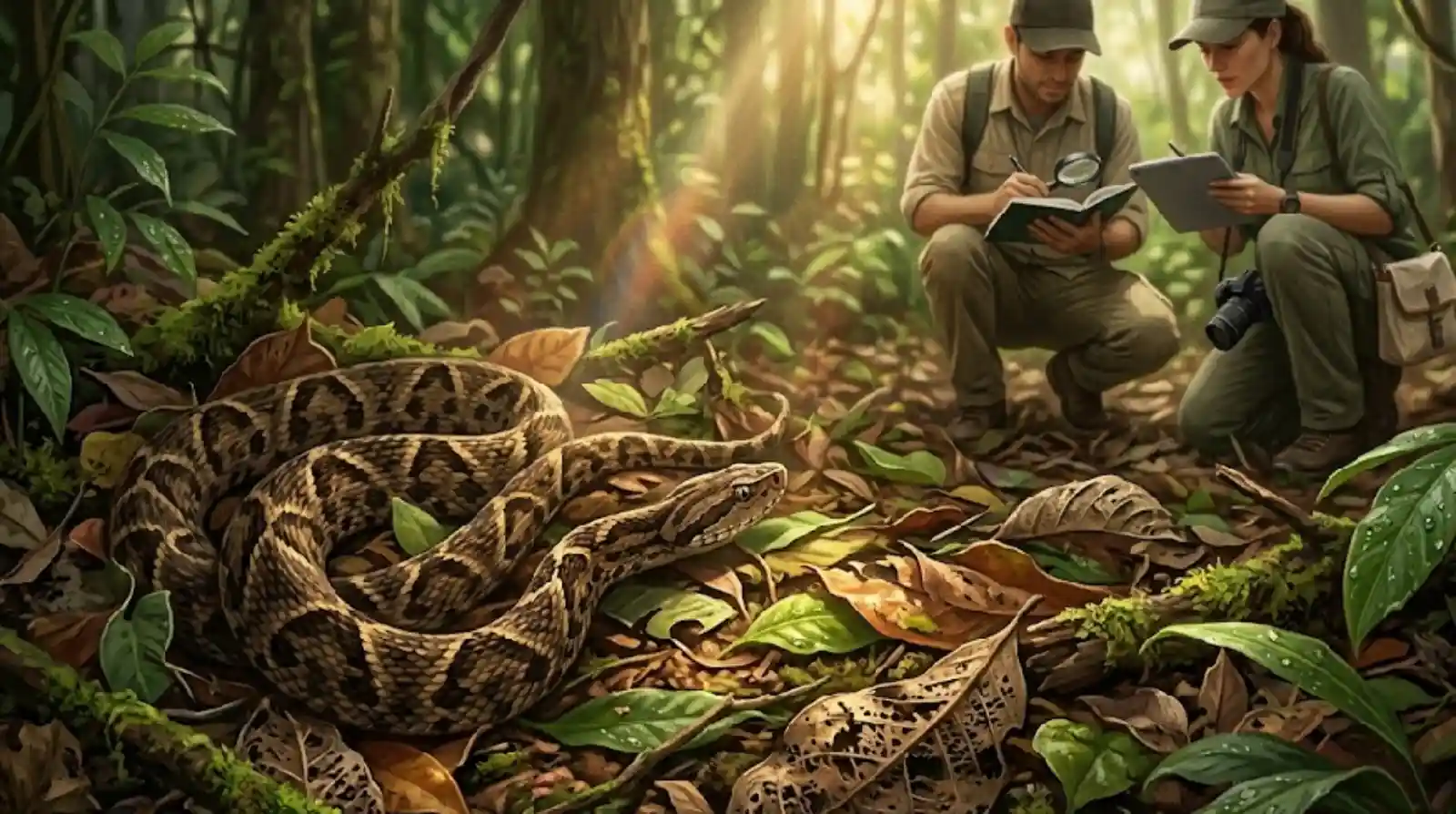
The jararaca has such a sophisticated hunting system that it can inject toxins capable of paralyzing its prey’s circulatory system within a few seconds. The effect comes through a drastic drop in blood pressure. What may initially look like nothing more than a ruthless survival strategy in the forest became the foundation for one of the major revolutions in modern pharmacology.
Science recognizes that a deep understanding of the molecules in this snake’s venom allowed Brazilian and foreign researchers to decipher complex biological mechanisms. A potential threat was transformed into an unprecedented tool for healing in the history of global public health, creating a lasting connection between Brazilian wildlife and cardiovascular medicine.
A snake adapted to Brazilian landscapes
The species Bothrops jararaca is widely known for its ability to adapt to different Brazilian biomes. It is found from southern Bahia to Rio Grande do Sul, a range that helps explain its importance in wildlife studies and in research into snakebite accidents.
Although it is the snake responsible for the largest number of snakebite accidents in Brazil, the jararaca plays a fundamental role in ecosystem balance. It controls populations of small rodents and helps maintain the health of the food chain. Its presence therefore cannot be reduced to the image of a dangerous animal.
Its hemotoxic venom is one of the features that makes the snake so compelling to study. It is a complex mixture of proteins and peptides that attack tissue and the circulatory system. That chemical combination, which can cause serious effects in prey or in a bitten person, also drew the attention of cardiovascular medicine.
This so-called “chemical signature” changed the lives of millions of people who suffer from high blood pressure. It gave researchers clues about how certain substances act on blood vessels and how that knowledge could become a controlled medical intervention.
From venom to captopril
The development of captopril is a classic example of how observing nature can lead to high-impact technological solutions. In the 1960s, scientists observed that jararaca bite victims experienced such a sharp fall in blood pressure that they could enter circulatory shock.
By isolating the bradykinin-potentiating factor found in the venom, researchers were able to understand how to block the angiotensin-converting enzyme. This blockade prevents the formation of a substance that constricts blood vessels, allowing blood to flow with less resistance.
The result was captopril and an entire class of medicines that are now essential for controlling high blood pressure and preventing heart failure. Captopril was not only the first angiotensin-converting enzyme inhibitor, but also a pioneer in drug design based on natural molecular structures.
The venom does more than immobilize prey. It also begins the process of internal digestion through proteolytic enzymes. This natural chemical complex allowed scientists to understand how human blood pressure could be manipulated safely and effectively, turning a biological function into a reference for pharmacology.
Biodiversity as a scientific library
The importance of captopril gives a new meaning to the value of Brazilian biodiversity. The discovery opened the door for the pharmaceutical industry to view tropical forests not only as reserves of timber or minerals, but also as immense genetic and chemical libraries.
This perspective changes how conservation is understood. Protecting the areas where jararacas live is also a strategy for safeguarding future discoveries that may treat diseases still without a cure. Environmental protection, in this sense, cannot be separated from scientific progress.
Modern medicine owes much to evolutionary processes that unfolded over millions of years in the heart of Brazil’s forests. Whenever a patient takes medication for blood pressure, there is an invisible link to jararaca biology and to the molecules evolution produced in its venom.
This successful example of biotechnology is a reminder that Brazil’s wealth also lies in its living abundance. Investing in species cataloging and habitat protection means preserving a living database that may contain answers to global health challenges.
Beyond the image of a villain
Alongside its medical importance, the jararaca holds a prominent place in Brazilian culture and environmental education. Removing the image of a forest “villain” is a crucial step toward helping society understand the need for coexistence based on respect and a safe distance.
When treated with respect and kept at a safe distance, the snake completes its biological cycle without posing an immediate danger to people. Knowledge of its hemotoxic venom has also helped improve antivenoms, ensuring that bites can be treated effectively and quickly.
This relationship between danger and benefit illustrates the complexity of wildlife and the precision of natural evolution. With its perfect camouflage and accurate strike, the jararaca is a symbol of resilience and adaptation. Its existence serves an ecological purpose, even though its venom can have severe consequences.
When we look at the Amazon and the Atlantic Forest, we should see more than a green landscape. Every living being, no matter how small or feared, may carry the key to the next major discovery. Respect for animal life is also recognition of our own vulnerability and our mutual dependence on the environment.
Protecting the ecosystems where these snakes live means ensuring that a source of scientific inspiration is not exhausted before it can be fully understood. The story of jararaca venom is only the tip of the iceberg in an ocean of biological possibilities held by Brazil.
Fostering a culture of curiosity and respect for wild fauna is essential so that future generations can take pride in living in a country that is a birthplace of solutions vital to the world. Science and the forest move together, showing that life in all its forms deserves constant protection and admiration.
Sustainability therefore becomes a practical tool for human survival. It connects knowledge of the land with laboratory technology and turns conservation into an investment in the future. Protecting biodiversity is, ultimately, the greatest health insurance humanity can have to secure its own tomorrow.
Reporting: Anne Silva / Amazonia Mag

Editor, English Edition — Amazonia Mag
Anne Silva is the editor of Amazonia Mag, the English-language edition of Revista Amazônia. She curates, translates and adapts the outlet's science and environment coverage for an international audience, reporting on Amazon wildlife, flora, rivers, climate and research. Every story she edits is grounded in peer-reviewed studies, official data and on-the-ground reporting from the Revista Amazônia newsroom in Belém, Pará, Brazil. More by Anne Silva →