
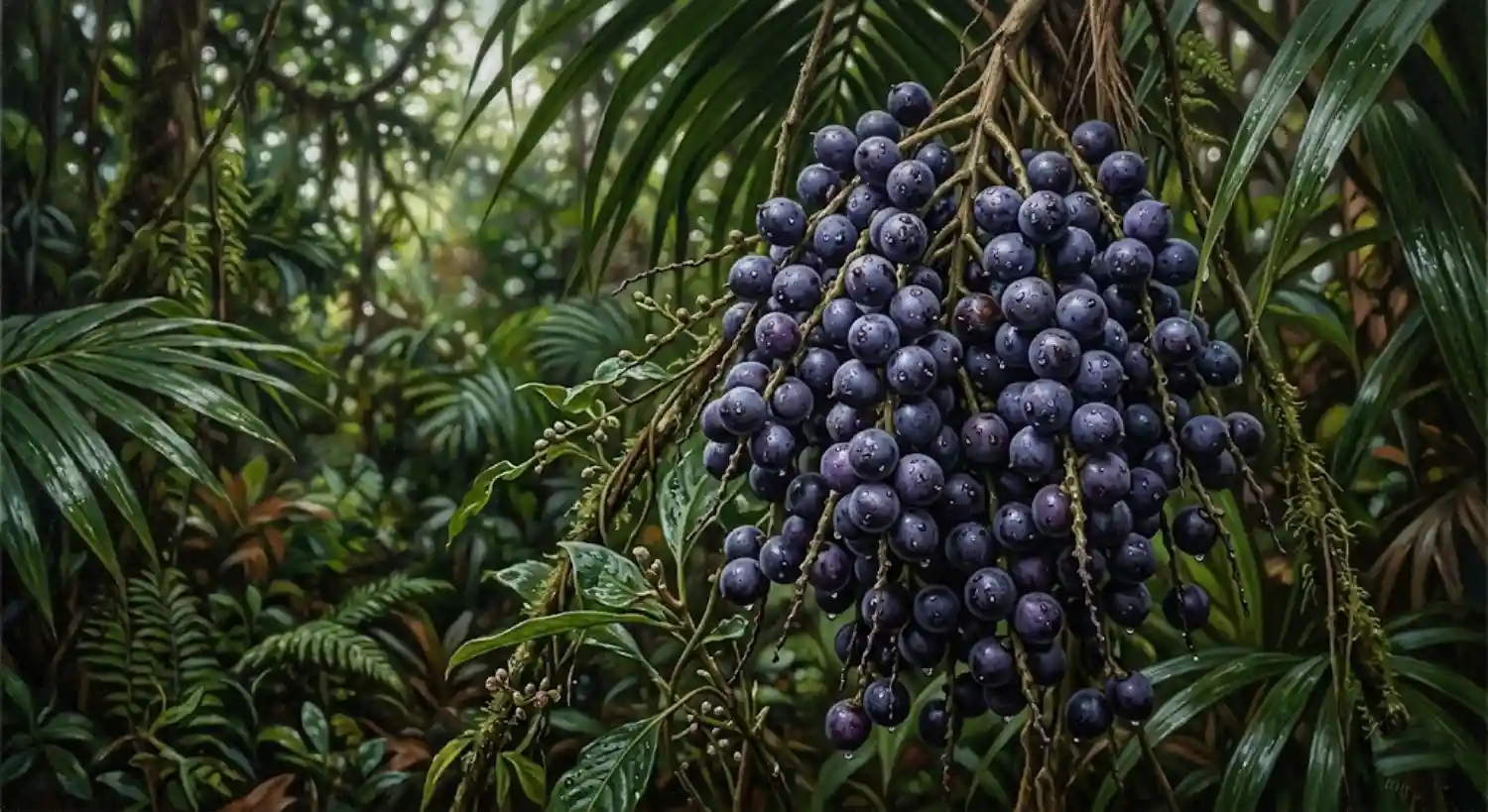
The tree that supports the economy of entire communities in northern Brazil carries a biological description in its name, coined centuries before microscopes arrived in the region. The word açaí is a phonetic adaptation of the Tupi term yasa’i, which, according to historical linguistic records, literally means "the fruit that weeps."
The name is not merely poetic. It describes the physical release of moisture and the dark juice that runs from the clusters when the small, globular fruits reach peak ripeness. In that Indigenous observation of plant physiology, contemporary journalism is rediscovering a precision that can serve as a foundation for the bioeconomy.
A name shaped by close attention to the forest
The etymology of açaí reveals a deep connection between language and ecosystem. According to historical and linguistic records from the Tupi-Guarani family, the word’s components come from y, meaning water, and sa’i, meaning to cry or to come out.
For Indigenous peoples, naming an element of nature was an act of practical scientific cataloging. By identifying açaí as the fruit that "pours water," the ancient inhabitants of the Amazon created a system of identification that helped with harvesting and processing.
This knowledge was passed down through oral tradition and later documented by chroniclers and linguists. It remains one of Brazil’s major forms of intangible cultural heritage, while also providing a bridge to understand how the forest was managed productively long before the modern concept of agriculture.
The history of the word shows that forest knowledge was not separated from daily life. Recognizing the fruit’s moisture, its stage of ripeness and its uses formed part of an integrated understanding of plants, water cycles and community work.
The biology of Euterpe oleracea
In botany, açaí is scientifically known as Euterpe oleracea. It is a palm that thrives in várzea, or floodplain areas, where the land is periodically inundated by the river cycles.
That habitat is essential to understanding why the fruit’s "weeping" is so meaningful. The plant developed adaptations for high-moisture environments, while the production of its polyphenols, which give the fruit its characteristic purple color, is an evolutionary response that protects against oxidation.
What ancient observers called the fruit’s "tear" is actually a solution rich in anthocyanins. These substances are now celebrated by medicine around the world as powerful antioxidants that can fight free radicals and support cardiovascular health.
The Tupi word and the botanical explanation meet at this point. The image of a weeping fruit refers to something visible during ripening, while modern science describes the compounds and processes associated with its color and moisture.
When production helps conserve the forest
Unlike other monocultures that require clearing land, açaí cultivation, when carried out through managed practices, can be one of conservation’s strongest allies. Minimal management of native açaí stands allows the forest to remain standing while preserving the canopy structure and local wildlife.
Studies conducted by Embrapa Amazônia Oriental show that managed açaí areas retain more carbon and promote more efficient nutrient cycling than degraded pasture. The finding places palm management within a broader conversation about producing goods without fully replacing ecosystems.
This model of "positive impact" shows that economic wealth can move together with environmental regeneration. It also turns riverside residents into the biome’s main guardians, because the continuity of their work depends on a productive and conserved environment.
The connection between the local economy and conservation is direct. If the várzea loses its structure and water cycles, the ecological foundation that supports açaí stands is weakened as well. Keeping the forest standing therefore helps ensure that the fruit can continue to "weep" on fertile, preserved ground.
Food as a form of cultural protection
Açaí consumption in the Amazon region differs sharply from the model exported to the rest of the world. In Pará, the fruit is processed and eaten as a savory accompaniment, usually alongside roasted fish or cassava flour.
This practice keeps the food’s nutritional and cultural essence alive. Valuing the traditional method of preparation also means protecting the communities that hold the technical knowledge of extraction.
Valuing yasa’i in its pure form counters the biological distortion of the fruit. It also helps preserve the region’s identity against excessively processed industrial products, maintaining the link between Brazilian tables and a living forest.
In this context, gastronomy is not separate from conservation. The way açaí is extracted, prepared and eaten expresses a historical relationship with the land and keeps the knowledge of várzea communities visible.
From a Tupi word to the future of the bioeconomy
The journey of the Tupi term to international shelves is a testament to the resilience of Brazilian biodiversity. Today, açaí represents a significant share of the gross domestic product of states such as Pará, although its real value reaches beyond financial figures.
The fruit symbolizes the possibility of an economy that respects the pace of the land and the wisdom of traditional peoples. When consumers choose products with origin certification and sustainable management, they help finance the protection of entire watersheds.
Modern science, by validating what the Tupi name had already announced, closes a cycle of knowledge. That cycle places Brazil at the forefront of global sustainability and shows that the forest is worth far more for what it produces naturally than for what it might offer if it were cleared.
Pará is the world’s largest açaí producer and accounts for more than 90% of national production. The state has transformed artisanal harvesting into a robust supply chain that generates employment for hundreds of thousands of riverside families.
The maintenance of this system depends directly on preserving the várzea zones. These critical ecosystems work as natural filters for rivers in the Amazon Basin and as nurseries for local aquatic wildlife.
Reflecting on açaí means understanding that words are more than sounds. They can also be maps of survival and respect for the environment.
Recognizing the fruit’s "weeping" as a symbol of abundance and life invites a reconsideration of consumption. True progress does not lie in exhaustive exploitation, but in the ability to hear what the forest says through its ancient names, ensuring that future generations can still see water running from purple clusters beneath the Amazon sun.
Reporting: Anne Silva / Amazonia Mag

Editor, English Edition — Amazonia Mag
Anne Silva is the editor of Amazonia Mag, the English-language edition of Revista Amazônia. She curates, translates and adapts the outlet's science and environment coverage for an international audience, reporting on Amazon wildlife, flora, rivers, climate and research. Every story she edits is grounded in peer-reviewed studies, official data and on-the-ground reporting from the Revista Amazônia newsroom in Belém, Pará, Brazil. More by Anne Silva →