
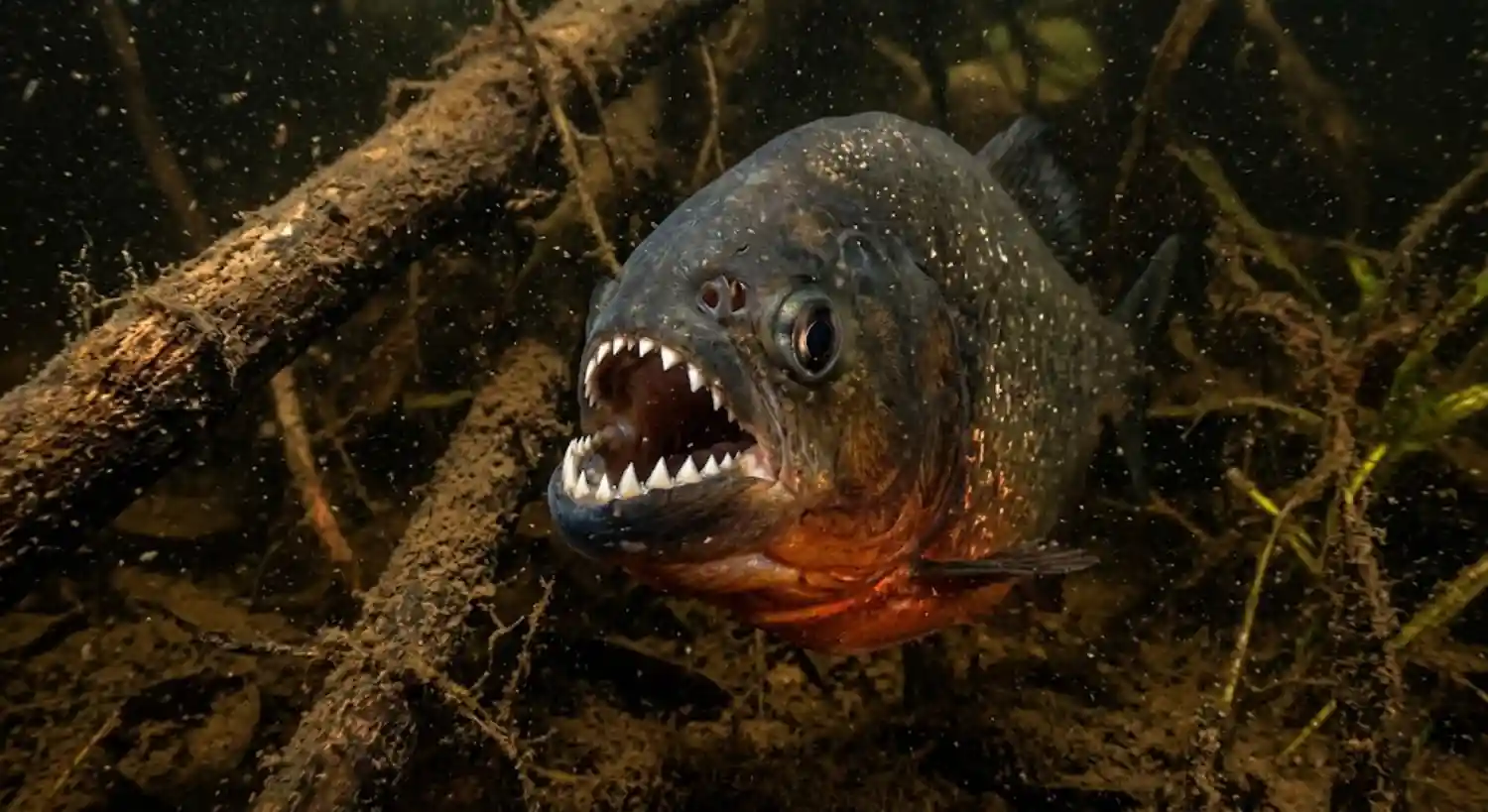
The red piranha, Pygocentrus nattereri, holds a record that challenges the usual perception of the great predators of the oceans. Among known fish, it has the strongest bite in proportion to body weight, a capacity that turns an animal only a few inches long, or a few centimeters, into one of the most efficient biological machines in the Amazon Basin.
A great white shark can exert enormous pressure because of its massive size. The red piranha, however, can generate a jaw-closing force equivalent to approximately 30 times its own weight. The difference is not body volume. It is the concentration of muscles, bones and teeth working together in a highly specialized structure.
A jaw built for cutting
To understand how a modest-sized fish achieves such performance, it is necessary to look at the evolution of its facial muscles. The red piranha has extraordinarily large mandibular adductor muscles, which occupy almost the entire side of its skull. These muscles work together with a highly optimized system of bony levers.
Unlike other fish, whose teeth may appear as separate structures, piranhas have interlocking dentition. When the jaw closes, the upper and lower teeth fit together like a perfect guillotine blade. This allows them not only to puncture tissue, but also to shear it with precision.
The combination of force and geometry explains the species’ efficiency in processing everything from tough carcasses to extremely hard seeds that fall onto the water’s surface during the flooding period. The bite is not merely an attacking tool. It is an instrument of feeding and survival, refined through millions of years of evolutionary adaptation.
The red piranha also has exceptional jaw musculature in relation to its body. Those muscles represent 2% of its total mass, a proportion described as rarely seen among vertebrates. This feature allows the fish to make clean cuts in seconds and contributes to its efficiency as an agent of organic cleanup in Amazonian rivers.
When bite force is adjusted for body mass, its performance surpasses that of dinosaurs such as Tyrannosaurus rex. The T. rex had a powerful bite because of its colossal size, but the piranha stands out for what it can accomplish with a far smaller body.
The ecological work of a feared fish
The image of the piranha as a “voracious monster” was spread largely by movies. In Brazilian rivers, however, the species performs a fundamental ecological role as a scavenger and population regulator. Its activity helps remove sick or dead animals from riverbeds.
By clearing away organic remains, piranhas help prevent the spread of pathogens that could compromise the health of the entire aquatic ecosystem. Their powerful bite should therefore be understood as a tool of environmental balance, not simply as a feature associated with aggression.
This specialization is part of a wider network of relationships in the Amazon. Each piranha participates in the rivers’ cycles of organic matter, while its presence is connected to food availability, water quality and seasonal changes in floodplain environments.
Strength also comes from the school
The social behavior of the red piranha has attracted the attention of researchers around the world. Although an individual bite is powerful, the strength of the group lies in strategic cooperation. According to observational studies, the school is not simply an attacking tool. Its primary function is defense against larger predators, including the pink river dolphin and the black caiman.
Living in a group reduces the chance that an individual will be captured. It also increases efficiency when locating food resources in waters that are often muddy and have limited visibility. Group life therefore provides protection while improving the chances of finding food.
During the dry season, river volume drops dramatically. Piranhas become confined to narrower channels and floodplain lakes, where competition for oxygen and food intensifies. Under these conditions, a powerful bite becomes even more important in territorial disputes and in taking advantage of the available resources.
Science has also documented a form of acoustic communication. When confronted or captured, piranhas produce sounds by contracting muscles connected to the swim bladder. These sounds function as an acoustic warning to the rest of the group about imminent danger.
Between mythology and river life
The relationship between traditional Amazonian communities and the red piranha is shaped by respect and sustainable use. According to the oral tradition of several peoples in the region, the piranha is seen as a sentinel of the waters. The species is part of a culture that recognizes the importance of aquatic animals and river cycles.
In local cuisine, the fish is the star of the famous piranha broth, valued not only for its distinctive flavor but also for its high protein content. Dried teeth and jaws are also frequently used as cutting tools and in handicrafts. These practices show how biodiversity can become part of material culture without extermination or irrational fear.
It is important to challenge the idea that these fish attack humans indiscriminately. Incidents are rare and generally occur under extreme environmental conditions, such as severe food scarcity, or when the piranhas are protecting their spawning sites.
Most of the time, piranhas avoid contact with large animals and prefer prey that fits their usual diet. Scientific knowledge about the biomechanics of these fish helps replace stigma with admiration and shows that the Amazon is shaped by complex biological solutions.
Water quality determines their future
The conservation of the red piranha is closely tied to the preservation of Amazonian water quality. Mercury contamination from illegal mining and changes to river courses caused by major infrastructure projects represent threats that may be invisible, but can be lethal to aquatic environments.
As top predators within their small food webs, piranhas tend to bioaccumulate heavy metals. For that reason, they also serve as bioindicators of river health. Protecting their habitat means protecting the region’s most valuable resource, freshwater, along with the life cycles that depend on it.
Continued research into piranha bite biology may have applications beyond ecology. The way its jaws work inspires biomimicry studies focused on creating new materials and industrial cutting tools. The species demonstrates that nature can produce precise solutions to the challenges of survival.
Looking at the red piranha reveals much more than a fish with powerful jaws. Its body brings together specialized muscles, interlocking teeth, social behavior, acoustic communication and an essential role in the balance of Amazonian rivers.
Its story also reminds us that strength does not depend only on size. It can emerge from specialization, from the coordination of several structures and from a close relationship with the environment. In every small creek, life takes forms that challenge our logic, proving that even the smallest tooth can play a vital role in the health of the planet’s largest tropical rainforest.
Reporting: Anne Silva / Amazonia Mag

Editor, English Edition — Amazonia Mag
Anne Silva is the editor of Amazonia Mag, the English-language edition of Revista Amazônia. She curates, translates and adapts the outlet's science and environment coverage for an international audience, reporting on Amazon wildlife, flora, rivers, climate and research. Every story she edits is grounded in peer-reviewed studies, official data and on-the-ground reporting from the Revista Amazônia newsroom in Belém, Pará, Brazil. More by Anne Silva →