
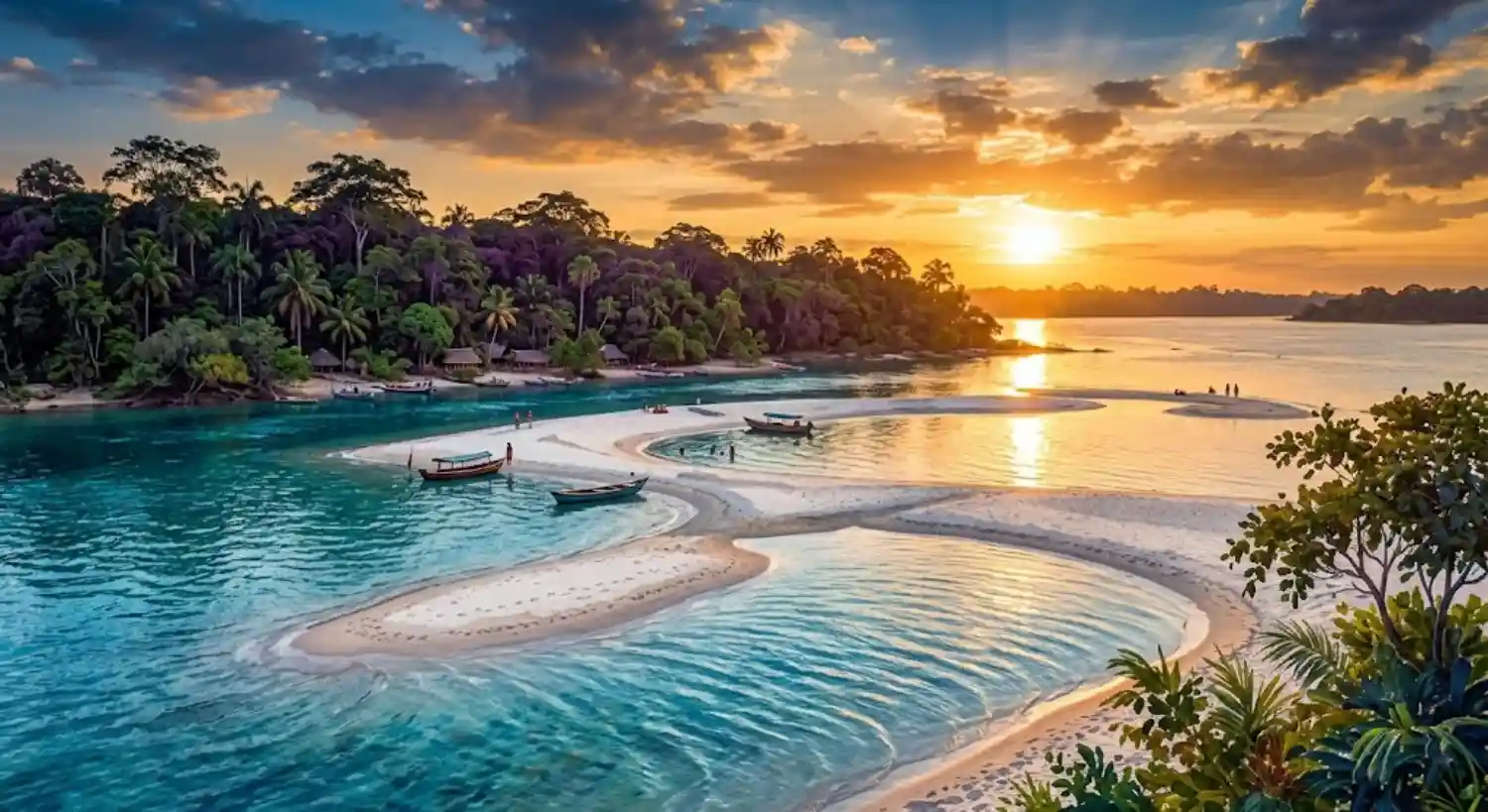
Hidden in the municipality of Santarém in the Brazilian Amazon, the village of Alter do Chão brings together a landscape that challenges the most familiar image of Amazonian rivers. White-sand beaches and transparent water appear in the middle of the largest tropical rainforest on the planet. The contrast between dense green forest and pale shores makes the region one of Brazil’s most distinctive natural settings.
The central element of this scenery is the Tapajós River. Its water is not as cloudy as that of most Amazonian rivers because the Tapajós basin runs over a bed of ancient rocks and siliceous sand. According to geographers, these materials act as a natural filter and help explain the clarity that sets the river apart.
The result is different from the experience offered by coastal destinations. Alter do Chão’s beaches can rival famous seaside locations in beauty, but they are washed by warm freshwater. Understanding why the river must be protected means looking beyond the sand to the water cycle, the surrounding forests and the communities whose lives and work are connected to this landscape.
The water cycle reshapes the landscape
Alter do Chão’s natural calendar is governed by the so-called “pulse of the waters,” a hydrological phenomenon essential to local biodiversity. As the river rises and falls, it changes the relationship among beaches, channels, flooded forests and wildlife. The same place can reveal very different environments during the year.
For visitors seeking the classic beach setting, the period known as the Amazonian Summer runs from August through December. During these months, the level of the Tapajós River drops sharply, exposing broad sandbanks. The famous Ilha do Amor, or Love Island, also emerges as one of Alter do Chão’s most recognizable landscapes.
The Amazonian Winter, from January through July, reveals another side of the region. As the water rises, the scenery becomes the Enchanted Forest, an area of igapó, or seasonally flooded forest, where visitors can travel by silent canoe among the treetops. Aquatic wildlife and migratory birds can be observed in this surreal setting, which is markedly different from the beaches seen during the low-water season.
These two periods should not be understood simply as better or worse times to visit. Each one displays part of the ecosystem’s operation. Exposed sand shows the force of the river’s seasonal movement, while flooded forest demonstrates that the Tapajós is also a route for species, nutrients and local communities.
A route that connects visitors with the forest
Santarém is the main gateway to Alter do Chão. The city has an airport with regular flights from Brazil’s major capitals. After landing, travelers follow about 21 miles of paved road, or 34 kilometers, to the village. The route is relatively short, but it leads from an Amazonian city into a setting where the river and forest shape the entire experience.
Travel by water is another option for those who want the journey itself to become part of the visit. Traditional regional boats depart from Belém or Manaus, offering another way to approach the Tapajós sanctuary. In this case, transportation is more than a connection between two points. It is a way to recognize the importance of waterways in Amazonian life.
Alter do Chão’s relative isolation has paradoxically helped protect the area. Tourism infrastructure has developed around charming inns and local food, without the large hotel complexes that could compromise the biome’s fragility. This model does not remove the challenges created by growth, but it keeps attention on the landscape’s scale and on the need to conserve it.
Ecotourism as a way to defend the forest
In Alter do Chão, tourism can provide an economic alternative to predatory activities. Initiatives connected to the Tapajós-Arapiuns Extractive Reserve have generated income for riverside and Indigenous populations through community-based ecotourism. The activity directly connects territorial protection with the work of people who know the area’s paths, rivers and forests.
By guiding visitors along trails in the Tapajós National Forest, known as FLONA do Tapajós, or through smaller river channels, local residents become the main monitors against illegal deforestation and mining. Community knowledge is not merely a decorative part of the tourist experience. It is part of the everyday protection of the environment.
The presence of responsible tourism helps finance the maintenance of standing forest. In this way, the aesthetic value of the rainforest, beaches and transparent waters becomes a renewable and extremely valuable economic asset for Brazil. The model also shows that conserving a landscape can support livelihoods without depending on the destruction of its natural elements.
This balance requires responsibility. The beauty that attracts visitors depends on the integrity of the forests, channels and water quality. If one of these parts is damaged, both the tourism experience and community life are affected.
Dolphins, giant trees and transparent water
The region is more than its beaches. Alter do Chão is also a meeting point for habitats and species. In the calm waters of Baía do Lago Verde, it is common to see pink river dolphins and tucuxi dolphins playing at dusk. Their presence links the river, aquatic wildlife and the experience of people who explore the area.
The transition between upland forest and várzea, or floodplain forest, supports enormous trees. One of the most notable is the samaúma, regarded as the “ladder to the sky” in local mythologies. Its presence shows that the Amazonian landscape is not a single vegetation type, but a set of connected environments that respond differently to the water cycle.
The Tapajós is the only one among the Amazon River’s major tributaries with clear water. Its headwaters are located on the Central Plateau, in areas formed by very old rocks that resist erosion. Because the river carries very little suspended sediment, sunlight penetrates deeply, creating the blue and green tones that make it unique.
This transparency has an ecological role that goes beyond visual beauty. Light reaching deeper water is vital for the photosynthesis of aquatic plants, which support the entire local food chain. Protecting the Tapajós’s clarity therefore means preserving a basic condition for the life that depends on the river.
The future of a fishing village
Alter do Chão’s transformation from a quiet fishing village into an internationally recognized destination brings immense responsibilities. The challenge is to ensure that increasing tourist traffic does not change the water’s chemistry or the behavior of local species. Growth must coexist with an ecosystem that has limits and with communities that depend on it.
Stronger public sanitation policies are essential. So is encouraging the consumption of sociobiodiversity products, including seed handicrafts and natural latex. These choices help value the knowledge and resources connected to the territory without reducing the Amazon to a simple tourism backdrop.
Keeping the waters suitable for swimming depends directly on the integrity of riverbank forests and on proper waste disposal. The local community has addressed this challenge through environmental education and regenerative tourism programs. The relationship between people and nature requires a delicate balance, built through everyday decisions.
The Tapajós is not merely a background for photographs. It is a living system made up of water, forest, wildlife, beaches and communities. Walking across the fine sands of Ilha do Amor makes clear that the Amazon is not only an impenetrable “great forest.” It is also a mosaic of paradise beaches, clear rivers and environments that demand respect.
Protecting Alter do Chão means preserving the possibility of living alongside nature and enjoying its beauty without destroying it. Ecotourism can contribute to that future when it generates income, strengthens communities and protects standing forest. In the clear waters of the Tapajós, ecological balance emerges as the region’s greatest wealth.
Reporting: Anne Silva / Amazonia Mag

Editor, English Edition — Amazonia Mag
Anne Silva is the editor of Amazonia Mag, the English-language edition of Revista Amazônia. She curates, translates and adapts the outlet's science and environment coverage for an international audience, reporting on Amazon wildlife, flora, rivers, climate and research. Every story she edits is grounded in peer-reviewed studies, official data and on-the-ground reporting from the Revista Amazônia newsroom in Belém, Pará, Brazil. More by Anne Silva →