
The word jacaré carries a detailed observation of an animal’s biology in only a few sounds. It comes from the Tupian expression ya-karé, which can be translated as the one who looks sideways. Long before biology was organized as a scientific discipline, Indigenous peoples were observing patterns in living beings and turning those observations into language that could endure across generations.
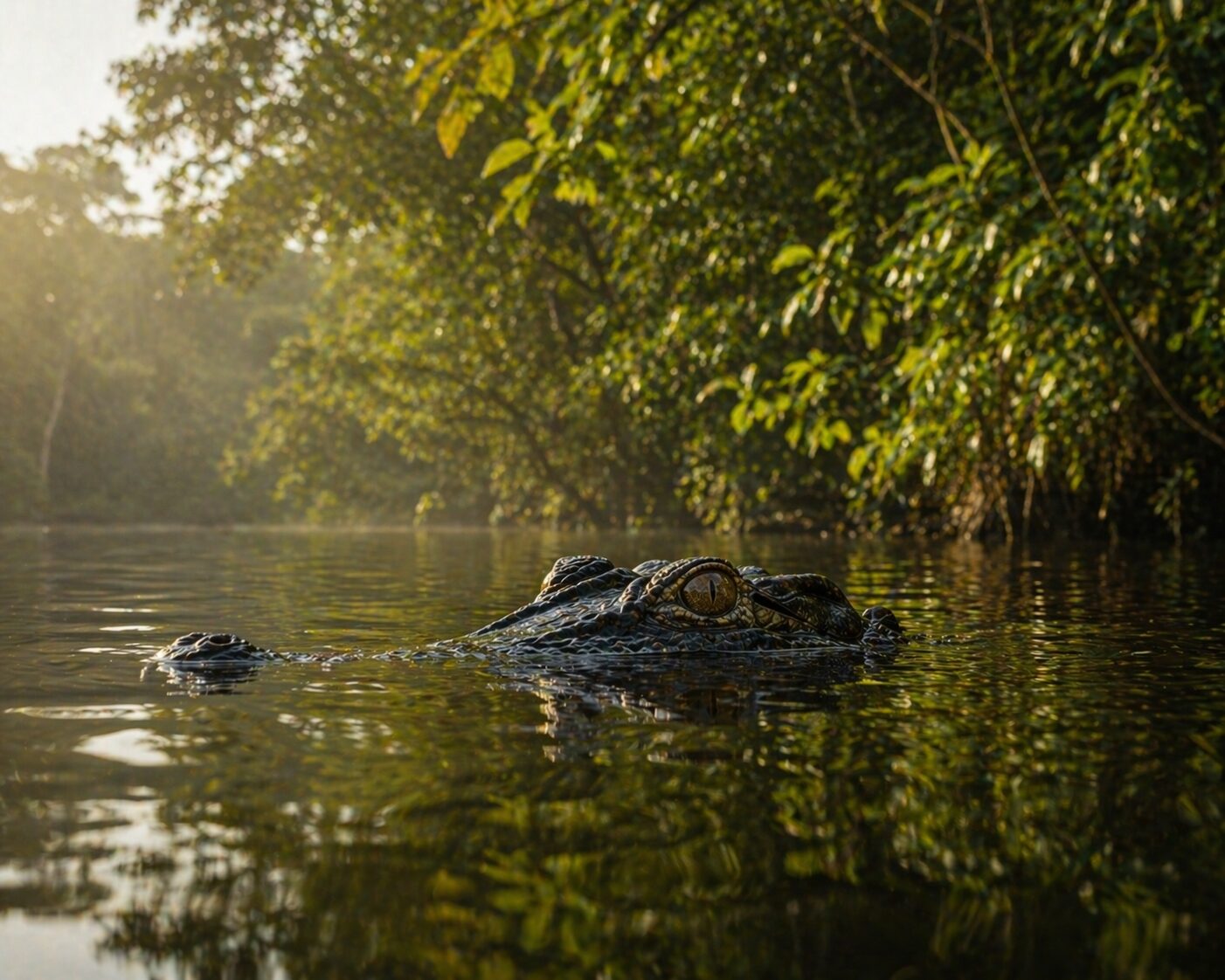
The connection between the name and the animal lies in the position of its eyes. The caiman keeps its eyes at the top of its head, an adaptation that allows it to watch what is happening above the water while its body remains almost completely submerged. It can stay hidden while monitoring the surface and the surroundings.
This arrangement helps the animal watch for prey and threats, but it also limits its direct forward field of view. To focus on objects at its side, the caiman needs to turn its head slightly. The image of an animal that looks sideways is therefore not an arbitrary label, but a compact way of linking a physical feature with visible behavior.
An adaptation for life in the water
The elevated position of the eyes is part of an efficient evolutionary strategy. With the eyes set high on the skull, the caiman can remain concealed in the water and observe what is happening at the surface. This combination of concealment and vigilance helps it detect movements made by prey approaching the bank.
The same adaptation that provides excellent vision upward and around the animal makes direct frontal alignment more limited. Small head movements are therefore needed to bring a target into focus. The name ya-karé gathers this distinctive feature and expresses it in a short, functional phrase that is easy to remember.
According to UOL, modern biology confirms that the position of the caiman’s eyes really influences how it perceives the world. The agreement between this traditional observation and the scientific explanation shows that different forms of knowledge can offer complementary interpretations of nature.
When nature becomes language
Tupian, spoken by various Indigenous peoples across the territory of Brazil, contains many terms built from observable characteristics of the natural world. Rather than acting as arbitrary labels, numerous words describe the appearance, diet, behavior or function of living beings.
This way of naming reveals a deep relationship with the environment. It is based on coexistence and on close attention to details in animals, plants and landscapes. Each word can work as a small living description, preserving ecological information and passing it on in an accessible form.
The caiman is only one example of this linguistic logic. Its name does not simply identify a reptile: it also suggests a posture and a specific way of watching. Hearing the idea of the one who looks sideways makes it possible to imagine the animal’s slight head movement and the position of its eyes above the water.
Capybara, piranha and toucan
The word capivara derives from kapi’wara, an expression meaning grass eater. The reference points directly to the diet of the world’s largest rodent and turns one aspect of its feeding habits into part of its name.
Piranha comes from pira-anha, which can be interpreted as fish that cuts. The meaning refers to the animal’s sharp teeth and the way it feeds. As with jacaré, the word combines identification and observation in a single expression.
Tucano, meanwhile, comes from tukana, an Indigenous name associated with the bird’s prominent bill and common presence in tropical forests. In these cases, the language records features that can be recognized through direct experience with animals and with the environments where they live.
Indigenous words in Brazilian Portuguese
The influence of Indigenous languages is not limited to animal names. Abacaxi refers to the idea of a fragrant fruit, while mandioca is associated with a root that is essential to Indigenous food traditions. Tatu is linked to the animal’s habit of hiding, and arara imitates the bird’s characteristic sound.
The same group includes jaguar, associated with the large forest cat, and igarapé, a term describing small waterways. Each word turns an observation of nature into an expression that continues to circulate in Brazilian Portuguese.
The sidebar titled Words That Tell Stories summarizes this inheritance: jacaré, capivara, piranha, tucano, mandioca, abacaxi, tatu and igarapé have Tupian origins and reflect direct observations of nature made by Indigenous peoples. They are everyday words that preserve traces of an attentive relationship with the environment.
Knowledge carried across centuries
Naming something according to its behavior, appearance or function is more than a practical solution. It is also a cultural way of recording ecological knowledge and making it durable. Words can act as small narratives about the inhabitants of an environment and the features that define them.
In the case of the caiman, the name teaches something about the animal even when the person saying it does not know its origin. The expression connected with a sideways glance links language, posture and biology. In this way, an everyday word preserves part of an observation accumulated over generations.
The presence of these terms in modern Brazilian Portuguese also shows the profound influence of Indigenous languages on Brazil’s cultural formation. Jacaré, capivara and piranha are still used every day, including in urban settings far from the forest, although their origin and original meaning are often unknown.
Valuing these words also means recognizing knowledge accumulated by generations of peoples who lived in balance with the Amazon and other biomes. Careful observation of animal behavior, as in the case of the caiman, demonstrates a detailed understanding of the environment built over time and transmitted through language.
When etymology and animal behavior are brought together, jacaré reveals much more than a simple linguistic origin. The term carries a history of observation, coexistence and respect for the natural environment. Every time it is spoken, it echoes a way of seeing the world in which language and nature move together, reminding us that understanding living beings is also a way of learning to name what surrounds us.
Reporting: Anne Silva / Amazonia Mag

Editor, English Edition — Amazonia Mag
Anne Silva is the editor of Amazonia Mag, the English-language edition of Revista Amazônia. She curates, translates and adapts the outlet's science and environment coverage for an international audience, reporting on Amazon wildlife, flora, rivers, climate and research. Every story she edits is grounded in peer-reviewed studies, official data and on-the-ground reporting from the Revista Amazônia newsroom in Belém, Pará, Brazil. More by Anne Silva →