
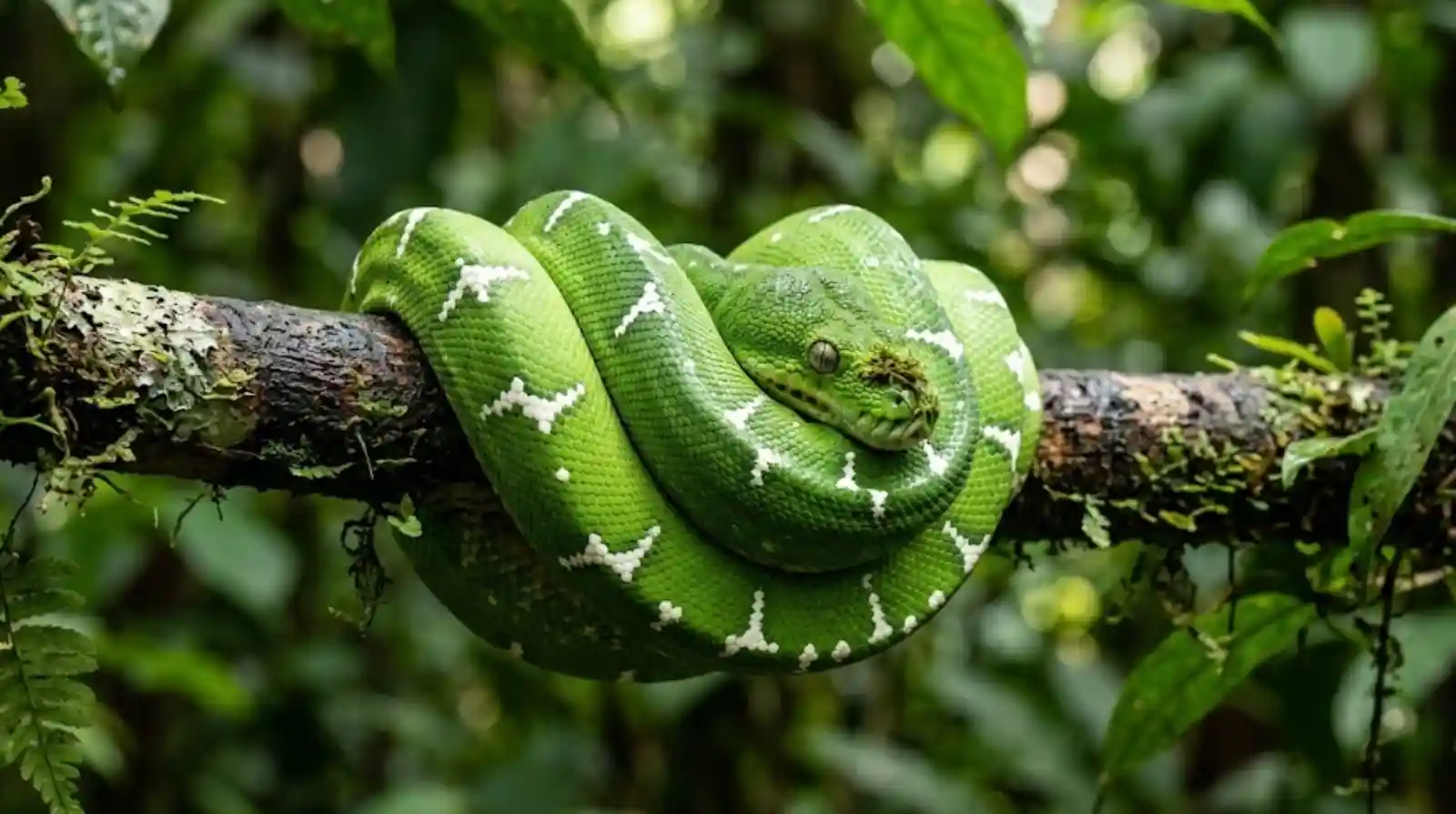
The green parrot snake has a set of front teeth so highly developed that, relative to its body size, they exceed those of almost any other nonvenomous snake in the world. This remarkable feature allows it to seize birds in midair while remaining anchored only by its tail, combining strength, balance and precision in a hunting strategy shaped for the treetops.
In the heart of the Amazon Basin, where competition for food is fierce and the ground can be dangerous territory, Corallus caninus has found a refuge in the upper levels of the forest. Its body, senses and behavior form a system adapted to a vertical environment of narrow branches, bright leaves, deep shadows and brief opportunities.
A body engineered for life in the canopy
The green parrot snake’s coloration is one of the finest examples of disruptive camouflage in tropical nature. In an adult, a pattern of white dorsal markings breaks up the animal’s outline against foliage lit by the sun. Emerald green blends with the vegetation, while the dorsal pattern makes it harder to recognize the snake’s full shape.
Young snakes, however, do not necessarily look like adults. The species is born with colors ranging from brick red to vivid orange and undergoes an ontogenetic color change as it matures. The process takes about one year, transforming the young snake into an adult that is perfectly integrated into the canopy.
Science suggests that this color change is connected to the different niches occupied at each life stage. The snake seeks protection from particular predators in different layers of the forest. The transformation is therefore not merely a visual change. It is part of a survival strategy tied to height, vegetation and the conditions of each stage of life.
Its physical structure is also a lesson in applied physics. The body is laterally compressed, which helps the animal balance on thin branches. Its prehensile tail works as a fifth limb and has impressive muscular strength, allowing the snake to project more than half of its body beyond a branch during a strike without falling.
This ability makes head-down attacks possible and helps make the green parrot snake one of the most efficient hunters in the forest’s middle layer. From an elevated position, it can remain still, hold itself with its tail and launch its body toward prey crossing its range.
Labial pits and a map built from heat
Unlike humans, who depend mainly on vision, the green parrot snake uses a sophisticated system of thermal perception to locate prey in the total darkness of dense forest. Along the scales of its lips are deep cavities known as labial pits.
These organs are highly sensitive to infrared variations. They allow the snake to detect the body heat of a small mammal or bird at considerable distances. It is as if the animal carried an integrated thermal camera, creating a mental map of its surroundings from heat signatures.
This sensory specialization is essential to its sit-and-wait hunting strategy. Corallus caninus can remain motionless for days in the same position, conserving metabolic energy until a thermal opportunity appears. In the stillness of the canopy, every branch can become an observation post and every heat signal can mark the beginning of a hunt.
When prey crosses its range, neural processing of the information received by the pits is so rapid that the strike takes place in milliseconds. According to herpetology studies published in the ICMBio Biodiversity Portal, this precision is vital because, in the canopy, a mistake can mean not only losing a meal but also suffering a dangerous fall.
A life far from the forest floor
This snake’s entire life takes place away from the ground. It drinks rainwater collected in bromeliads or droplets running down leaves, using resources available within the arboreal environment. Its reproduction also reflects this isolation among the treetops.
The green parrot snake is viviparous, meaning that its young develop inside the mother’s body and are born ready for an independent life. This removes the need to descend to the ground to lay eggs, where they would be exposed to countless terrestrial predators, including carnivorous ants and small lizards.
At birth, the young individuals already possess the instinct to climb toward higher branches. In a species whose existence depends on the forest’s vertical architecture, beginning life among branches links reproduction, shelter and feeding from the start.
Preserving the species is inseparable from maintaining that vertical structure. Centuries-old trees with broad crowns are not simply oxygen producers. They are complex cities where the green parrot snake acts as a natural population regulator, controlling the number of rodents and birds and helping preserve the ecological balance that supports the health of the Amazon biome.
A predator that helps maintain balance
People who do not know its nature often fear this snake, yet the green parrot snake plays an important role in maintaining biodiversity. As a top predator within its specific niche, it helps prevent overpopulation of certain small vertebrates that, in excessive numbers, could harm forest regeneration by consuming too many seeds.
The species is a vital link in an invisible chain of interdependence that keeps the Amazon standing. Its presence connects the canopy, prey, predators and plant regeneration in a system where every element influences the others.
Finding Corallus caninus in a forest area is often a positive sign of environmental quality. Snakes in this family are sensitive to drastic changes in microclimate and to habitat fragmentation. For that reason, seeing an individual resting quietly on a kapok tree branch may indicate that the region’s ecological processes still retain their integrity and resilience.
Valuing that presence means understanding that every scale and every strike belong to a life-support system that benefits the entire ecosystem. The snake is not an isolated creature, but one piece of the forest’s natural organization.
Conservation challenges and close relatives
Despite its broad distribution across the Amazon Basin and the Guianas, the green parrot snake faces modern challenges. Wildlife trafficking, driven by its exotic beauty, and habitat loss caused by fires are ongoing threats.
Environmental education projects and stronger protected areas have shown promising results. Local communities have also become more aware of the importance of not killing these animals out of fear. In this way, fear is beginning to give way to pride in local wildlife.
Brazilian scientific research continues to uncover secrets about the snake’s physiology and venom, or its absence, in the case of this boa. The proteins found in its saliva and the workings of its immune system in humid environments are frontiers that science is still exploring. Protecting the species ultimately means protecting a living genetic library that still has much to teach us.
Although it closely resembles Australia’s green tree python, Morelia viridis, Brazil’s green parrot snake is a fascinating example of convergent evolution. The two are not close relatives, but they developed nearly identical traits because they live in similar environments.
The main visual difference lies in the arrangement of their labial pits. In the Amazonian species, the pits are located between the scales of the upper lip, while in the Australian species they are situated inside the scales themselves. The comparison shows how similar environments can produce similar body solutions, even in snakes that are not closely related.
Reporting: Anne Silva / Amazonia Mag

Editor, English Edition — Amazonia Mag
Anne Silva is the editor of Amazonia Mag, the English-language edition of Revista Amazônia. She curates, translates and adapts the outlet's science and environment coverage for an international audience, reporting on Amazon wildlife, flora, rivers, climate and research. Every story she edits is grounded in peer-reviewed studies, official data and on-the-ground reporting from the Revista Amazônia newsroom in Belém, Pará, Brazil. More by Anne Silva →