
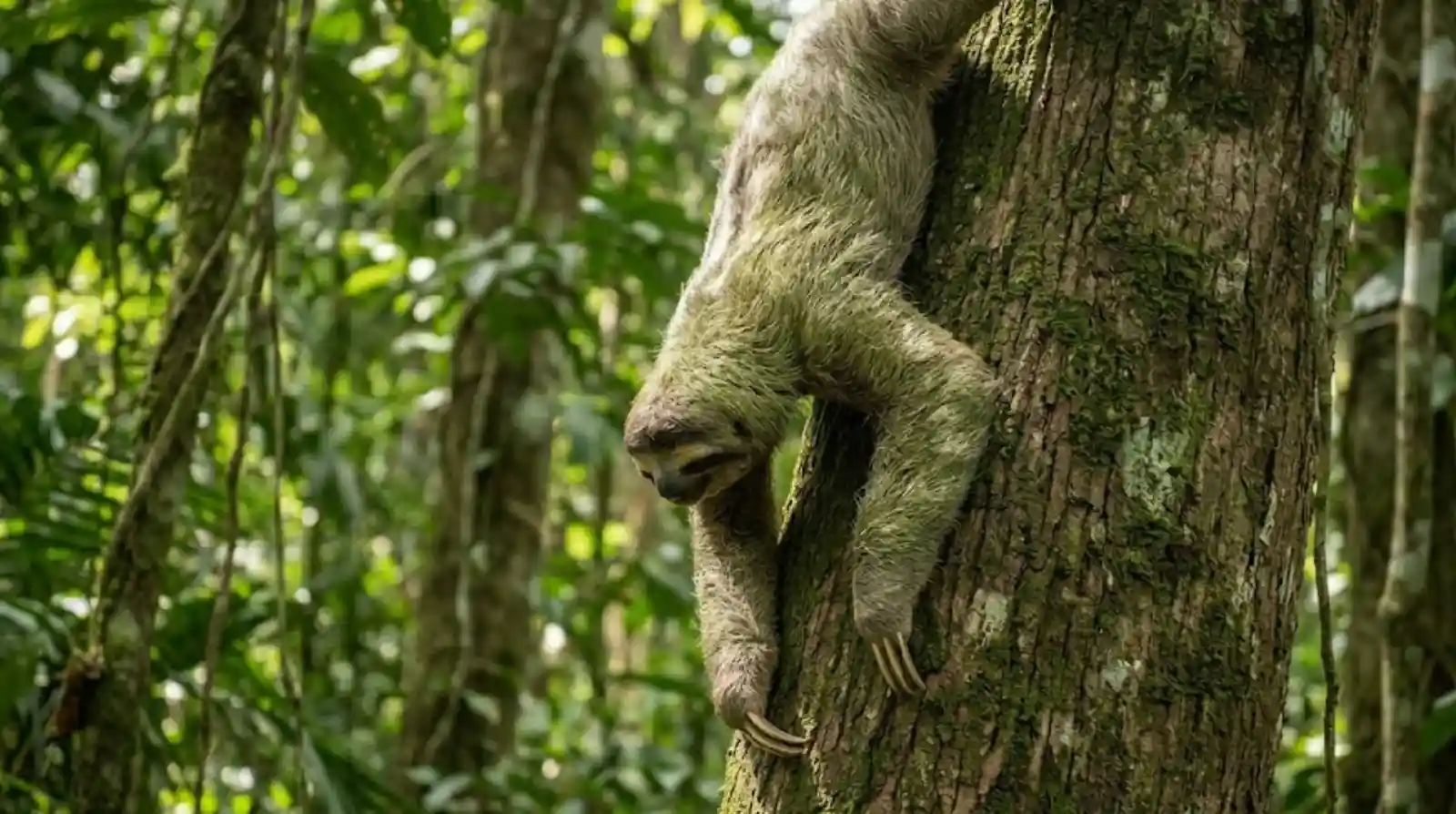
A dangerous weekly trip
The sloth spends almost its entire existence high in the forest canopy. Yet once a week, it begins a slow and hazardous journey to the forest floor to defecate. The behavior has puzzled scientists for decades because it imposes a major energy cost and exposes an animal to significant predation risk.
The question seems obvious, but its answer is not. If a sloth simply released its waste from the branches, it could avoid a dangerous trip that may cover hundreds of feet (hundreds of meters). Most primates and birds sharing the same habitat deposit their waste from above, without making a descent to the base of a tree.
On the ground, the sloth’s main defenses, camouflage and stillness, are much less effective. Its slowness also makes it vulnerable, forcing it to spend energy on a journey that appears unnecessary for an animal that could seemingly drop its feces from the canopy.
The regularity of the ritual is therefore especially striking. The sloth repeats it once a week despite the danger, suggesting that the behavior provides an evolutionary advantage powerful enough to offset both the energy expenditure and the possibility of attack.
A mammal built to conserve energy
Bradypus tridactylus, the three-toed sloth, is the slowest mammal in the world. It has an extremely slow metabolism, a biological condition connected to a diet made up almost exclusively of leaves. Leaves are difficult to digest and provide very little energy.
To manage this poor-energy diet, the sloth’s digestion is extraordinarily slow. The animal spends most of its time conserving energy and limiting movement. For that reason, climbing down from a tree is not a minor action. It is a monumental effort for a mammal adapted to remain still among the branches.
According to studies of the animal’s behavior, the descent and the climb back up can consume as much as 8% of the sloth’s entire daily energy. That estimate helps explain why the behavior is so puzzling. Even with that cost, the animal performs the weekly ritual with enough regularity to suggest a strong evolutionary reason.
The routine itself is meticulous. Once it reaches the ground, the sloth uses its short tail to dig a small hole at the base of the tree where it lives. After defecating, it carefully buries the waste before beginning the exhausting climb back toward the safety of the canopy.
An ecosystem living in the fur
The main hypothesis recognized by science connects the trip to a complex form of symbiosis involving the sloth, specific moths and algae that live in its fur. The coat is more than an outer covering. It shelters an entire small ecosystem, with organisms whose life cycles are linked to the mammal that carries them.
Moths known as Cryptoses choloepi live exclusively in sloth fur. When the sloth descends to defecate, female moths travel down with it and lay their eggs in the sloth’s feces. The larvae feed on the feces and, once they become adults, fly back to the sloth’s fur.
The cycle continues when the adult moths die. Their bodies decompose in the fur and release nutrients that fertilize the green algae growing there. The weekly descent may therefore sustain a microscopic food chain that begins on the forest floor and ends on the surface of the sloth itself.
The algae are thought to provide two main benefits. First, they create green camouflage that helps the sloth blend into vegetation and makes it harder for predators to detect. The second possible benefit is nutritional, and it is even more surprising.
Scientists believe sloths consume the algae while licking themselves. In doing so, they may obtain nutrients that are absent from their nearly exclusive leaf diet. The terrestrial behavior of Bradypus tridactylus could therefore maintain the chain linking moths, algae and the mammal that transports them through the forest.
Alternative explanations
The moth-and-algae hypothesis is the leading explanation, but it is not the only one. A less established alternative proposes that the sloth descends to fertilize the particular tree where it lives. Because sloths often favor specific trees, placing nutrients directly at the roots might help preserve the tree’s health.
If the tree remained healthy for longer, the sloth could retain its food source and shelter. There is, however, an obvious limitation to this idea. The amount of feces produced each week may be too small to have a significant effect on the fertility of a large tree.
A third hypothesis suggests that the act serves as chemical communication. By defecating at the base of a tree, the sloth might leave an odor signal for other sloths. The signal could communicate its presence, sex and reproductive status.
Because sloths are solitary animals, this passive form of communication could help individuals find mates. Still, the energy required and the danger involved appear disproportionate when compared with less risky methods, such as vocalizations. Chemical communication remains an alternative possibility rather than a consolidated explanation.
When the forest floor becomes a trap
Predation risk is the most puzzling part of the equation. On the ground, the sloth is extremely vulnerable to terrestrial predators such as jaguars and ocelots. Its slowness, which can help it remain unnoticed among the branches, makes it an easy target below.
Science estimates that most predator-caused deaths among adult sloths occur when the animals are on the ground or during the descent and ascent. The evolutionary persistence of the ritual, despite its potentially fatal danger, reinforces the idea that the resulting benefit must be substantial.
That benefit may be nutritional, arising from the symbiosis involving moths and algae. It may also include a reproductive advantage connected with chemical communication. The final explanation remains uncertain, but every hypothesis shows how an apparently irrational action can belong to a tightly connected ecological system.
The sloth’s weekly journey demonstrates that nature is full of subtle, interdependent relationships. Each descent, each deposit of waste and each return to the canopy may participate in a cycle connecting digestion, shelter, feeding, reproduction and survival.
The three-toed sloth carries a unique ecosystem of moths and algae in its fur. Its terrestrial behavior of climbing down to defecate appears essential to the life cycle of the moths, whose larvae feed on the feces. In return, adult moths fertilize the algae in the sloth’s fur, providing camouflage and supplemental nutrients.
Understanding this chain also underscores the importance of protecting the animal and its habitat. The sloth’s survival depends not only on remaining in the trees, but also on preserving the relationships that make life there possible. Watching its deliberate slowness may remind us that human haste can prevent us from seeing the deep connections that sustain Amazonian biodiversity.
Reporting: Anne Silva / Amazonia Mag

Editor, English Edition — Amazonia Mag
Anne Silva is the editor of Amazonia Mag, the English-language edition of Revista Amazônia. She curates, translates and adapts the outlet's science and environment coverage for an international audience, reporting on Amazon wildlife, flora, rivers, climate and research. Every story she edits is grounded in peer-reviewed studies, official data and on-the-ground reporting from the Revista Amazônia newsroom in Belém, Pará, Brazil. More by Anne Silva →