
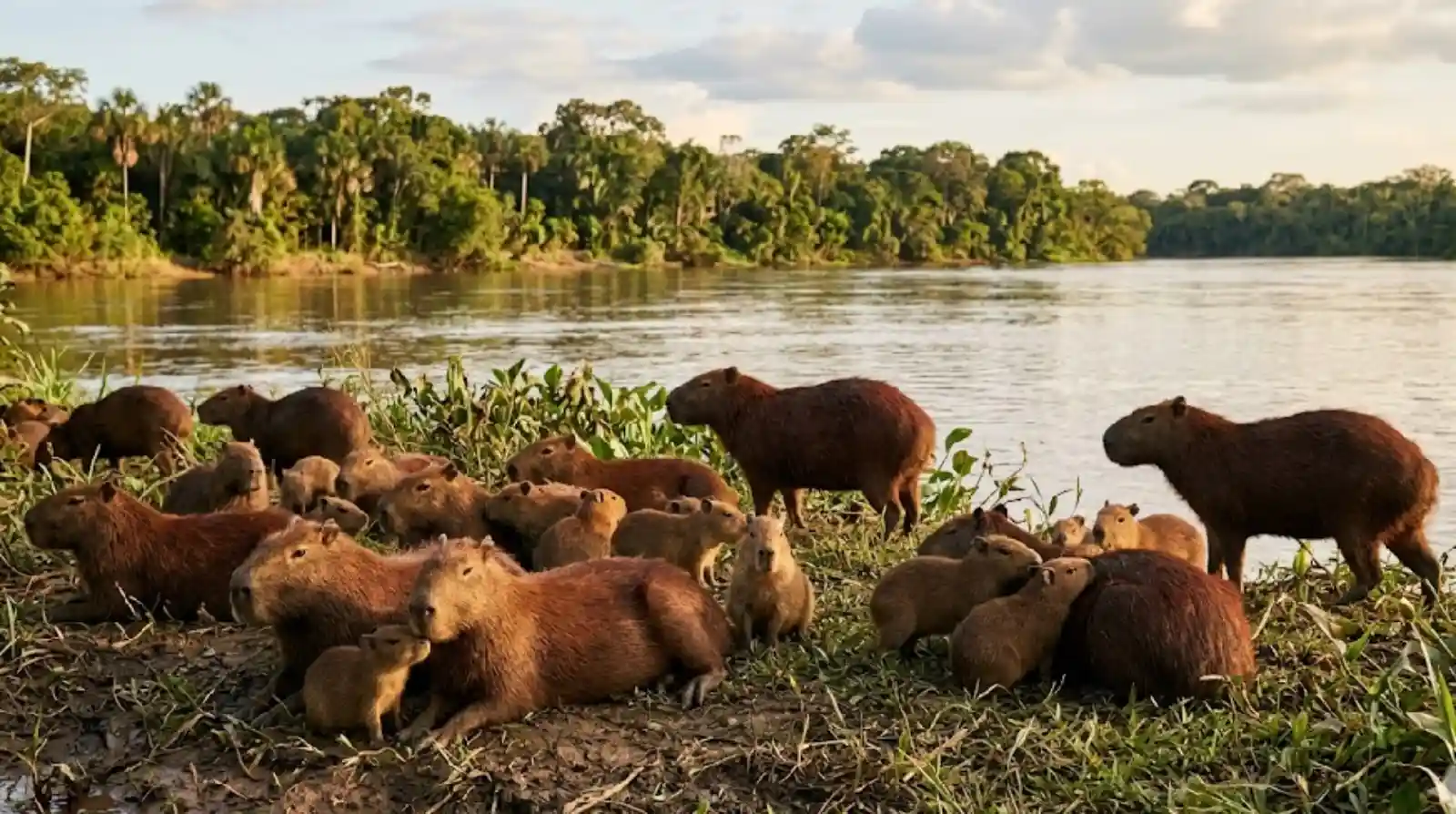
The capybara, scientifically known as Hydrochoerus hydrochaeris, is often seen as a calm and sociable animal. Behind that impression, however, is a complex and clearly ranked social organization that is closely tied to the survival of the group.
Capybaras live in groups ranging from 10 to more than 30 individuals. The arrangement is not random. Each animal occupies a place within a network of relationships that helps keep the group together, coordinate its movements, and respond to the constant presence of predators such as the jaguar and the caiman.
At the center of this organization is a dominant male. He maintains his position through ritual interactions and, on occasion, direct confrontations. The dominant male has the right to mate with the females and is chiefly responsible for coordinating the group’s defense and movement.
A hierarchy that organizes group life
Capybara society does not end with the position of the dominant male. According to science, below him is a social structure in which females also maintain their own dominance relationships, often based on age and experience.
Subordinate males remain part of the group, but their access to females is limited. They generally live on the edges of the group’s main territory, a position that reflects their place in the hierarchy while still keeping them connected to collective life.
This arrangement helps reduce internal conflict. When positions and dominance relationships are established, the group can remain cohesive, stay attentive to its surroundings, and manage the demands of watching for danger and defending itself.
Group living also comes with costs. Close contact can increase the risk of disease transmission and competition for resources, including food and resting places. Capybara social hierarchy is therefore not simply a system of domination. It is also a mechanism for managing those costs and optimizing the benefits of living together.
Shared vigilance and alarm signals
Cooperative vigilance is one of the pillars of Hydrochoerus hydrochaeris behavior. The group shares responsibility for monitoring its surroundings, allowing some individuals to rest or feed while others remain alert.
This shared watch is vital in places where predators such as jaguars and caimans may appear. When danger is detected, a capybara produces a vocal warning often described as a short, high-pitched bark.
The sound prompts an immediate response from the other members of the group. Capybaras may run toward the safety of the water or take a defensive position, depending on the collective response to the threat.
The alarm system shows how social cooperation can make individual defense more effective. Protection does not depend only on each animal watching for itself. It also depends on sharing information and reacting quickly when one member identifies danger.
Communication extends well beyond warning calls. Capybaras use a broad range of vocalizations to maintain social cohesion and mediate hierarchical interactions. These sounds include subtle whistles, grunts, and a variety of clicks.
The signals can indicate an individual’s intention, position, and status within the group. In this way, sound plays a role both in everyday coordination and in the expression of social relationships.
Communal latrines as message boards
Capybara communication also takes place through scent and visual signals. The dominant male has a scent gland on the top of his head, which he uses by rubbing against vegetation and objects. This leaves an odor mark and reinforces his leadership position.
The group’s territory is a vital area. It is where the animals forage, rest, and reproduce. To signal that the area is occupied, capybaras use communal latrines, specific places where group members deposit their feces.
These latrines function as message boards that can be interpreted by other populations. The information conveyed by the odor and the visible presence of the sites signals occupation without requiring neighboring groups to meet physically right away.
According to science, territorial marking through scent and latrines reduces direct physical confrontations between adjacent groups. Fewer confrontations help prevent wasted energy and contribute to more peaceful coexistence within the ecosystem.
The combined use of a scent gland, marks on vegetation, rubbed objects, and communal latrines shows that territory is not maintained only through direct confrontations. It is also organized through signals that other groups can detect and interpret.
Cooperative care and group success
The importance of social life becomes especially clear during reproduction. Females generally give birth in synchrony, and the group takes collective responsibility for protecting the young from predators.
Although the pups are mobile soon after birth, they remain vulnerable for several months. During this period, protection from the group is essential to their survival.
Females often cooperate in nursing and caring for the offspring of other females within the group. This behavior, known as alloparental care, is a striking example of how social cooperation can increase individual reproductive success.
Social hierarchy, shared vigilance, vocal communication, and communal latrines are parts of the same system. Each element helps manage close contact among individuals, protect young animals, defend territory, and reduce conflict with neighboring groups.
These refined evolutionary strategies have allowed capybaras to thrive in a variety of habitats, from wetlands to savannas and river margins. Observing them in their natural habitat offers a fascinating window into the complexity of Brazilian wildlife.
The group’s organization, centered on the dominant male, allows its members to share responsibility for monitoring the environment and defending themselves against predators. At the same time, communal latrines and scent-based territorial marking reduce conflict and support more peaceful and efficient coexistence.
Recognizing this social sophistication also encourages a broader appreciation of the need to protect the creatures that share the planet with us. In capybaras, cooperation is not a secondary detail. It is one of the foundations of their ecological success.
Reporting: Anne Silva / Amazonia Mag

Editor, English Edition — Amazonia Mag
Anne Silva is the editor of Amazonia Mag, the English-language edition of Revista Amazônia. She curates, translates and adapts the outlet's science and environment coverage for an international audience, reporting on Amazon wildlife, flora, rivers, climate and research. Every story she edits is grounded in peer-reviewed studies, official data and on-the-ground reporting from the Revista Amazônia newsroom in Belém, Pará, Brazil. More by Anne Silva →