
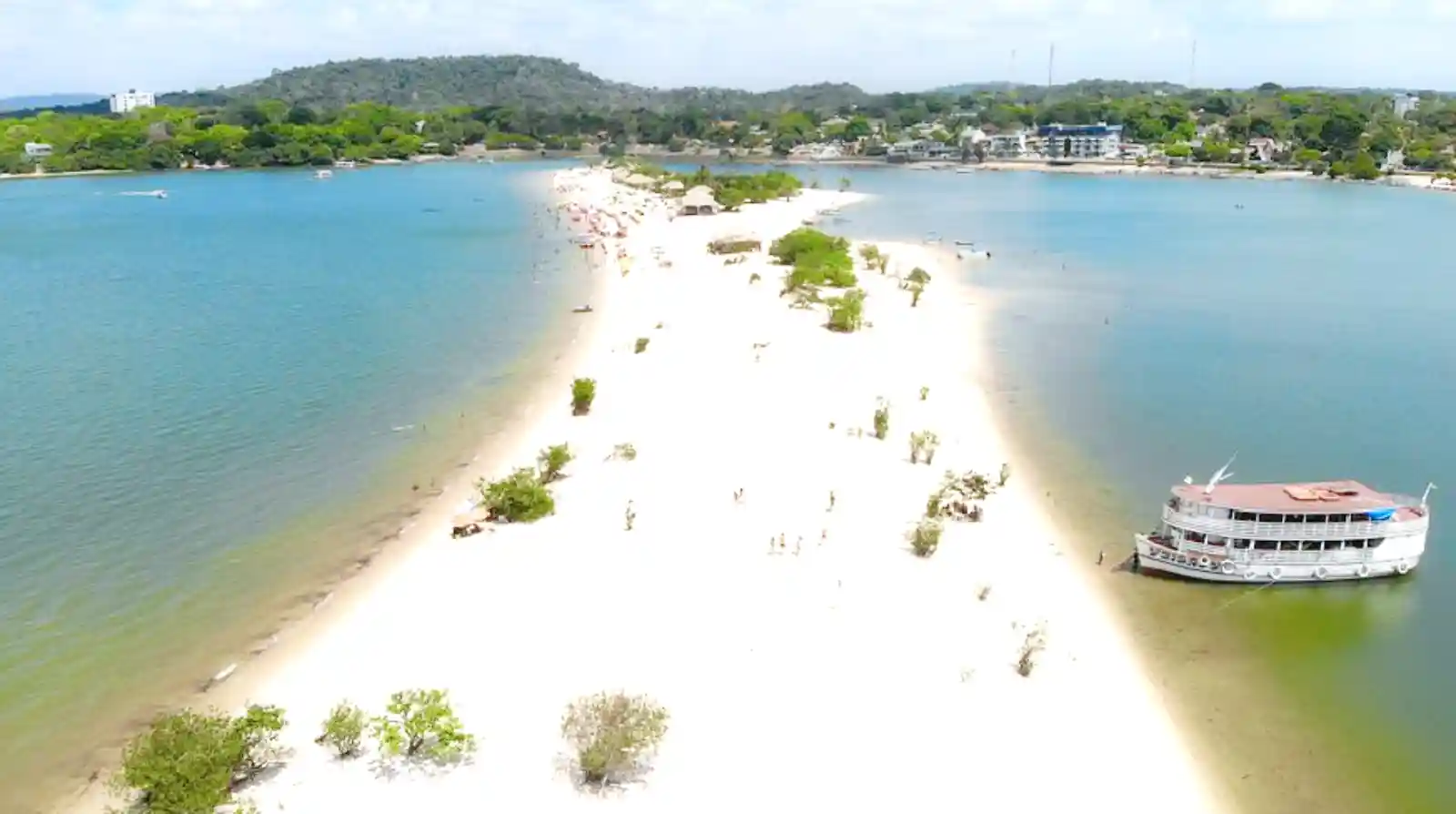
In the western reaches of Pará state, in northern Brazil, thousands of kilometres from any ocean shoreline, there is a landscape that contradicts almost everything people expect of the tropical rainforest. It is Alter do Chão, a village perched on the bank of the Tapajós River, where every year strips of white sand and transparent water appear and are routinely mistaken for the sea. The most striking fact about the place is not its beauty but its impermanence: these beaches are not fixed features. They are seasonal structures that form and dissolve completely over an annual cycle set by the rise and fall of the Tapajós.
That pulse of water creates a dynamic ecosystem in which the landscape reinvents itself roughly every six months. When the river drops to its lowest level, banks of very pure quartz sand surface and trace out beaches that rival the most celebrated coastal strips anywhere on the planet. Months later, the very same spot is entirely submerged, and the hot sand becomes an underwater habitat where fish swim between the crowns of flooded trees.
A clearwater river running over an ancient shield
The presence of such pale beaches and see-through water in the middle of Amazonia, a region popularly associated with muddy, sediment-heavy rivers, comes down to the geology of the Tapajós itself. Unlike the Amazon River, which carries an enormous load of Andean sediment that clouds the water, the Tapajós is classified as a clearwater river.
According to geological research on the basin, the bed of the Tapajós runs over an ancient crystalline shield, which means it carries very little suspended sediment. The sand that builds the beaches of Alter do Chão is made up essentially of silica and quartz grains worn down over millions of years. When the water level falls, that extremely pale substrate is laid bare under the sun. The clarity of the water, combined with the white bottom and the reflection of the tropical sky, produces the blues and turquoise greens that earned the village its nickname, the “Amazonian Caribbean”. The label works well in tourism brochures, but it is misleading: there is no salt here, no ocean tide, and the calendar is written by rainfall rather than by the moon.
The water calendar and the shifting Island of Love
The clearest emblem of this seasonal rhythm is Ilha do Amor, the Island of Love, a sand peninsula that juts out in front of the Alter do Chão waterfront and separates the river from Lagoa do Verde. Its behaviour is governed entirely by the rainfall regime in the headwaters of the Tapajós, which rises in central Brazil, an enormous distance from the village. What happens in the centre of the country months earlier determines whether there will be a beach at all in western Pará.
Hydrological studies divide the regional year into two main seasons: the so-called Amazonian summer, the dry period running from August to December, and the Amazonian winter, the rainy period that stretches from January to July. At the height of the dry season, in November, the Island of Love reaches its greatest width, with calm, warm water that invites swimming. As the rains fall heavily across the basin, the river level climbs steadily and can vary by as much as seven metres. By May or June the beach at the Island of Love has vanished entirely beneath the water, and swimmers give way to canoes drifting over what was hot sand only months before.
Igapó: the forest that lets itself be flooded
When the beaches disappear, the spectacle does not stop; it simply changes dimension. Rising water gives rise to the igapós, flooded forests reachable only by small boats. Trees adapted to that temporary submersion, such as taperebá (Spondias mombin) and apuí (Ficus sp.), spend half the year with their roots and trunks underwater, following a survival strategy refined over millennia.
For local wildlife, the flood amounts to the opening of an immense banquet. Fish such as tambaqui (Colossoma macropomum) and tucunaré (Cichla sp.) move into the flooded forest to feed on fruit and seeds falling from the trees straight into the water. Research indicates that this exchange between forest and river is vital to the reproduction and nutrition of dozens of fish species. Put another way, the scenic beauty of Alter do Chão is not decorative packaging: it is the visible face of complex ecological processes that are still working.
Green Lake and the Enchanted Forest
Immediately behind the Island of Love lies Lago Verde, or Green Lake, also known as the Mirror of the Moon. It is a bay of calm water fed by igarapés, the small forest streams of the region, and by springs of extremely clear water. During the day the lake shows different shades of green because of microscopic algae and underwater vegetation. In the high-water period, visitors can paddle a canoe through the Floresta Encantada, the Enchanted Forest, a dense stretch of igapó inside the lake where tree crowns are reflected with precision on the mirrored surface.
Tourism, sanitation and the risk of losing the clarity
The international fame of Alter do Chão draws a growing stream of visitors and puts the region in front of a considerable challenge: reconciling tourism development with environmental conservation. Because this is an extremely fragile and seasonal ecosystem, disorderly human interference can cause irreversible damage to water quality and to local biodiversity.
Inadequate disposal of solid waste, the lack of basic sanitation capable of supporting mass tourism, and excessive traffic of motorised boats are real threats to the transparency of the Tapajós. Added to that are property speculation along the riverbanks and the advance of agricultural activity within the basin, which raise the risk of nutrient pollution. An excess of nutrients can trigger uncontrolled algal growth and undermine precisely what brings visitors in the first place: clean water.
The routes forward identified by those working in the territory involve promoting community-based tourism, strengthening local protected areas, among them the Tapajós National Forest, and raising awareness among the people who arrive. Organisations such as Projeto Saúde e Alegria operate in the Tapajós region with conservation and sustainable development initiatives, while management of the federal protected areas falls to the Chico Mendes Institute for Biodiversity Conservation.
There is also a practical lesson in the calendar for anyone planning a trip. A visitor arriving in November and a visitor arriving in June are not seeing two versions of the same destination; they are seeing two different landscapes that happen to share coordinates. One brings sand, shallow warm water and long horizons. The other brings flooded forest, canoe routes through the canopy and a river that has swallowed the postcard. Knowing which season is which is the difference between disappointment and understanding what the Tapajós actually does.
Alter do Chão teaches something about impermanence and about nature keeping its own time. Visiting this corner of Amazonia requires accepting that the forest and its rivers have a rhythm to be respected rather than mastered. Protecting the Tapajós and its seasonal beaches means safeguarding one of the greatest freshwater heritages on the planet, a heritage that, paradoxically, only exists for half of each year.
Reporting: Anne Silva / Amazonia Mag. Source: Revista Amazônia, drawing on geological and hydrological research into the Tapajós river basin, on Projeto Saúde e Alegria and on the Chico Mendes Institute for Biodiversity Conservation (ICMBio).

Editor · Amazonia Mag
Anne Silva is the editor of Amazonia Mag, the English-language edition of Revista Amazônia. She curates, translates and adapts the outlet's science and environment coverage for an international audience, reporting on Amazon wildlife, flora, rivers, climate and research. Every story she edits is grounded in peer-reviewed studies, official data and on-the-ground reporting from the Revista Amazônia newsroom in Belém, Pará, Brazil. More by Anne Silva →