
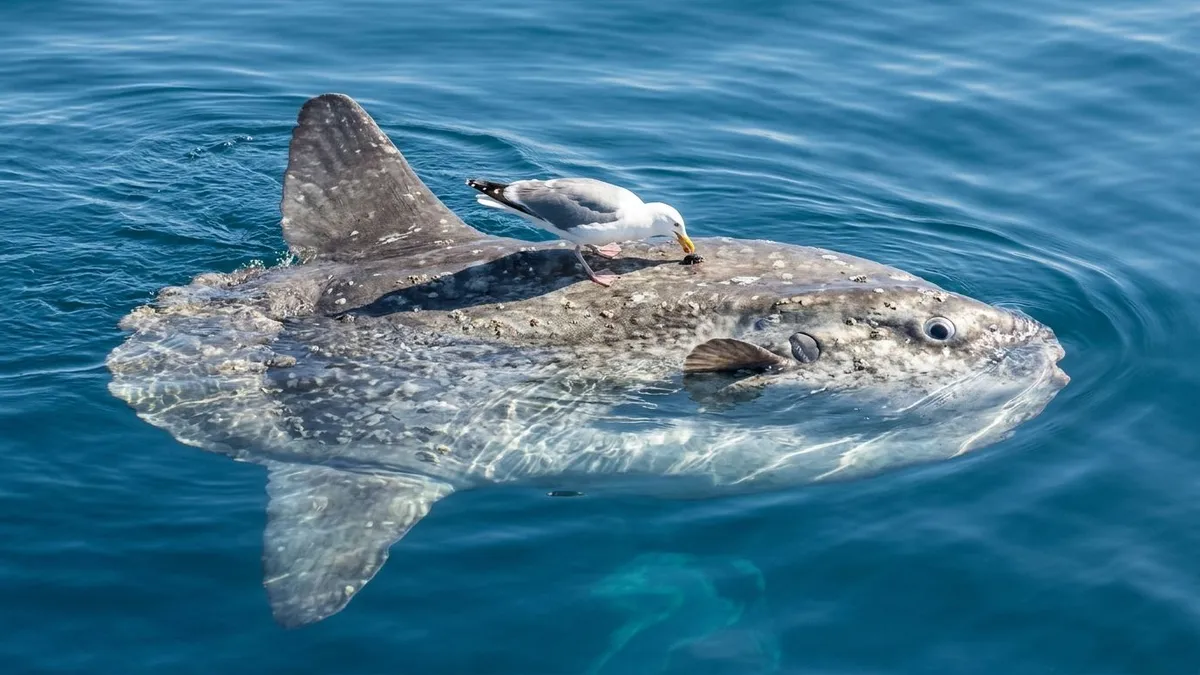
The ocean sunfish, known as the mola, begins life as a larva of a few millimeters, smaller than a grain of rice, and can reach adulthood weighing more than 2,200 pounds (1,000 kg). It is one of the biggest differences in size between the start and the end of life recorded among vertebrate animals. What makes this growth even harder to explain is the diet that supports it.
The base of the diet of the sunfish is made up of gelatinous organisms, mainly jellyfish and similar creatures. These are prey formed almost entirely of water, with very little usable material in each pound swallowed.
A prey that barely feeds
A gelatinous animal is largely seawater held inside a fragile structure. The share of protein and fat available is low when compared with a fish or a crustacean of the same volume. To get enough energy, the sunfish has to eat very large quantities, without a break.
Its feeding behavior reflects this demand. The animal travels long distances in search of concentrations of these organisms, which turn up unevenly in the ocean, and it stays to feed for long periods when it finds a dense group.
The mouth that never closes and the fused teeth
The teeth of the sunfish are fused into a structure like a beak, with one pair on top and one on the bottom. They are not made for cutting pieces off. They serve to hold and break open soft bodies. The mouth stays permanently half open, without the full closing ability found in most fish.
Inside the throat there are projections that help grind the gelatinous material before it moves on. The whole system is specialized in processing volume, not in overcoming resistance, which fits a prey that puts up no fight and has no shell.
The body that lost its tail
The adult looks like a body cut in half. In place of a tail fin there is a rounded structure formed by the joining of rays of the dorsal and anal fins, which works as a rudder and not as a propeller.
Movement comes from the alternating beat of the dorsal and anal fins, long and vertical, which move almost like wings. It is an uncommon way of swimming among fish and a fairly economical one for an animal that must cover great distances without hurry.
Deep dives and returns to the surface
The sunfish alternates between periods in deep, cold water and returns to the warmer surface layer. The gelatinous organisms it eats occupy different bands of depth, and this alternation follows the distribution of the food.
Staying in cold water for a long time has a cost for an animal of great mass, and researchers think that returning to the surface helps restore body temperature before the next dive. The pattern of going up and down is therefore tied both to eating and to keeping the body in condition to go on eating.
Many eggs for few chances
Female sunfish release enormous numbers of eggs, and most of them never reach adulthood. The first larvae have proportionally large spines, which disappear as the animal grows, and they are easy prey for a wide variety of marine predators.
This strategy of producing many offspring with low individual survival is common in the open ocean, where there is no way to protect the young. The huge size of the adult is, in part, an answer to the same problem, since few predators can deal with an animal of that bulk.
The thick skin that replaces scales
The sunfish has no scales like most bony fish. In their place there is a very thick, tough layer of skin, covered in mucus, that works as a physical barrier against bites and against friction from organisms that attach to the body.
This thickness has another practical consequence. An animal that spends part of its time in cold, deep water needs to limit heat loss, and a dense outer layer may help with that. The skin therefore serves for both protection and insulation.
No swim bladder, with buoyancy handled another way
Many fish control their depth with an internal gas bag. The adult sunfish does not have this feature and deals with buoyancy through the makeup of its own body, which is built largely of low-density gelatinous tissue.
This keeps the animal close to neutral buoyancy, without spending energy to stay in the water column. For a species that depends on eating large volumes of prey poor in energy, any saving of this kind counts in the final balance.
Why it matters to the ocean
Predators of gelatinous organisms play a little-seen role in marine balance. Jellyfish populations can grow quickly when conditions favor them, and this growth affects schools of fish and fishing activity, because these organisms compete for food with fish larvae.
Animals able to eat large volumes of this material exert some control over that process. The sunfish does this on an oceanic scale, crossing regions and linking distant areas through what it eats and through what no longer exists where it has passed.
An animal that starts at the size of a grain and ends up weighing more than a small car, feeding on something that barely nourishes, is a reminder that the ocean runs by rules of its own.
Reporting: Natália Santos / Amazonia Mag

Editor · Amazonia Mag
Anne Silva is the editor of Amazonia Mag, the English-language edition of Revista Amazônia. She curates, translates and adapts the outlet's science and environment coverage for an international audience, reporting on Amazon wildlife, flora, rivers, climate and research. Every story she edits is grounded in peer-reviewed studies, official data and on-the-ground reporting from the Revista Amazônia newsroom in Belém, Pará, Brazil. More by Anne Silva →