
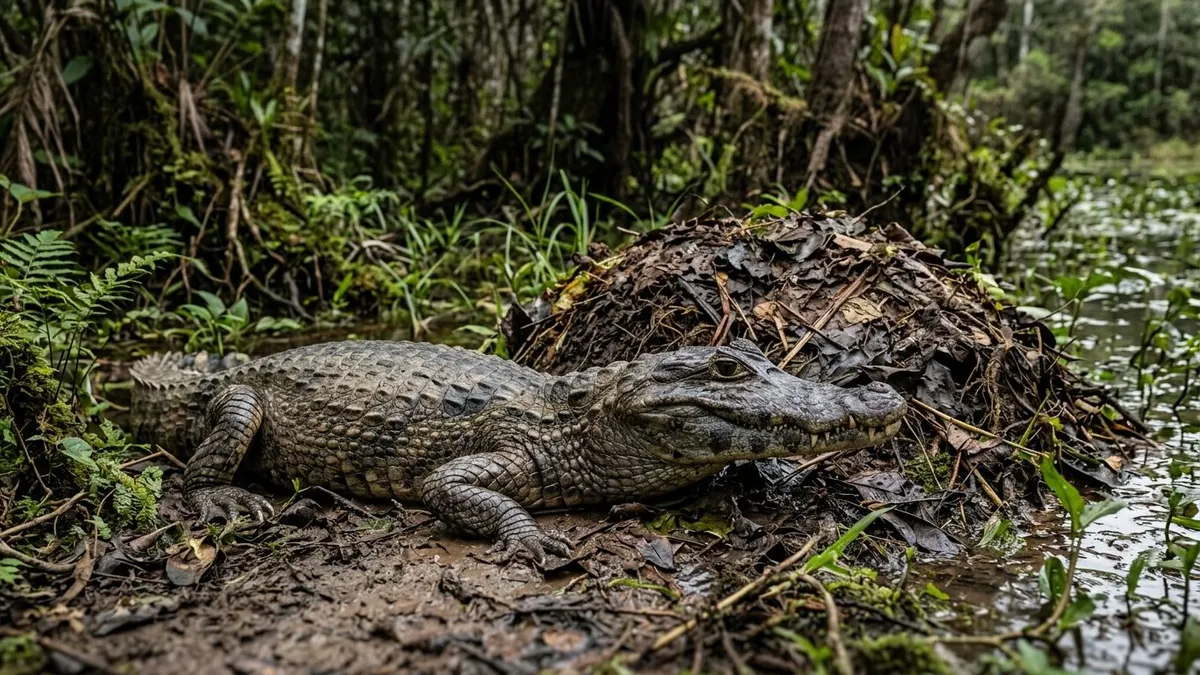
The spectacled caiman, known in Brazil as jacaretinga, uses the decay of plant matter as a heat source to incubate its eggs in the flooded lowlands of the Amazon. Instead of relying on the sun alone, the female builds a raised structure by piling damp leaves, twigs and mud along the water’s edge. The mound works as a natural thermal reactor: microbial fermentation releases a steady supply of energy that keeps the clutch warm through the breeding season.
The temperature inside that vegetation chamber also shapes the sex ratio of the brood, with no chromosomal trigger at the start. Nests held consistently above about 90 °F (32 °C) tend to produce males, while cooler nests produce mostly females. This temperature-dependent mechanism conditions the population dynamics of the reptile and shows how closely the species is tuned to the microclimates of the igapó and várzea forests.
How fermentation turns a leaf pile into an incubator
Nest building begins with the female scraping the damp ground and gathering organic matter found near bodies of water. She uses her tail and hind legs to pile leaf litter, decaying foliage and river mud into a compact, circular, raised structure. As decomposer microorganisms consume the wet material, aerobic fermentation begins and releases continuous heat toward the interior of the mound.
That microbial activity insulates the eggs from extreme swings in outside air temperature and from brief flooding at the surface. The density of the pile slows moisture loss, keeping the inside saturated, which protects the porous eggshells from drying out. The heat produced by fermentation stays stable even under heavy rain, supporting uninterrupted embryo development through the whole incubation cycle.
Temperature, sex and a critical window of development
Temperature-dependent sex determination happens during a sensitive window of embryonic development, when the gonads respond to thermal cues. When fermentation and sunlight keep the central chamber of the nest above roughly 90 °F (32 °C), hormonal activity steers the embryo toward the formation of testes, and males hatch.
If the temperature inside the vegetation mound stays below that threshold, the hormonal cascade changes the development of the reproductive system and females are produced. Published thresholds for the species vary a little from one study to another, which is why a figure around 90 °F (32 °C) is best read as a reference point rather than a fixed line.
Because the mound has natural thermal gradients, with a warmer center than outer edges, a single nest can produce both sexes. Eggs in the hot core tend to become males, while eggs at the cooler periphery tend to become females in the same clutch.
A cone built for flooded forests
The conical architecture of the mound answers the demands of the Amazonian floodplains. The sloped shape sheds rainwater at once, preventing waterlogging of the egg chamber, which would suffocate the embryos. The mix of mud and plant fibers acts as an efficient thermal insulator and reduces heat loss during the cooler hours of the night.
The female chooses a nesting site on slightly elevated ground under the forest canopy, which limits exposure to extreme direct sunlight. The base of the mound is consolidated with packed soil so that it resists the erosion caused by rising and falling river and stream levels. This dense physical barrier also makes it harder for small opportunistic predators moving across the forest floor to find the clutch or reach it.
A mother on guard for the whole incubation
Throughout incubation, the female keeps permanent watch around the vegetation mound. She sets up a safety perimeter in the adjacent water or in the igapó forest around the nest. Her constant presence discourages carnivorous mammals, other reptiles and birds that raid unprotected nests in search of protein.
Beyond defending the territory, she monitors the condition of the structure and repairs it when rain or decomposition changes the volume of the cover. This investment forces her to spend less time hunting, so she does not stray far from the clutch. Her sustained attention significantly reduces the embryo mortality caused by territorial predators.
Calls from inside the mound and a mother that digs
When embryonic development inside the shell is complete, the hatchlings begin to give sharp, repeated calls from within the sealed mound. These high-frequency sounds cross the compact layer of organic matter and reach the female patrolling the surroundings. Hearing them triggers an immediate response: she moves onto the mound and begins opening the chamber.
Using her snout and forelimbs, she gradually removes the layer of soil and fermented vegetation that seals the eggs. This mechanical help is essential for the survival of the brood, since newborns are not strong enough to break out of the structure on their own. She then gently picks up the hatchlings in her mouth and carries them to the safety of shallow water.
The relationship between the female and her young continues for a long period after hatching. The juveniles stay together in tight groups in dense aquatic vegetation, remaining under her supervision for months and, by some accounts, for more than a year. Grouping raises survival against aquatic predators such as carnivorous fish and large waterbirds.
During this time the young give contact calls to signal danger or to stay close to the group during night movements. The female answers alarm calls by intervening to drive off nearby threats. This extended support lets the juveniles develop the ability to hunt small invertebrates and fish until they are large enough to disperse on their own.
The reproductive cycle of the spectacled caiman shows how closely the physiological processes of the species are tied to the microclimate dynamics of the Amazonian ecosystem. Using the heat of decaying plant matter to influence the sex ratio of its offspring makes the reptile directly dependent on the integrity of the várzea and igapó forests. Conserving these nesting habitats remains crucial to maintaining the population structure of the species across tropical river basins.
Reporting: Natália Santos / Amazonia Mag

Editor · Amazonia Mag
Anne Silva is the editor of Amazonia Mag, the English-language edition of Revista Amazônia. She curates, translates and adapts the outlet's science and environment coverage for an international audience, reporting on Amazon wildlife, flora, rivers, climate and research. Every story she edits is grounded in peer-reviewed studies, official data and on-the-ground reporting from the Revista Amazônia newsroom in Belém, Pará, Brazil. More by Anne Silva →