
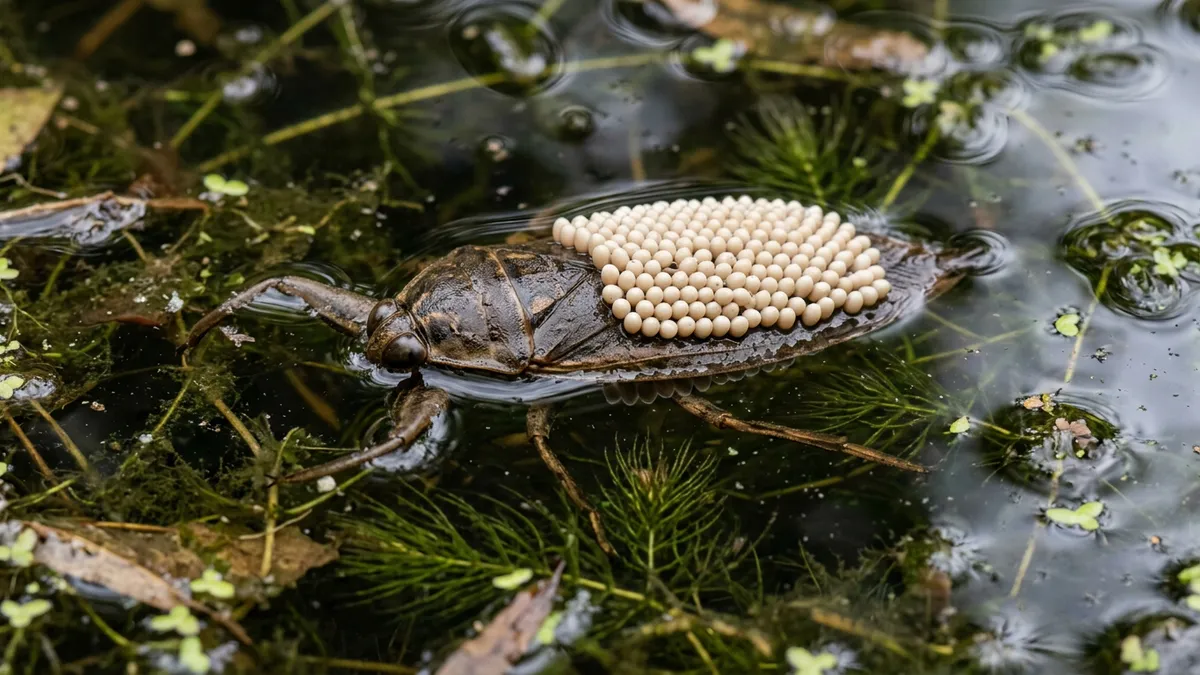
In the reproduction of the giant water bug, known in Brazil as barata-d’água, the male keeps the eggs on his back until they hatch, while the insect goes on living and hunting in the water.
The female deposits her eggs on the back of her partner, and the male receives the clutch glued to his upper body. From then on he carries it until hatching. During that period the movement of his body and the contact between the surface of the eggs and the water help to aerate the mass, while the adult stays in its aquatic habitat. The male’s back becomes a structure for transport, protection and parental care.
This behavior changes the routine of an insect that is also a predator. With sucking mouthparts, the giant water bug seizes and pierces its prey, including tadpoles and small fish. While it looks for food, the male has to keep the clutch protected and in suitable conditions for development. Reproduction, in this case, does not end when the eggs are laid: it continues on the father’s body.
How the eggs stay attached to the back
The female glues the clutch directly to the male’s dorsal region. The eggs sit grouped on his back, forming a mass that travels with the adult as he moves through the water. That position is not just a storage spot. It keeps the clutch with an individual that can move around, adjust his position and stay in contact with the aquatic environment during the period before hatching.
The male physically carries the couple’s reproductive investment. Instead of being left alone on a surface, the eggs stay fixed to the body that received them. This attachment narrows the gap between the clutch and the adult responsible for guarding it. It also means that every movement the male makes affects the whole set of eggs, which travels along with him and has water flowing around his back.
Movement helps to aerate the clutch
The development of the eggs depends on the condition of the water around them. When he moves, the male favors the renewal of water over the egg mass, allowing it to reach the exposed surfaces. This circulation helps to aerate the clutch, the central mechanism of the parental care described for the giant water bug. His back stops being merely a support and works as a mobile position in constant contact with the water.
Aeration also explains why carrying the eggs demands constant activity. If the clutch stayed still and isolated, the water around it could be renewed less efficiently. Attached to the male, the eggs follow the insect’s movement and remain exposed to the flow of water that his travel produces. The behavior does not speed up hatching in any magical way, but it creates conditions for development to proceed until the young leave their eggs.
Parental care protects a vulnerable stage
The egg is one of the most vulnerable stages of the life cycle. Before hatching, the embryo cannot flee an attack or look for another spot. The presence of the male offers a physical and behavioral layer of protection, because the clutch is not abandoned in the environment. The adult carries the eggs, keeps moving and reduces the exposure of a motionless mass to threats that might find it.
This protection does not mean the clutch becomes unreachable. The male is still subject to the risks of the environment and has to sustain his own body while transporting the eggs. Even so, the strategy places the defense on the back of an adult rather than on the ability of embryos to survive alone. Paternal care ties the survival of the clutch directly to the body condition, behavior and continued presence of the male in the water.
A predator that keeps hunting while it breeds
The giant water bug does not stop being a predator while it carries eggs. Its sucking mouthparts are adapted to pierce prey and draw out its contents, rather than to crush it the way animals with chewing jaws do. Tadpoles and small fish are among the targets of this insect. Capture takes place in the same environment where the male transports the clutch, bringing parental care and the search for food together.
This detail makes the reproductive behavior especially efficient. The male does not need to leave the water or stop hunting entirely to look after the eggs. He can keep occupying his habitat and exploiting prey, even while carrying a mass on his back. The energy gained from feeding helps sustain the adult during the period of development, while the care keeps the clutch in contact with water and under protection.
When the female glues the eggs to the male’s back, the immediate cost of care shifts sides. She deposits the clutch, and he transports, aerates and protects it until hatching. The division is not just a sequence of behaviors but an association between egg-laying and parental care. The male becomes the living surface on which the eggs stay and the agent that keeps them moving through the habitat.
For reproduction, this strategy can raise the chance that the eggs make it through the period before hatching. A clutch carried by an adult does not depend solely on staying intact at one fixed point. It follows the father, receives aeration linked to his movement and benefits from the protection associated with the species’ behavior. The result is a direct relationship between the survival of the young and the male’s ability to keep up his aquatic routine while carrying the mass.
A double role in freshwater
The giant water bug holds a double position in its environment. As a caregiver, it carries a new generation on its back. As a predator, it catches tadpoles and small fish with its sucking mouthparts. These two roles link the insect’s reproduction to the aquatic food web, because the same adult that protects eggs also takes part in the predation relationships that shape the community.
When the eggs hatch, the young leave the support their father provided and move on to another stage of the life cycle. Their presence adds new predators to the habitat, while the activity of the adults continues to influence the number of small prey available. A scene concentrated on the back of one insect thus reveals a wider connection: protecting the clutch helps maintain the continuity of a species that takes part in the balance among different freshwater organisms.
In the giant water bug, reproduction turns the male’s body into shelter, vehicle and place of development. The clutch is not simply laid in the environment and forgotten: it stays tied to an adult that breathes, moves, hunts and protects. This care shows that the survival of a new generation can depend on little-noticed tasks, such as renewing the water over the eggs and keeping them from abandonment. In the margins and shallow waters, the continuity of life can travel quietly on the back of a predator.
Reporting: Natália Santos / Amazonia Mag

Editor · Amazonia Mag
Anne Silva is the editor of Amazonia Mag, the English-language edition of Revista Amazônia. She curates, translates and adapts the outlet's science and environment coverage for an international audience, reporting on Amazon wildlife, flora, rivers, climate and research. Every story she edits is grounded in peer-reviewed studies, official data and on-the-ground reporting from the Revista Amazônia newsroom in Belém, Pará, Brazil. More by Anne Silva →