
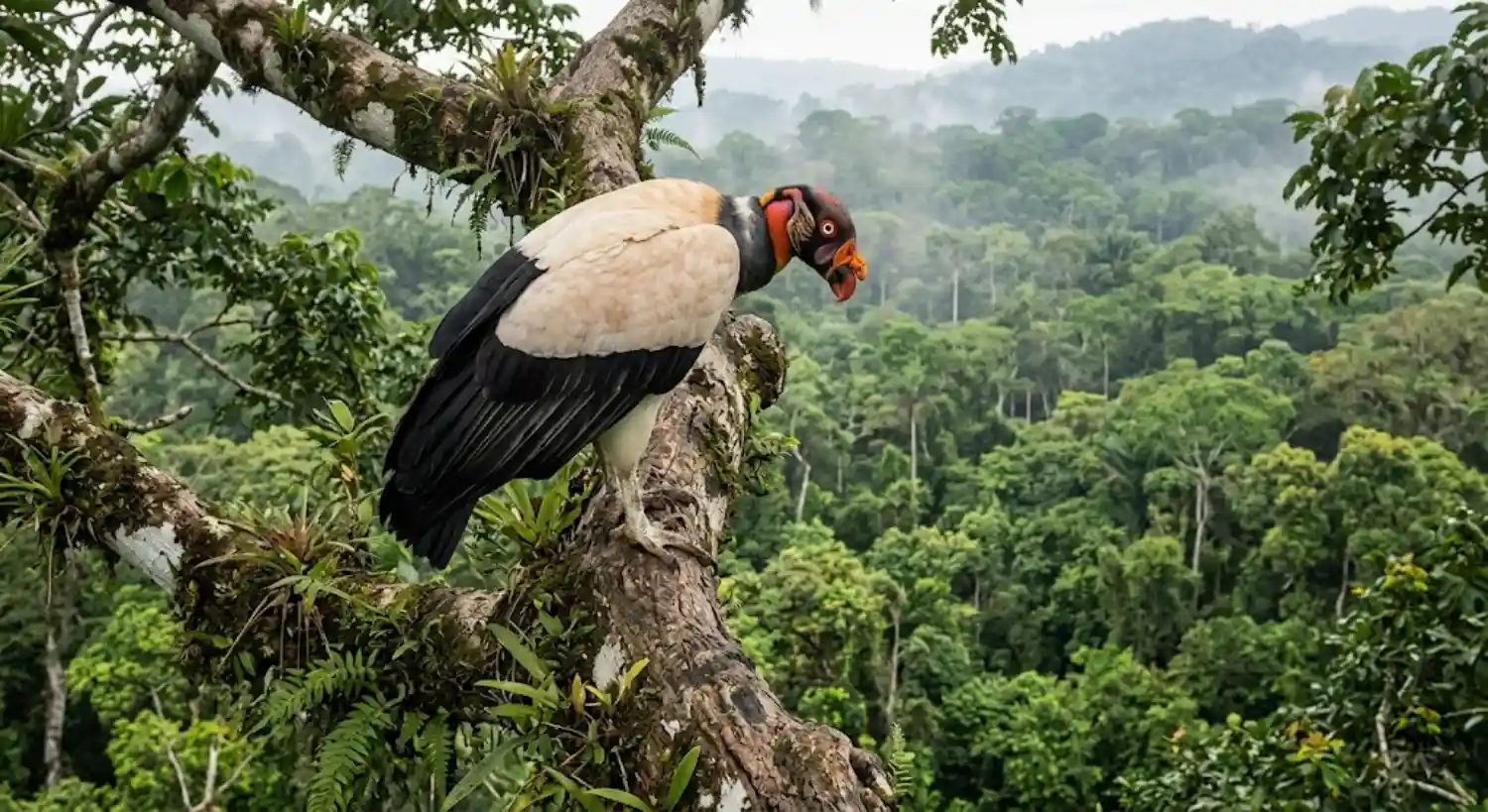
Across the immense Amazon rainforest, where life pulses with extraordinary intensity, death also performs an essential task. Among the species that turn dead matter back into nutrients, the king vulture holds a unique place, ruling both the skies and the forest floor.
With a wingspan that can exceed 6.6 feet (2 meters), the bird has an imposing appearance marked by a bald head in vivid shades of red, orange and purple. The Sarcoramphus papa is more than a striking presence in the landscape: it carries a biological tool that is essential to the ecosystem’s operation.
While other scavenging birds circle and wait, the king vulture can begin breaking down the carcasses of large animals. That ability establishes a natural hierarchy and helps ensure that organic matter is removed efficiently throughout the forest.
The bill that opens the way
The king vulture’s priority does not come from unusual aggression. It comes from a remarkable evolutionary adaptation, its bill. Compared with the bills of other vultures and scavengers in the region, it is extremely sturdy, hooked and powerful.
This specialized anatomy allows the bird to tear through the thick, resistant hide of large animals, such as tapirs or capybaras that have died in the forest. Smaller scavengers may find these bodies, but they cannot always reach the food while the hide remains intact.
Without the king vulture’s first intervention, many carcasses would remain closed for much longer. That would slow the nutrient cycle and could create potential centers for the spread of disease, affecting other animal species and even human communities along the rivers.
In this sense, the king vulture is a path opener. Its first cuts begin a process that returns the nutrients and energy held in an animal’s body to the surrounding environment.
A coordinated network of scavenging birds
The king vulture’s importance goes far beyond the strength of its bill. It operates at the top of a complex decomposition system in which several species participate at different stages of carcass removal.
Birds that may follow its high flight include the black-headed vulture, Coragyps atratus, and the turkey vulture, Cathartes aura. These smaller birds have a highly developed sense of smell, especially the turkey vulture, and they are often the first to locate a carcass beneath the dense forest vegetation.
When the animal is large and its skin is tough, however, finding the carcass does not mean they can immediately feed. This is when the king vulture becomes crucial. When the smaller species see the larger bird descending, they move away and wait.
The king vulture lands and uses precise, powerful blows of its bill to tear open the hide. Only after this opening has been made can the other scavenging birds, with their less powerful bills, reach the carcass and continue feeding.
The behavior creates an efficient and orderly feeding hierarchy. Each species plays a role in removing decomposing organic matter quickly, and this implicit cooperation greatly reduces the time a carcass remains in the environment.
Between legend and scientific evidence
The king vulture’s colorful head, set against the predominantly white plumage of adults, has long inspired fascination and fear. In the oral traditions of several Amazonian ethnic groups, the bird is viewed as a being with special powers, sometimes associated with guardian spirits or chiefs of the winged world.
Some legends describe it as the king who commands all other vultures. That mythological interpretation reflects, with surprising accuracy, a biological observation: the bird’s dominance around carcasses. The common name king vulture comes directly from this perception of natural authority.
Modern science provides a more precise explanation. According to ornithological studies, the bird is not literally a king issuing orders. Its dominance is established by its size and by the unique tool it possesses, its specialized bill.
Those studies also indicate that the king vulture prefers dense, undisturbed tropical forest. Its presence can therefore serve as an indicator of ecosystem health, signaling a complex food chain and the availability of large mammals whose carcasses form the foundation of its diet.
A species tied to preserved forest
The king vulture’s geographic range extends from Mexico to northern Argentina. It lives mainly in lowland tropical forests and prefers well-preserved areas, while avoiding places that have become heavily urbanized.
The combination of a bald, vividly colored head and a light-colored body makes the species relatively easy to identify. In adults, the plumage can be described as white and black, along with the bare head in bright colors. The wingspan can reach 7.2 feet (2.2 meters), and the bird can weigh up to 9.9 pounds (4.5 kilograms), making it one of the largest birds of prey in the Americas.
The species has a close relationship with primary forest. Conserving the king vulture requires protecting large expanses of woodland, as well as the large mammals that provide the carcasses needed to sustain its ecological role.
Threats and the species’ future
Despite its importance, the king vulture faces growing threats. The main one is habitat loss and fragmentation. Deforestation in the Amazon reduces the dense forest areas required for survival and nesting, while also affecting populations of large mammals that provide its food.
The species is not currently considered globally threatened with extinction, but local populations in areas of intense human activity have experienced worrying declines. The hunting of large mammals also affects the bird indirectly by reducing the availability of carcasses.
Another significant challenge is contamination. As a bird that feeds at the top of the scavenging food chain, the king vulture is vulnerable to the accumulation of toxins in the environment and in the tissues of the animals it consumes.
The use of pesticides in agricultural areas next to the forest, along with heavy-metal contamination resulting from illegal mining, poses serious and still poorly understood long-term risks to the health of these birds.
Protecting the king vulture therefore requires integrated conservation strategies. Those strategies must address habitat preservation, enforcement against illegal activities and the promotion of sustainable farming practices around the forest.
Watching a king vulture glide high on warm air currents above the forest canopy is like witnessing a living lesson in ecology. By turning death into life and nutrients quickly and efficiently, the bird shows that every organism, however unusual it may seem, has an irreplaceable role in the intricate web of biodiversity.
Understanding the king vulture’s unique role invites a broader reflection on the complexity and fragility of tropical ecosystems. Conserving the Amazon is not only about protecting trees or charismatic species. It also means preserving every link that maintains the natural balance.
Protecting the king vulture and its habitat helps ensure that the rainforest’s vital cycle continues to turn. In that cycle, the bird’s sovereign flight is not a symbol of command, but of the interdependence that keeps the Amazon alive and healthy for present and future generations.
Reporting: Anne Silva / Amazonia Mag

Editor, English Edition — Amazonia Mag
Anne Silva is the editor of Amazonia Mag, the English-language edition of Revista Amazônia. She curates, translates and adapts the outlet's science and environment coverage for an international audience, reporting on Amazon wildlife, flora, rivers, climate and research. Every story she edits is grounded in peer-reviewed studies, official data and on-the-ground reporting from the Revista Amazônia newsroom in Belém, Pará, Brazil. More by Anne Silva →