
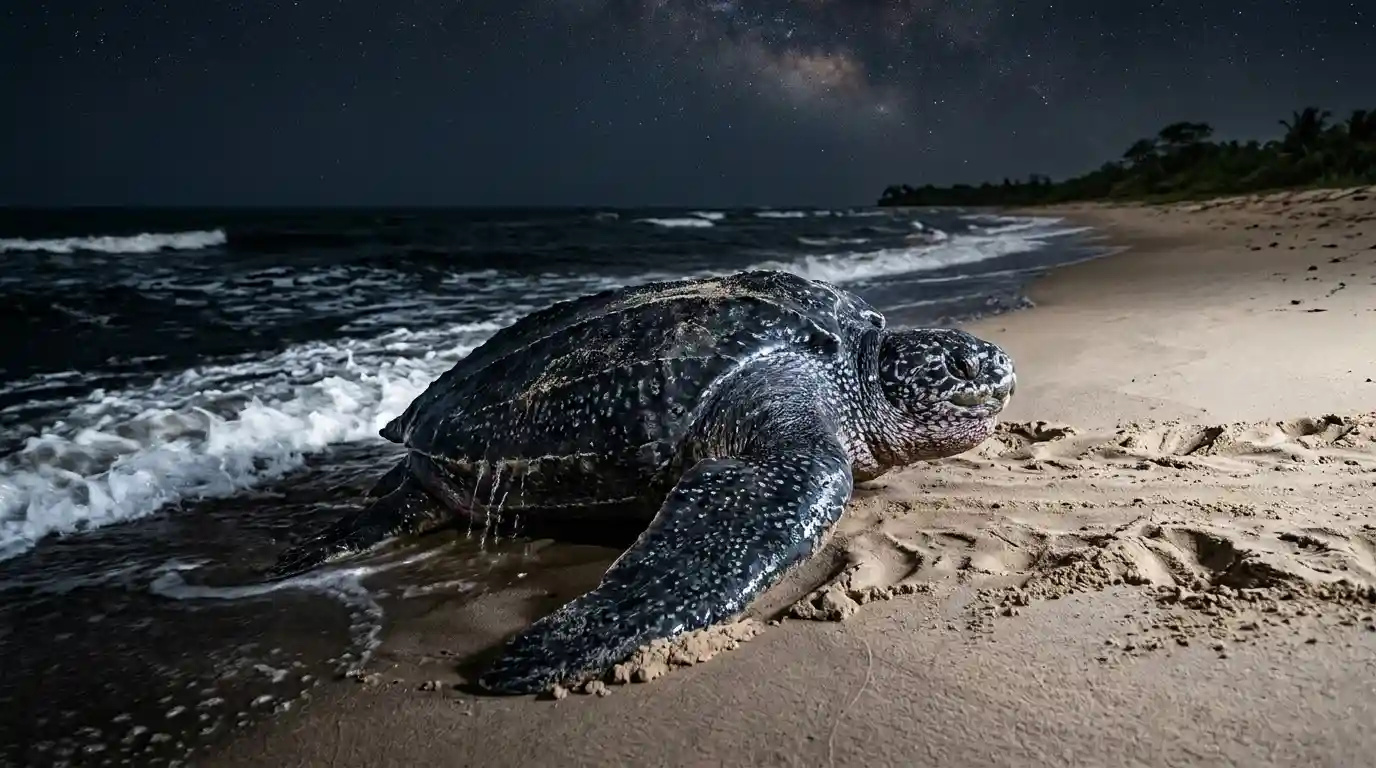
A formidable creature that can exceed 6.5 feet (2 meters) in length and reach a staggering 1,980 pounds (900 kilograms) is rewriting the story of marine conservation in Brazil’s far north. The latest environmental monitoring data show that the number of leatherback turtle (Dermochelys coriacea) nests on the beaches of Amapá jumped exponentially last breeding season, one of the highest figures documented in the region in decades.
This colossal animal, which has swum the planet’s oceans since the age of the dinosaurs, has chosen the rich, isolated sands of the Amazon coast to carry on its lineage. It is proof that the biome still holds wildlife sanctuaries whose scale modern science is only beginning to grasp.
The massive presence of the leatherback works as a high-precision thermometer for the health of the entire ocean and coastal ecosystem. Unlike other marine turtle species, which have a hard, bony shell, this marvel of evolution developed a covering of extremely tough, flexible connective tissue that resembles a thick layer of leather.
That anatomical adaptation lets it withstand crushing pressures and dive to depths beyond 3,280 feet (1,000 meters) in search of food, a feat out of reach for the vast majority of marine vertebrates. The return of these giants in such striking numbers signals that the waters at the mouth of the Amazon River still offer a nourishing, welcoming environment.
The Perfect Refuge in the Far North
To understand this triumphant comeback, you have to look at the local geography. The Amapá coastline is shaped by the monumental meeting of the muddy fresh water of the Amazon River and the salt currents of the Atlantic Ocean. That dynamic creates a zone of extremely high biological productivity.
The Amazon beaches offer conditions that are rare in the modern world: very low human population density and an almost total absence of light pollution. The absolute darkness of the beaches at night is a critical, non-negotiable factor for nesting success. Females rely on the natural contrast between the dark sea and the star-lit sand to orient themselves, and hatchlings use that same natural glow to find their safe path to the waves right after the eggs hatch.
The geographic isolation of beaches such as those in the Bailique archipelago and Cabo Orange National Park acts as a natural shield against urban threats, real estate speculation and predatory tourism that have scarred much of the world’s coastline. Researchers from federal universities and research institutes map every mile of this coast, camping under extreme conditions to record, measure and protect each female that emerges from the water. The fieldwork involves fitting microchips and collecting genetic samples, all done in total darkness and silence so as not to stress the animals during the most vulnerable moment of their lives.
Technology in the Service of Conservation
Advances in satellite telemetry have transformed how biologists understand this enigmatic species. In the past, what became of the turtles once they left Amapá’s beaches was a complete mystery. Today, small transmitters carefully attached to their shells send daily signals to orbiting satellites, tracing remarkably detailed maps of their migratory routes.
The data reveal epic journeys of thousands of miles across the Atlantic. Some individuals cross the ocean toward the coast of Africa, while others travel to the cold waters of the North Atlantic in search of dense concentrations of jellyfish, the sole staple of their diet.
The most fascinating part is the precision of the return. After years swimming through international waters, pregnant females come back with mathematical accuracy to the same region, and often to the very stretch of Amapá sand where they hatched decades earlier. That magnetic sense of direction is one of the great miracles of animal navigation. Protecting the beaches of Brazil’s far north therefore means safeguarding entire populations that spread across half the globe, connecting the Amazon to marine ecosystems on other continents through an invisible web of biological dependence.
Local Guardians and the New Bioeconomy
None of these encouraging results would be possible without the profound transformation that took place in the state’s coastal communities. For a long time, the collection of turtle eggs and incidental capture in fishing nets posed severe threats to the species. An intense effort of environmental education and community engagement radically changed that picture.
Nongovernmental organizations and environmental agencies brought local residents into the protection programs, valuing the priceless firsthand knowledge of traditional fishers. Those who once saw the nests as an immediate food source were trained and hired as environmental monitors, becoming the wildlife’s fiercest defenders.
It is a classic example of successful bioeconomy: a model in which conservation generates jobs, income and pride for traditional populations. Payment for environmental services allows the beach guardians to support their families while they patrol miles of sand before dawn, identify tracks, move nests threatened by the tides into safe incubation enclosures and keep natural and domestic predators at bay.
Climate, Science and the COP30 Window
Despite the formidable success in Amapá, the future of the leatherback demands constant vigilance in the face of global challenges. Global warming is an invisible but powerful threat. In sea turtles, the sex of the hatchlings is not set by chromosomes at fertilization but by the temperature of the sand during the weeks of incubation. Warmer temperatures produce females while cooler ones produce males, so a steady rise in global temperature could drive an extreme feminization of the populations and undermine reproduction over the long term.
On top of that, coastal erosion accelerated by rising sea levels threatens to swallow the sandy strips ideal for nesting. It is in this critical context that hosting COP30 in the Brazilian Amazon takes on historic significance. The event places the world’s spotlight on the region and creates a unique chance to draw international climate finance, vital for expanding research bases, developing artificial shading technologies for the nests and ensuring that payments to community monitors continue for decades.
Brazil and Ecological Leadership
The recovery of the leatherback in Brazil is proof that the country has the technical expertise, natural wealth and social engagement needed to lead the global biodiversity conservation agenda. What is happening on Amapá’s beaches debunks the idea that environmental preservation is an obstacle to development. On the contrary, it is the foundation of a more resilient and innovative society.
The Brazilian scientists leading these efforts are producing cutting-edge knowledge that helps other countries refine their own coastal management strategies. The rescue protocols, incubation techniques for dynamic beaches and community integration models developed in Brazil’s far north already serve as a reference for similar initiatives in the Caribbean and Africa.
The sight of a giant turtle rising silently from the waves in the dead of night, digging its nest in the damp sand and depositing the hope of a new generation, is a spectacle of pure biological force. The ecological success of Amapá teaches that the time to act has not run out, and that the recovery of great ecosystems is not a utopian dream but a tangible reality built with science, respect and political will.
Reporting: Anne Silva / Amazonia Mag
This article is the English edition of reporting originally published by Revista Amazônia. Images: Revista Amazônia archive.

Editor · Amazonia Mag
Anne Silva is the editor of Amazonia Mag, the English-language edition of Revista Amazônia. She curates, translates and adapts the outlet's science and environment coverage for an international audience, reporting on Amazon wildlife, flora, rivers, climate and research. Every story she edits is grounded in peer-reviewed studies, official data and on-the-ground reporting from the Revista Amazônia newsroom in Belém, Pará, Brazil. More by Anne Silva →