
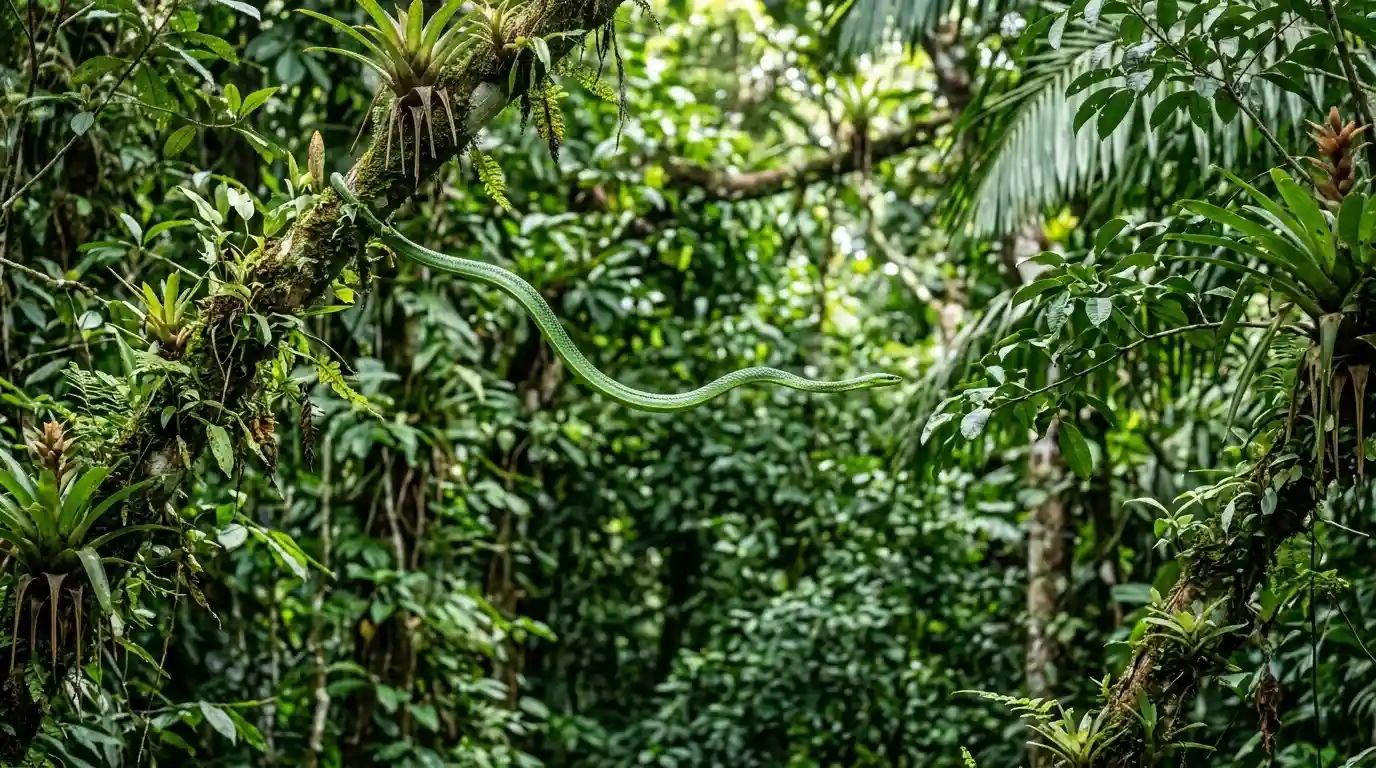
A snake can generate aerodynamic lift in the air more efficiently than many modern drone designs. Although common sense links flight only to birds and insects, the Amazon rainforest is home to reptiles that turn their own bodies into living wings, crossing considerable distances between treetops. The phenomenon is not a simple gravity-driven leap: it is a sophisticated control of pressure and motion that has left aerospace engineers and biologists fascinated by the energy efficiency of these animals in an extraordinarily dense ecosystem.
The engineering of an aerodynamic shape
Unlike what its popular name suggests, the Amazon flying snake has no wings or membranes like flying squirrels do. The secret lies in a drastic change to its anatomy the moment it launches into the void. As it jumps, the snake pushes its ribs forward and upward, flattening its body from a cylindrical shape into a concave one, similar to a parachute or the airfoil of an aircraft.
That morphological shift lets the air beneath the animal exert a pressure force that slows the fall and allows precise steering of its path. What would otherwise be a free fall becomes a controlled glide.
A physical dance in mid-air
Recent biomechanics studies reveal that the lateral undulation snakes use to crawl across the ground is the same motion that keeps them stable during flight. While airborne, the snake performs a continuous ‘S’ movement. That aerial sway is not random: it prevents the body from spinning on itself or losing balance against wind currents.
It is a nearly perfect physical choreography that lets the animal change direction midway to dodge obstacles or reach a specific branch. Scientists found that, contrary to earlier belief, these reptiles do not ‘fall with style’: they swim through the air, using the density of the tropical atmosphere to their advantage.
How evolution shaped canopy life
Survival in the jungle demands extreme adaptations. For a snake living in the canopy, climbing down to the ground to switch trees means exposure to ground predators and a costly waste of energy on the way back up. Evolution selected gliding as a brilliant logistical solution.
This remarkable Amazonian wildlife developed a technique in which the tail acts as a rudder, while the front of the body sets the angle of attack against the wind. Every time a snake crosses the open air, it executes a maneuver that human engineering is only beginning to understand.
Lessons for technology and robotics
The discovery offers valuable lessons for contemporary science. Biomimicry researchers are using data on these snakes’ flight to develop new kinds of rescue robots. The idea is to build devices that can flatten and undulate to navigate rubble or dense forest, combining the agility of a ground reptile with the ability to clear obstacles through the air, without large motors or noisy propellers. Such technology will be essential for monitoring hard-to-reach areas, especially in environmental enforcement missions.
Beyond robotics, analyzing the airflow around the snake’s body is helping engineers rethink the design of wind turbine blades. The way the snake manages the turbulent wake behind it is far more efficient than the smooth surfaces humans create. By mimicking the small ridges of the scales and the body’s floating motion, it is possible to reduce drag and boost clean energy output. It is biodiversity serving as the foundation for the energy grid of the future.
Conservation and COP30 in Belem
Preserving these species is essential to understanding the complexity of canopy life, an environment that still holds many mysteries for modern biology. Every time a stretch of forest is conserved, these natural laboratories are guaranteed to keep running in silence. Understanding these snakes goes far beyond the instinctive fear they provoke in part of the population: it means recognizing that nature has already solved complex engineering problems that humans are only starting to grasp.
With COP30 approaching in Belem, international attention is turning to how nature-based solutions can mitigate climate change. Gliding snakes are a living example of resilience and adaptation. Protecting the corridor of trees that makes their flight possible means protecting the integrity of an entire system of seed dispersal and pest control that unfolds high above the ground. Destroying the treetops breaks evolutionary bridges that took millennia to build.
Citizen science and the future of research
Today, citizen science projects are helping researchers map where these snakes occur through photographic records from local guides and tourists. That engagement is vital, because direct observation in the treetops is one of the greatest logistical challenges in field biology. By turning the gaze of the riverside dweller and the forest resident into a scientific one, protection efforts expand.
Science is at the forefront of this study, using high-speed drones to film the glide in 4K and to build mathematical models that explain how a limbless animal manages to overcome gravity so naturally. The existence of such abilities in animals so often underestimated reinforces the importance of biodiversity as an asset for technological innovation. Looking to animal behavior is finding shortcuts to a more efficient, lower-impact future: the Amazon is not only the lungs of the world, but also its greatest research center for solutions that evolution took millions of years to perfect.
Reporting: Anne Silva / Amazonia Mag
This article is the English edition of reporting originally published by Revista Amazônia. Images: Revista Amazônia archive.

Editor · Amazonia Mag
Anne Silva is the editor of Amazonia Mag, the English-language edition of Revista Amazônia. She curates, translates and adapts the outlet's science and environment coverage for an international audience, reporting on Amazon wildlife, flora, rivers, climate and research. Every story she edits is grounded in peer-reviewed studies, official data and on-the-ground reporting from the Revista Amazônia newsroom in Belém, Pará, Brazil. More by Anne Silva →