
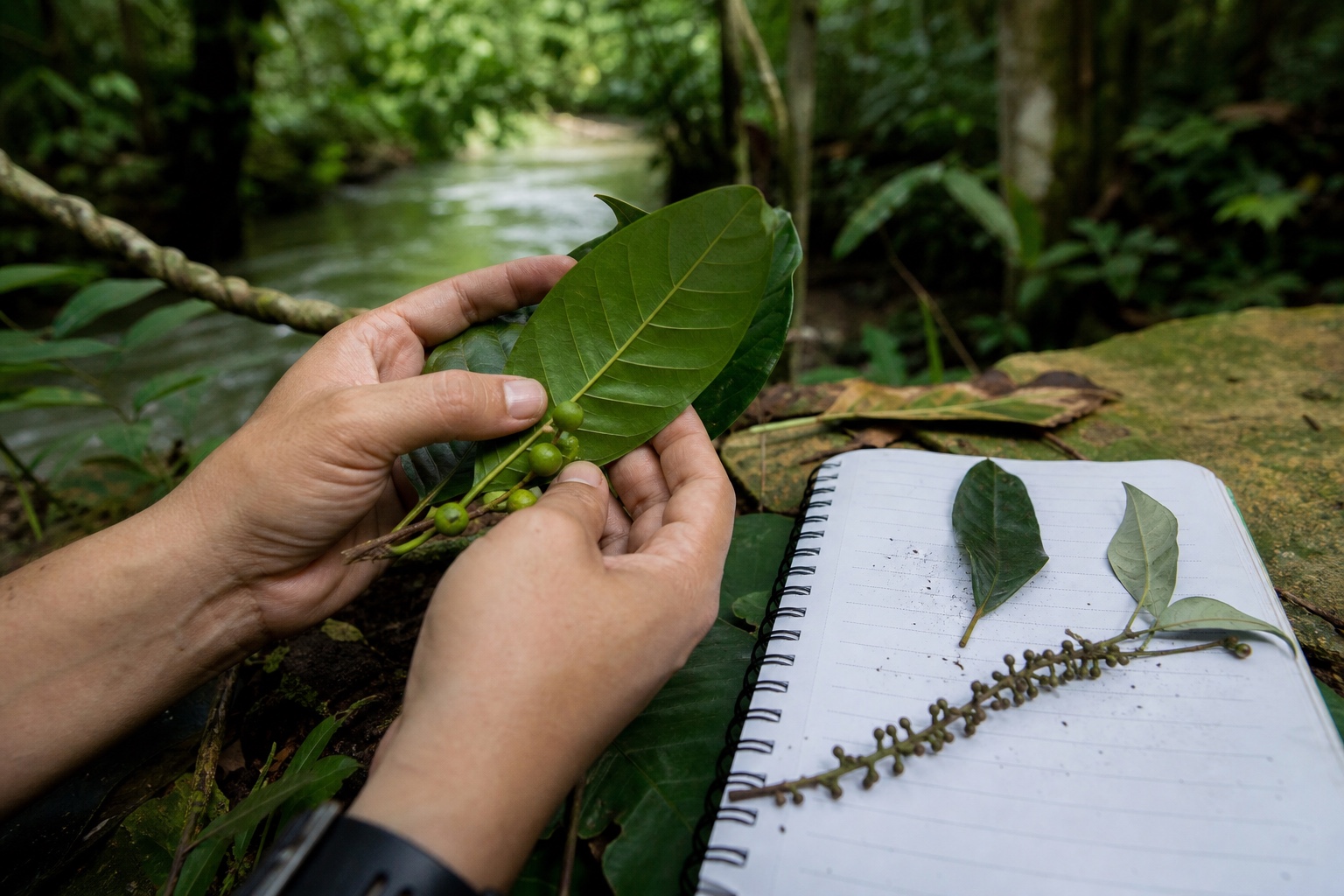
For a long time the assumption seemed reasonable enough: learn the name of a plant and you know the plant. In Amazonian territory that certainty does not survive contact with practice. Recognising a species by its common name, or even by its scientific name, is only the starting point of a far broader body of knowledge. Knowing a plant means knowing the season in which it appears, the place where it grows, the part that is used, how it is prepared, how much can be gathered without causing harm, and how it relates to the other species growing around it.
Research on Amazonian agrobiodiversity points in the same direction. A plant is not a name, and it is not an isolated property either. The knowledge built around it covers the variety, the environment, the timing of the harvest, the purpose of the use, and the way all of that is passed from one generation to the next. It is a body of knowledge that links biodiversity to collective decision making, and that sustains both food and landscapes. None of it fits into a generic list of remedies, and reducing Indigenous practices to that format is, before anything else, a description that is simply wrong.
The name is only the first layer
A plant can be recognised by its appearance, its smell, the season when it shows up and the place where it is found. But the knowledge attached to it includes something no label records: what must not be gathered, the appropriate quantity, the part that is used and the correct way to prepare it. Pulling off a leaf without understanding those relationships can damage the plant and can also harm the person who uses it. Botanical identification describes an individual specimen. Traditional knowledge describes a relationship.
That distinction changes how the forest looks. Someone working only with names sees an inventory, a list of entries that can be counted and sorted. Someone working with the full body of knowledge sees a system of decisions: when to go in, how much to take, what to leave standing, who needs to be told. The gap between those two ways of seeing is not a matter of how much information each one holds. It is a matter of kind. One accumulates data about objects, the other organises responsibilities towards living beings that people live alongside over time.
Knowledge that is not a list of recipes
Traditional knowledge does not work like a recipe book of isolated uses. It connects environment, food, health, work, language and responsibility, and those threads cannot be pulled apart without unravelling the whole weave. That is why the same plant may have different uses depending on the people, the territory and the specific situation in which it is used. What is prepared one way in one place may be prepared another way somewhere else, and both versions are equally precise inside their own context.
This detail has practical consequences for anyone writing about the subject. Presenting the knowledge of one people as though it stood for all Indigenous peoples is a serious inaccuracy. So is suggesting that a plant delivers a guaranteed effect when there is no clinical evidence to support the claim. A careful text shows specificity, shows limits and shows context. Handled that way, the plant appears as part of a living relationship rather than as a loose ingredient ready to be lifted out of the place where it makes sense.
Cultivated diversity as a form of memory
Studies of farming systems and managed plants show that cultivated diversity also works as memory. Keeping varieties means keeping possibilities open for the future, and that is not a comforting metaphor: it describes a concrete subsistence strategy. One seed may hold up better in a particular soil, another may carry a household through an irregular season. Maintaining many varieties means maintaining alternatives for conditions that have not arrived yet.
Every variety that is kept also carries a history of choices and experiences. Someone decided to save it, someone planted it again, someone compared it with another and preferred this one. Agricultural diversity links food and memory because each seed is also the record of a decision taken in the past and sustained across generations. Losing a variety does not only mean losing a crop. It means losing the accumulated information that the crop stood for.
Knowledge that is transmitted and that changes
Knowledge about plants circulates through stories, through shared work, through observation and through repeated practice. It is not stored in a fixed archive. It can shift when the territory shifts, when a species becomes scarce, or when a community decides to protect a particular piece of information and stop sharing it. That movement does not weaken the knowledge or make it less reliable. On the contrary, it shows that the knowledge is still alive and still responding to the real conditions of the place where it is practised.
It also explains why a single snapshot is a poor way to record it. A description written down at one moment captures a state, not a system. The people who hold the knowledge are the ones who know which parts are stable, which parts are being adjusted and which parts are deliberately being kept out of circulation. Anyone documenting the subject from outside is working with a fragment, and saying so plainly is part of doing the work honestly.
Consent before publication
The most important lesson in all of this is an ethical one. Describing a traditional use does not authorise exploitation or harvesting without consent. Researchers need to recognise the collective authorship of the knowledge, protect sensitive information and return their results to the people who shared it. Collective knowledge must not become the property of whoever recorded it first, and that principle applies to journalism just as much as to academic work.
In practice that means explaining the purpose of the research, asking permission before publishing, safeguarding whatever was shared in confidence, and coming back with the findings in a form that is actually useful to the community. Knowing a territory also means knowing when not to publish. Revealing the location of rare species, for instance, can enable precisely the kind of extraction the research claimed it wanted to prevent.
The limits of what can be told
That caution protects the research itself as well. Information about a collection site, a scarce species or a specific preparation can be used far outside the context in which it was produced, and once it is published it cannot be pulled back. The value of the knowledge lies in the relationship between environment, community and practice, not in the quick promise of an immediate use. Publication therefore has to preserve the context, the authorship and the limits set by the people who shared the information.
What remains is a conclusion that applies to researchers, journalists and readers alike. Knowing an Amazonian plant is not a matter of arriving at a name. It is a matter of entering a network of relationships that includes people, territory, time and responsibility. The scientific name is useful and necessary, but it is only the door. What lies on the other side does not fit on an index card, and treating it accurately is itself a form of respect.
Reporting: Anne Silva / Amazonia Mag. Source: Revista Amazônia; IRD, Agrobiodiversity and traditional knowledge in the Brazilian Amazon; IPHAN, cultural heritage and traditional knowledge.

Editor, English Edition — Amazonia Mag
Anne Silva is the editor of Amazonia Mag, the English-language edition of Revista Amazônia. She curates, translates and adapts the outlet's science and environment coverage for an international audience, reporting on Amazon wildlife, flora, rivers, climate and research. Every story she edits is grounded in peer-reviewed studies, official data and on-the-ground reporting from the Revista Amazônia newsroom in Belém, Pará, Brazil. More by Anne Silva →