
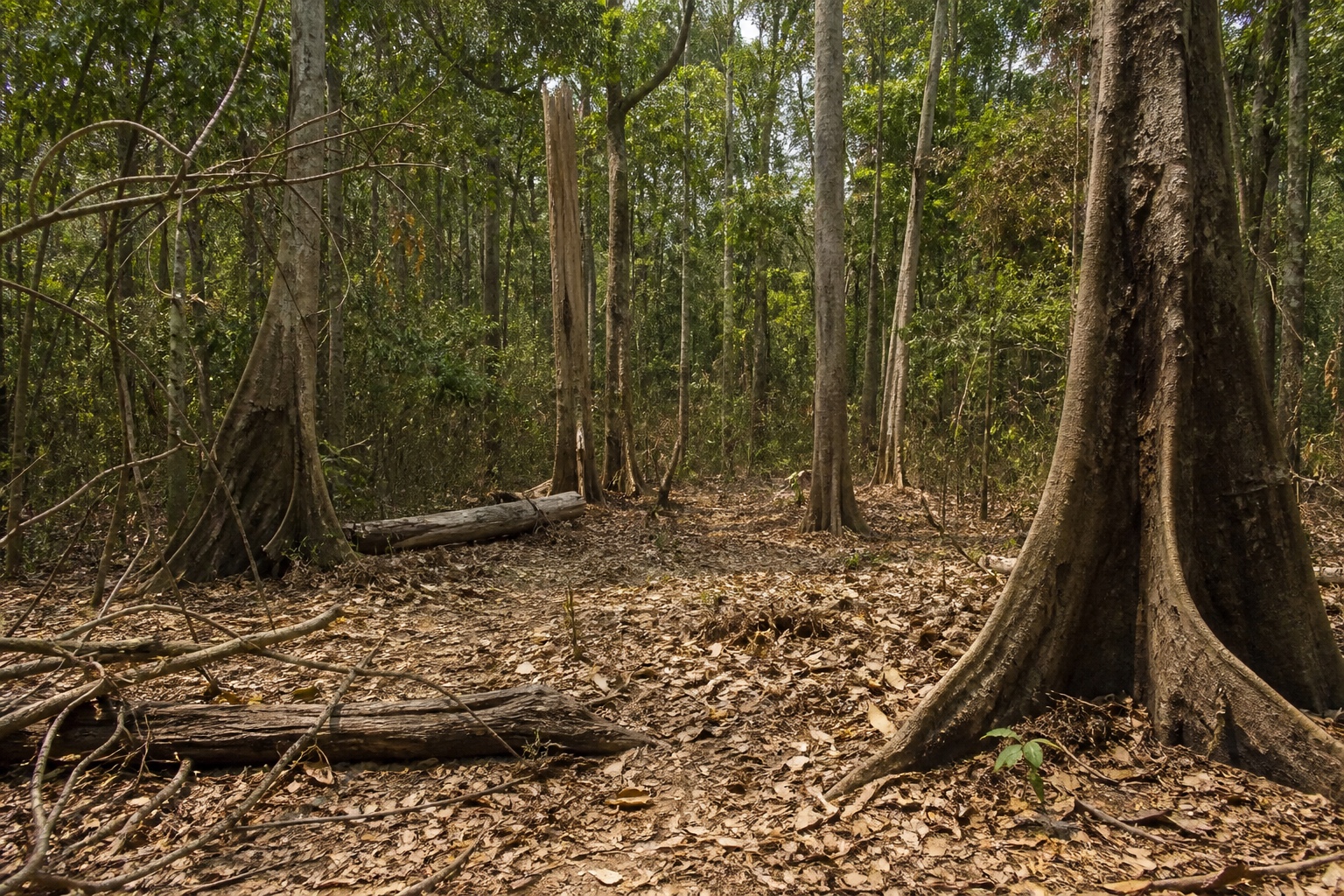
An Amazon forest plot kept under an artificially induced drought for more than twenty years did not collapse the way many people expected it to. It also did not walk away unharmed. The researchers who followed the experiment ended up with a result that is hard to compress into a headline: the ecosystem reached hydrological stability, meaning it stopped showing acute signs of water stress, but only after passing through deep changes in its own structure. The trees left standing competed less for soil water. The forest, meanwhile, lost biomass and lost part of its ability to accumulate carbon in wood.
The work followed a large scale field experiment and was published in the journal Nature Ecology & Evolution. The contradiction it exposes sits at the heart of the finding: surviving did not mean staying the same.
The forest adjusted by getting smaller
In the first years of the treatment, the intensified drought raised tree mortality, above all among the largest individuals. That was the opening blow and the most visible one. But the loss opened an unexpected route: with fewer trees drawing water, the survivors gained access to a larger share of the moisture still held in the soil.
That mechanism lowered the physiological signals of stress. The variables ecologists use as a tree’s internal thermometer, leaf water potential, sap flow and the water content of tissues, converged toward the values measured in a control forest, a neighbouring plot that never received the drought treatment.
At first glance the convergence could be read as a full recovery. The numbers match, so the problem must be over. The catch is that the structure holding that stability up was no longer the same. There was less biomass, there were fewer large trees and there was less carbon accumulating in wood. The forest held on because it changed size and composition, not because it went back to what it had been.
Resistance is not the absence of damage
In ecology, resilience can mean simply that a system keeps its functions after a disturbance. It does not promise that every original element is still there. A landscape can remain covered in trees and, at the same time, have lost precisely the individuals that stored the most carbon or offered the cavities that many animals depend on.
The result matters because climate models tend to frame the question in binary terms: will the forest die, or will it survive? The experiment shows a third possibility, less cinematic and considerably more unsettling. A forest can reorganise itself, remain partly functional and still deliver fewer ecological services than before.
That difference also changes how satellite imagery should be read. A green canopy on its own says nothing about how many trees died, how big the remaining ones are, or how the capacity to store carbon shifted. The green persists. What sits underneath the green may have been quietly hollowed out.
Why the study needed twenty years
Unlike a single observation made after a natural drought, the experiment made it possible to track the response for more than two decades. That duration is not a methodological luxury, it is the condition for seeing what needs to be seen. Trees grow slowly, and the effects of a change in the soil can surface long after the first dry season has passed.
The researchers compared the treated plots with areas that were never exposed to the same reduction in water. They measured physiological variables, vegetation structure and biomass, guided by one underlying question: was the forest simply suffering, or had it found a new condition of balance?
Research of this kind is hard to sustain, and it does not stand in for every Amazon forest. Soils vary, species vary, rainfall varies, and so do the histories of past disturbance. The value of the experiment lies in revealing a possible mechanism, not in offering a single forecast for the whole basin.
The greater risk lies in repetition
An isolated drought can cause mortality and then be followed by partial recovery. Repeated droughts, combined with fire and fragmentation, shrink the margin for adaptation. Every large tree that falls alters shade, humidity, competition and seed availability in the space around it.
This is where the hidden cost of the finding appears. If the system has to lose biomass in order to reach stability, then the response carries a price that grows with the frequency of droughts. The forest can stay standing and, at the same time, arrive at the next disturbance with thinner reserves.
Two simple stories worth dropping
The research helps retire two equally comfortable narratives. The first is an Amazon incapable of withstanding any drought at all, permanently on the edge of immediate collapse. The second is a forest that survives without consequences, endowed with an unlimited capacity to adapt. The reality described by the experiment is more uncomfortable than either of them: the forest can stay green while its structure changes in silence.
For anyone who follows the forest through images, that distinction is decisive. The green can hold while the number of large trees falls, the shade opens up and the amount of accumulated carbon declines. The resistance observed in the experiment is real and deserves to be acknowledged, but it should not be mistaken for a recovery without losses.
What only long records can show
The experiment also shows why long time series are indispensable. A plot can look stable for a handful of years and reveal accumulated losses only once the measurements stretch across decades. Drought does not act in a single moment. It gradually reorganises the competition for water, for light and for space, and the outcome becomes legible only when someone has been watching the whole time.
Read that way, what the experiment recorded was neither a death nor a recovery. It was a change of state. The distinction may sound academic, yet it decides how the risk facing the largest tropical forest on the planet gets measured. A forest that survives by shrinking is still a forest, but it is a forest carrying less carbon, holding fewer giants, and starting each new dry season from a lower point than the one before it.
Reporting: Anne Silva / Amazonia Mag. Source: Nature Ecology & Evolution / Revista Amazônia.

Editor, English Edition — Amazonia Mag
Anne Silva is the editor of Amazonia Mag, the English-language edition of Revista Amazônia. She curates, translates and adapts the outlet's science and environment coverage for an international audience, reporting on Amazon wildlife, flora, rivers, climate and research. Every story she edits is grounded in peer-reviewed studies, official data and on-the-ground reporting from the Revista Amazônia newsroom in Belém, Pará, Brazil. More by Anne Silva →