
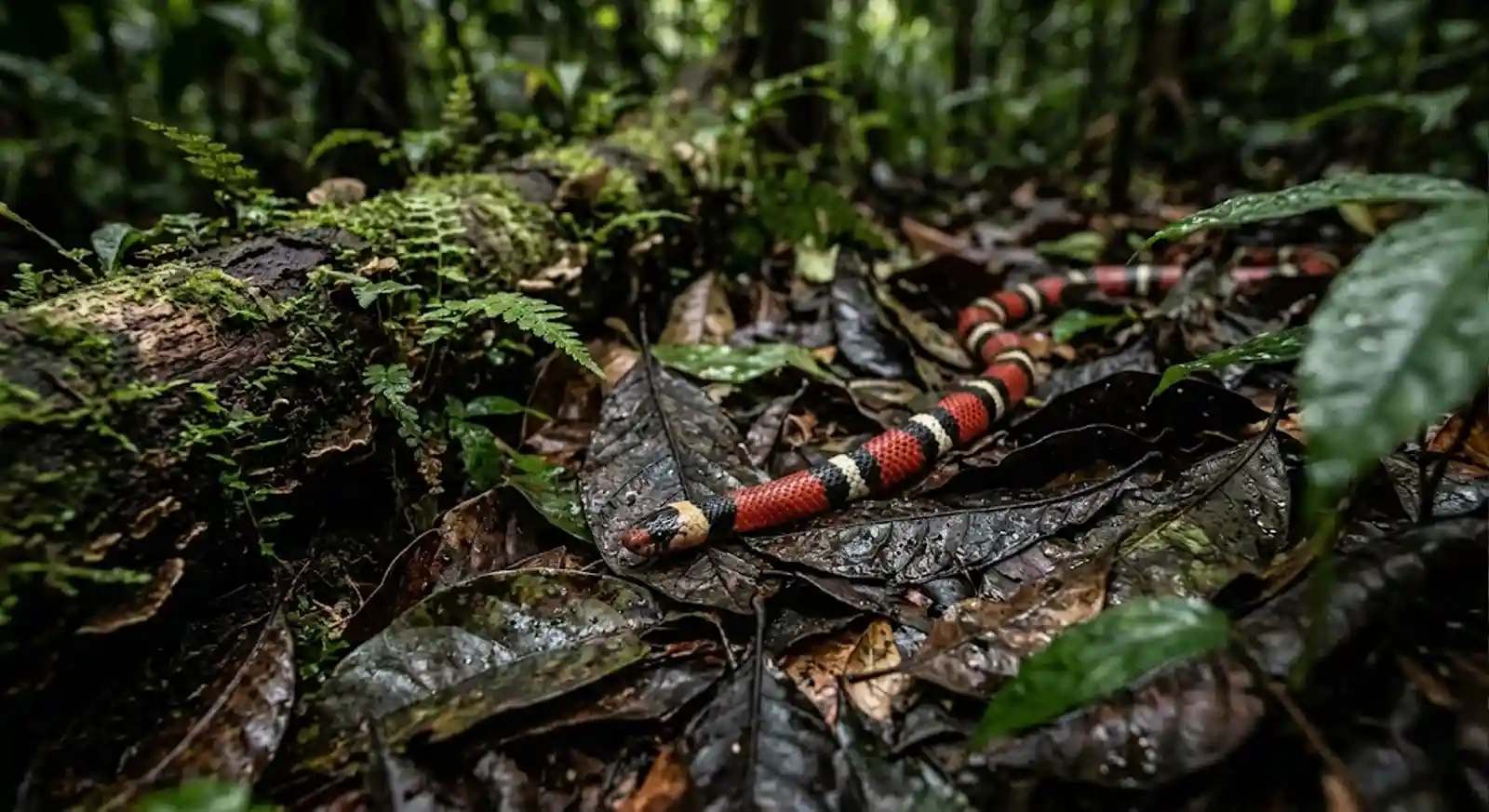
Finding an intensely colored snake moving across a home yard, a family farm or a weekend trail is enough to cause a serious fright. Yet one detail is known by very few people: the famous foreign rhyme about the order of red and yellow colors simply does not work for identifying every species found in Brazil’s northern region.
The coral snake carries one of the most powerful neurotoxic venoms in the country. In terms of toxicity, it even surpasses the feared jararaca. Despite that dangerous reputation, it is an extremely shy animal that usually prefers to flee into the vegetation rather than confront people.
Understanding the visible signs of this fascinating reptile can save a life, prevent serious accidents and protect local wildlife from unnecessary deaths. The safest response is not to test a rule from memory, but to keep away from any brightly banded snake.
A silent danger beneath the leaves
When people talk about the extraordinary biodiversity of northern Brazil, the snake group in the genus Micrurus deserves special attention. These are the true and lethal coral snakes of the Amazon region, and they favor damp environments where they can remain hidden beneath thick layers of dry leaves on the dark forest floor.
They are also found close to the banks of igarapés, the waterways that cross the region. The constant humidity of the equatorial climate creates ideal conditions for their reproduction, so an encounter may occur while someone is clearing land, tending crops or walking through wooded areas.
Unlike other well-known venomous snakes, coral snakes have fixed, very short fangs. Because of this mouth structure, they need to bite and hold on for several seconds in order to inject their venom.
That small mouth structure is one reason serious accidents are quite rare in the statistics of Brazil’s Ministry of Health. According to the information cited here, such incidents happen almost always when someone tries to pick up the wild animal with unprotected hands.
Why the colors can be misleading
For residents of Pará and Amazonas, the major challenge is telling a false coral snake from a true one in the wild. Several harmless snakes have copied the pattern of red, black, white and yellow rings with remarkable precision over thousands of years, helping them deceive natural predators.
That is why relying only on the order of the colored rings is not a safe strategy in the forest. Anyone wondering how to identify a venomous coral snake without being a specialist should begin with the most cautious answer: treat every brightly colored, banded snake as a true coral.
Do not move closer to confirm the species. Do not handle the snake, and do not try to capture it for a photograph, even if it appears small, slow or harmless.
Specialists nevertheless point to some notable physical features. True coral snakes generally have very small eyes, and their heads do not have the triangular shape associated with other snakes.
Another vital detail is that the bands on a true coral snake continue all the way around the body and reach the underside, resembling perfect rings. By contrast, the large majority of false coral snakes have an underside that is entirely white or mottled, breaking the banded pattern.
These characteristics can be useful for understanding the difference, but they are not an invitation to approach an animal in the field. Distance remains the most reliable protection when a person cannot identify the snake with certainty.
Protecting the yard and the family
For people living in the more wooded areas of Belém or in the interior municipalities of Pará, contact with these animals may happen during land clearing or crop management. Leaves, building debris and damp corners can provide hiding places that are easy to overlook.
Keep the yard clean, mowed and completely free of piles of accumulated dry leaves. Avoid leaving construction scraps, old roof tiles and bricks stacked in damp corners, since these materials can create places where a snake may remain out of sight.
Always wear sturdy high-top boots and thick leather gloves when clearing dirty or overgrown land. When walking on trails through dense forest, pay attention to where you place your feet and never put bare hands into dark holes.
These actions do not remove snakes from the landscape, but they reduce the chance of direct contact. The most important rule is never to touch a colorful, banded animal with bare hands, regardless of how familiar its pattern may seem.
What to do during an encounter
If a visual encounter happens despite careful prevention, remember that panic and running are the worst responses. Do not try to hit the snake with a piece of wood, and do not attempt to capture it for a picture.
Move away very slowly. Walk backward at a controlled pace and avoid sudden movements, giving the snake space to retreat instead of trying to corner it.
Then isolate the entire area around the yard or house so that small children and pets cannot approach. If the animal is inside the home, immediately call the Pará Fire Department through the emergency number 193.
If a bite occurs, wash the site only with soap and water and seek medical care. In Pará, the Hospital Universitário João de Barros Barreto, or HUJBB, in Belém, is the reference facility for treatment with antielapidic serum.
The HUJBB is located at Rua dos Mundurucus, 4487, in the Guamá neighborhood, and provides 24-hour emergency care. This address matters to people who live in the capital or move through its wooded areas, particularly during cleaning, gardening and land-management work.
The myth of venomous leaps
Many people in local communities firmly believe that a coral snake can make a venomous leap from far away. This is a popular myth that needs to end, because it can intensify fear and encourage dangerous reactions during an encounter.
Coral snakes move slowly and do not have the physical ability to project their bodies quickly forward. Even so, they must not be touched or provoked, because they are venomous snakes and a bite can have serious consequences.
Keeping a minimum safety distance of five feet, or one and a half metres, is more than enough to leave the situation completely safe, according to the guidance presented here. The proper response is to watch from a distance, move people and pets away, and request help when necessary.
The foreign rhyme about red and yellow may sound like an easy solution, but it cannot safely identify every coral snake in Brazil’s northern region. Distance, prevention and respect for wildlife offer a much more responsible response.
Sharing this information in a family WhatsApp group can help relatives and neighbours understand what to do. It protects people while also reducing unnecessary deaths among animals that, in most encounters, would rather escape into the forest.
Reporting: Anne Silva / Amazonia Mag

Editor, English Edition — Amazonia Mag
Anne Silva is the editor of Amazonia Mag, the English-language edition of Revista Amazônia. She curates, translates and adapts the outlet's science and environment coverage for an international audience, reporting on Amazon wildlife, flora, rivers, climate and research. Every story she edits is grounded in peer-reviewed studies, official data and on-the-ground reporting from the Revista Amazônia newsroom in Belém, Pará, Brazil. More by Anne Silva →