
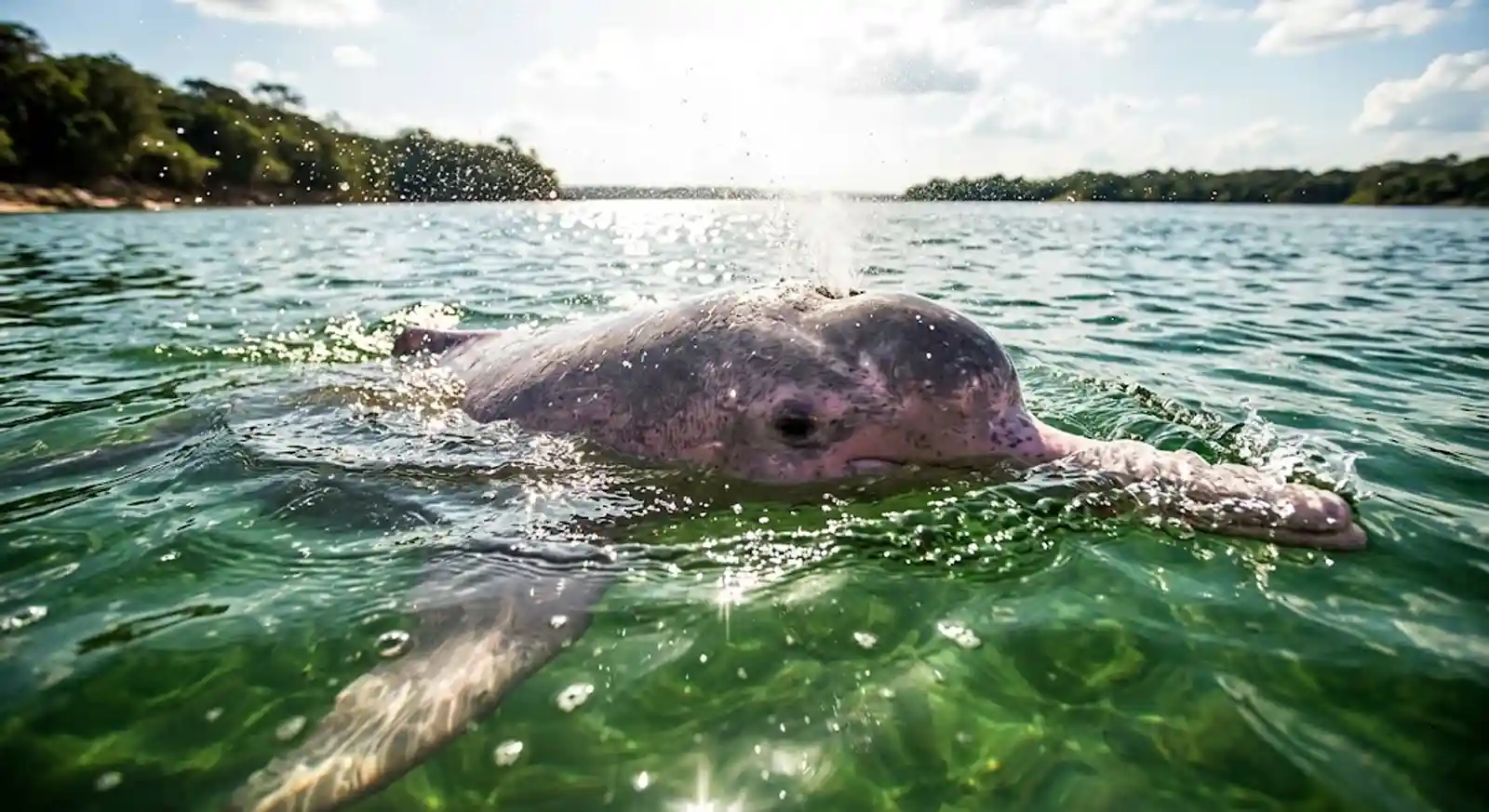
A unique genetic signature is setting the cetaceans of Brazil’s Tapajós River apart from every other record on the planet. Recent studies led by specialists linked to the National Institute of Amazonian Research, INPA, indicate that these animals may represent an exclusive freshwater dolphin species shaped by thousands of years of geographic isolation.
The finding places the Tapajós at the center of an evolutionary story that modern genetics is bringing to the surface. According to the genomic study on freshwater cetaceans published in the journal Nature, the animals’ genomic divergence goes beyond the limits expected from ordinary variation.
The interpretation presented by the researchers is striking. This would not simply be an isolated group within a known population. The cetaceans appear to have followed their own biological path in the heart of Pará, a region where rivers can serve as corridors for life but also as barriers that separate populations for long periods.
For conservation, that distinction matters. An isolated population may require a different strategy from one that regularly exchanges genes with animals in another part of the Amazon basin. If the Tapajós cetaceans are confirmed as a separate species, their survival will depend on protecting both the animals and the river environment that shaped them.
A genetic signature of its own
The strongest evidence lies in the genetic code. Mitochondrial DNA sequencing revealed specific mutations that do not appear in the river dolphins living in the main channel of the Amazon River.
Mitochondrial DNA is important for comparing lineages and identifying signals of separation between populations. In the Tapajós cetaceans, the mutations form a signature that distinguishes them from other known records, according to the evidence described in the study.
The separation did not happen by chance. Thousands of years of geographic isolation, combined with the structure of the river system, allowed these animals to accumulate their own differences. The result is a record of independent evolution within the Brazilian Amazon.
Natural barriers help explain how that process unfolded. Rapids and waterfalls can block gene flow between river basins, reducing exchange among freshwater dolphin groups. When a population remains separated for a long time, genetic, physical and behavioral traits can follow different paths.
Understanding how river fragmentation affects Amazonian aquatic wildlife is therefore essential. The Tapajós case shows why a river cannot be treated only as a route for water. Its rapids, waterfalls and connected channels can determine which animals meet, which populations remain isolated and how new lineages emerge.
More than an invisible difference
The features of the Tapajós dolphin are not limited to what can be detected under a microscope. Researchers observed subtle differences in the teeth and skull, structures that are fundamental to feeding in waters with different levels of visibility.
Teeth can be related to the way an animal captures and processes prey, while the skull contributes to feeding mechanics and other essential functions. In this case, the physical differences add to the molecular evidence and help build a broader picture of the possible species.
The Tapajós provides conditions that differ from other parts of the Amazon river network. Water visibility, the presence of rapids and waterfalls, and the separation from the Amazon’s main channel may all have influenced the animals’ biological path.
“We are looking at a unique window into evolution in real time,” says Dr. Ricardo S. Mendes, a biologist specializing in aquatic mammals. His statement captures the scientific importance of the case, because the animals make it possible to observe how river fragmentation can produce accumulated differences between populations.
According to Mendes, official recognition as a new Amazonian dolphin species still depends on the final taxonomic description. The molecular data, however, already guarantee, in his assessment, that a distinction exists between the Tapajós cetaceans and those found in the main channel of the Amazon River.
A new conservation priority
The possible identification of a distinct species changes conservation priorities in the region. Protecting a unique population means more than preserving a number of animals. It also means maintaining the ecological and geographic conditions that made its evolution possible.
Recognition of a new species would also impose serious legal responsibilities on Brazil. The Brazilian Institute of Environment and Renewable Natural Resources, IBAMA, and the Ministry of the Environment would need to review environmental protection areas so the new dolphin’s habitat remains free from industrial threats.
One of the risks identified is illegal mining. Reducing its impact on the health of large aquatic mammals is urgent, particularly because of the danger of mercury contamination. Water quality is directly connected to the survival of animals that depend on rivers for feeding, movement and reproduction.
Protecting the Tapajós dolphin is also presented as a strategic victory for the bioeconomy and for science-based ecotourism. The Tapajós can be viewed as a global biodiversity sanctuary, but its value does not rest only on the appeal of one species. It depends on the protection of the entire river system.
The challenge is especially serious when a population has a restricted geographic range. Rapids and waterfalls that helped create its genetic identity can also make it vulnerable to changes within its habitat. A threat that affects the Tapajós may not be balanced by animals from another basin if gene flow remains limited.
The Tapajós as an evolutionary laboratory
The evidence points to the Tapajós as more than an arm of the Amazon. In the interpretation described by the studies, it is an independent and vibrant evolutionary laboratory, where isolation in the waters allowed characteristics to emerge that are not repeated in other records on the planet.
The MapBiomas Report on water quality is also cited when discussing the importance of conserving the rivers. That reference reinforces the idea that the health of the aquatic environment cannot be separated from the protection of the large mammals living in it.
Science has identified a genetic signature and shown that the Tapajós cetaceans do not simply fit within the ordinary variation of other freshwater dolphins. The next responsibility belongs to society and the institutions charged with conservation: they must prevent this neighbor from disappearing before it even receives its definitive scientific name.
The story still depends on the final taxonomic description, but the genetic evidence has already expanded what is at stake. Every specific mutation recovered by the research reveals part of the path followed by an animal shaped by the river, separated by its barriers and adapted to a particular Amazonian environment.
Brazil reaffirms its position as the world’s greatest biological power with every decoded drop of DNA. At the same time, the case is a reminder that technology can process only a fraction of the secrets held by the Amazon. Protecting the Tapajós gives science time to discover them without losing the organism that carries them.
The possible new dolphin therefore stands at the meeting point of evolution, conservation and public responsibility. Its identity is written in mitochondrial DNA, reflected in its teeth and skull, and tied to the waters of Pará. Keeping those waters healthy is the clearest way to preserve the living evidence of a lineage that took thousands of years to form.
Reporting: Anne Silva / Amazonia Mag

Editor, English Edition — Amazonia Mag
Anne Silva is the editor of Amazonia Mag, the English-language edition of Revista Amazônia. She curates, translates and adapts the outlet's science and environment coverage for an international audience, reporting on Amazon wildlife, flora, rivers, climate and research. Every story she edits is grounded in peer-reviewed studies, official data and on-the-ground reporting from the Revista Amazônia newsroom in Belém, Pará, Brazil. More by Anne Silva →