
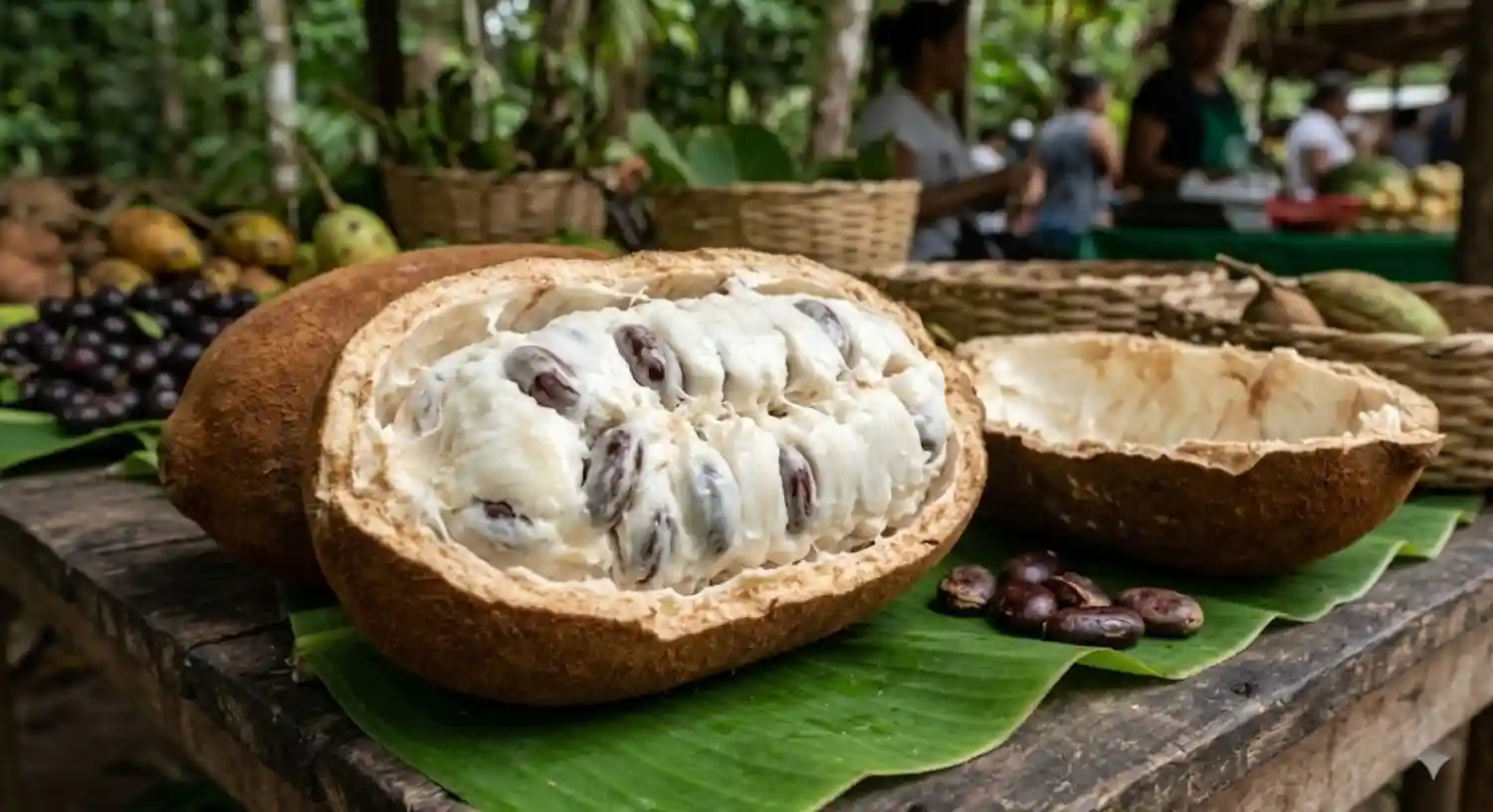
Cupuaçu (Theobroma grandiflorum) is one of the most emblematic trees of the Amazon: a close relative of the cacao tree whose heavy, brown, oval fruits hold a thick white pulp with an intense aroma and a flavour that sits somewhere between tropical fruit and chocolate. That fruit is not an accident of wild nature. Science and the historical record indicate that cupuaçu as we know it today is the result of a long and meticulous process of Indigenous domestication. For at least five thousand years, Amazonian peoples selected the best plants and turned a wild forest tree into a robust agroforestry species, with larger fruits, more abundant pulp and fewer seeds. It is a biocultural legacy that survives to this day, and it shows that the forest is, to a large extent, a garden cultivated by generations of ancestral knowledge.
A relative of cacao shaped by human hands
To understand the history of Theobroma grandiflorum is to step into the history of the civilisations that inhabited the rainforest long before Europeans arrived. Cupuaçu belongs to the same genus as cacao (Theobroma cacao), and biological studies indicate that its closest wild relative was a plant with small fruits and very little pulp. The selection carried out by Indigenous peoples concentrated on increasing the quantity of the white, aromatic pulp that wraps around the seeds. Across generations of agroforestry management, those ancient farmers created a domesticated variety that today is essential for food security and for the local economy. The process did not happen in isolation. It advanced through extensive exchange networks between different ethnic groups, which spread the plant across vast regions of the Amazon basin.
From wild fruit to creamy pulp
The difference between wild and cultivated cupuaçu is striking, and it illustrates the power of sustainable human management. While the wilder forms of Theobroma tend to have larger seeds and a thin layer of pulp, the domesticated varieties carry a thick, creamy pulp that is highly valued for making juices, sweets and ice cream, and more recently a type of chocolate produced from the seeds and known as cupulate. That process of selection did not change only the morphology of the fruit. It also expanded the area where the species occurs and made the tree a common presence in the agroforestry systems that characterise land use among many Indigenous and riverside communities. The cupuaçu tree, with its long leaves and heavy fruits, is living testimony to the ecological engineering practised by the ancient inhabitants of the forest.
A pillar of the Amazonian bioeconomy
Today the fruit has established itself as a fundamental pillar of the Amazonian cupuaçu bioeconomy. It occupies a prominent place in regional fairs and markets, and it drives a production chain that generates income and dignity for thousands of smallholder families. Harvesting cupuaçu inside agroforestry systems, intercropped with other native species, offers a sustainable and profitable alternative to deforestation. National and international markets show growing interest in Amazonian products of sustainable origin, and cupuaçu, with its distinctive flavour and its versatility, is well positioned to meet that demand. Sweets, jams, frozen pulp and cosmetics made from cupuaçu butter are examples of the diversity of products that can be generated from this precious resource.
Traditional knowledge as the base of a green economy
Valuing cupuaçu as a bioeconomy product is inseparable from recognising Indigenous traditional knowledge. The domestication and the sustainable management of this species are ancestral lessons in how to live in harmony with the forest, using its resources without exhausting them. Supporting the production and the consumption of cupuaçu does more than promote a fairer and greener economy: it also preserves a valuable cultural heritage. The standing forest, with its cupuaçu trees loaded with fruit, is the image of a sustainable future for the Amazon, where economic development walks alongside environmental conservation and social justice. The cupuaçu bioeconomy is a model of how valuing forest products can become a powerful tool against poverty and deforestation.
Five thousand years of lessons
The five thousand years of cupuaçu domestication teach that human intervention in nature does not have to be destructive. On the contrary, it can be enriching, creating new possibilities of life and wellbeing for people and for the planet. Cupuaçu is proof that the Amazon is not merely a biome to be preserved in an untouched state, but also a laboratory of social and ecological innovation capable of inspiring the entire world. The journey of this fruit, from the wild forest to the tables of consumers, is a celebration of the intelligence and the resilience of the peoples who created it and who continue to cultivate it with care and respect. To preserve cupuaçu is to preserve the history of the Amazon itself.
Agroforestry that imitates the forest
Cupuaçu thrives in agroforestry systems that mimic the structure of the natural forest. That cultivation method, practised for millennia by Indigenous peoples, brings together different plant species and promotes biodiversity, soil conservation and the generation of sustainable income, in contrast with destructive monocultures. Because the trees grow in the shade of taller neighbours, the plots keep much of the forest canopy intact while still producing food and raw material for local processing. When someone tastes cupuaçu, they are also giving value to an agricultural practice that protects the forest and strengthens local communities.
Tasting a cupuaçu sweet means tasting a piece of the living history of the Amazon. It is an invitation to reflect on the deep connections between biodiversity and human culture, and on the shared responsibility of preserving this biocultural legacy for future generations. The future of the region depends on the capacity to value and support solutions that unite ancestral wisdom with a modern bioeconomy, ensuring that the forest remains a place of life, abundance and hope.
Reporting: Anne Silva / Amazonia Mag. Source: Revista Amazônia, revistaamazonia.com.br

Editor · Amazonia Mag
Anne Silva is the editor of Amazonia Mag, the English-language edition of Revista Amazônia. She curates, translates and adapts the outlet's science and environment coverage for an international audience, reporting on Amazon wildlife, flora, rivers, climate and research. Every story she edits is grounded in peer-reviewed studies, official data and on-the-ground reporting from the Revista Amazônia newsroom in Belém, Pará, Brazil. More by Anne Silva →