
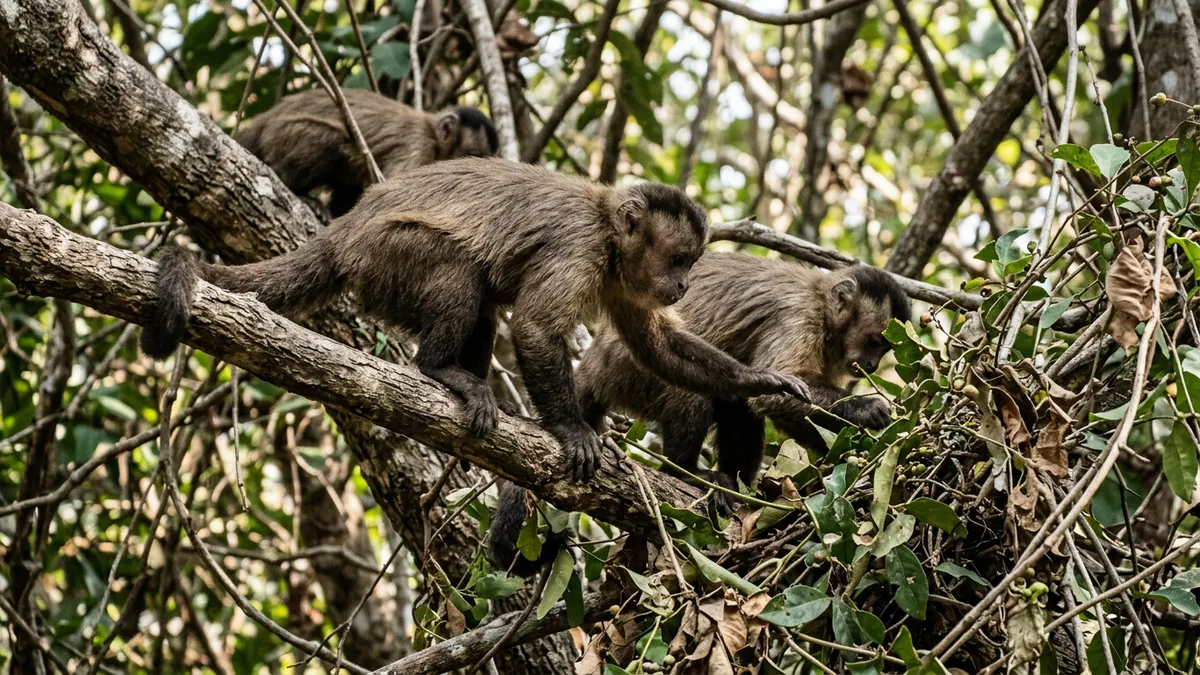
When the supply of fruit shrinks, two groups of capuchin monkeys observed in Brazil begin to include lizards, rodents and snakes in their diet more often. The behavior was documented over 45 months, between 2006 and 2010, at Fazenda Boa Vista. It may help explain how hunting small animals served as a stepping stone in the evolution of the diet of human ancestors.
The study was published on August 26, 2026, in the scientific journal PLOS One. Its central message is that a flexible primate, pressed by scarcity of plant food, can turn into a more active hunter than its everyday reputation suggests.
A change of menu seen in the field
The research gathered more than 5,000 hours of observation of bearded capuchin monkeys, a species known scientifically as Sapajus libidinosus. During that time, the researchers recorded 446 occasions on which the primates ate small animals.
Lizards appeared in 43% of those records, while rodents accounted for 28%. The team also noted the first documented cases, for these monkeys, of eating opossum, iguana and nestling birds taken from nests.
According to PLOS One, bearded capuchins consumed small vertebrates at Fazenda Boa Vista, in Brazil, during periods when fruit and other plant foods were less available between 2006 and 2010.
Males hunt more and take bigger risks
The decision to chase prey was not the same for every individual. Males hunted more often than females and were also more involved in capturing animals considered dangerous, such as snakes.
That difference suggests that hunting does not depend only on how much food the environment holds. Sex, the risk involved and nutritional needs also seem to influence the choice. The study does not present hunting as a uniform activity within the group.
Another detail caught the team’s attention: the monkeys showed a preference for the brain and the internal organs of their prey. Those tissues concentrate fat and other nutrients, which suggests the primates may be picking the most energy-rich parts of the animals instead of simply eating the whole carcass.
Why scarce fruit changes the calculation
Capuchin monkeys are known for dietary flexibility. They can exploit different resources, use objects to reach food and adjust their routine to the conditions around them. The new research adds hunting small vertebrates to that set of responses to scarcity.
In practical terms, the hypothesis is that a drop in fruit raises the value of small prey such as lizards and rodents. Those animals can offer a concentration of fat and protein able to make up for part of the energy the monkeys would no longer get from plants.
The result does not mean the monkeys gave up a plant-based diet. The evidence points to a temporary or conditional widening of the menu, triggered when certain nutrients or sources of energy become harder to find.
What it suggests about human ancestors
Humans are often described as the only living primates that regularly hunt animals larger than themselves. The origin of that behavior is usually linked to the growth of the brain, to social cooperation and to the ability to organize capture strategies.
Before chasing large prey, however, human ancestors may have started with smaller animals. The pattern seen in capuchin monkeys offers a model for investigating that transition, but it does not prove that human evolution followed exactly the same path.
The team suggests that periods of climatic instability faced by ancient human populations may have reduced the availability of plant foods. At such moments, small vertebrates would have worked as a complementary source of energy, creating a possible bridge toward eating larger prey.
“When we analyze 45 months of data, we see small vertebrates such as lizards, rodents and snakes as an important food source when fewer fruits are available,” said Susana Carvalho, Science Director of Gorongosa National Park and one of the study’s lead authors.
In the same statement, Carvalho stressed that the work depended on prolonged observation to identify behavior that could go unnoticed in short studies. “Hunting small prey may have been an important source of nutrition for human ancestors during periods of food scarcity,” she said.
Why long observation matters, and what comes next
A survey lasting a few days could record only the most common diet, dominated by fruit and other plant items. The 45-month series made it possible to compare moments of greater and lesser food availability and to relate that variation to how often the monkeys hunted.
This kind of monitoring also reveals rare events. Eating an opossum, an iguana or nestling birds would not necessarily be caught by a one-off visit. The team’s long stay in the field increased the chance of recording occasional behavior and differences between individuals.
The authors treat their conclusions as a basis for further research. Future studies may test whether the link between plant scarcity and hunting appears in other groups of capuchin monkeys and in other primate species. The next step the researchers propose involves the fossil record: re-examining signs associated with the eating of small vertebrates by ancient hominins to see whether the evidence fits this kind of strategy.
The behavior of capuchin monkeys should not be used as a direct copy of the human past. The species live in different environments, have evolutionary histories of their own and may respond differently to a lack of food. Even so, the study offers a living comparison for a question that is hard to answer with fossils alone. The full article is available free of charge in PLOS One, and the researchers expect it to be followed by analyses of other primates and by a search for marks of predation in the human fossil record.
Reporting: Natália Santos / Amazonia Mag

Editor · Amazonia Mag
Anne Silva is the editor of Amazonia Mag, the English-language edition of Revista Amazônia. She curates, translates and adapts the outlet's science and environment coverage for an international audience, reporting on Amazon wildlife, flora, rivers, climate and research. Every story she edits is grounded in peer-reviewed studies, official data and on-the-ground reporting from the Revista Amazônia newsroom in Belém, Pará, Brazil. More by Anne Silva →