
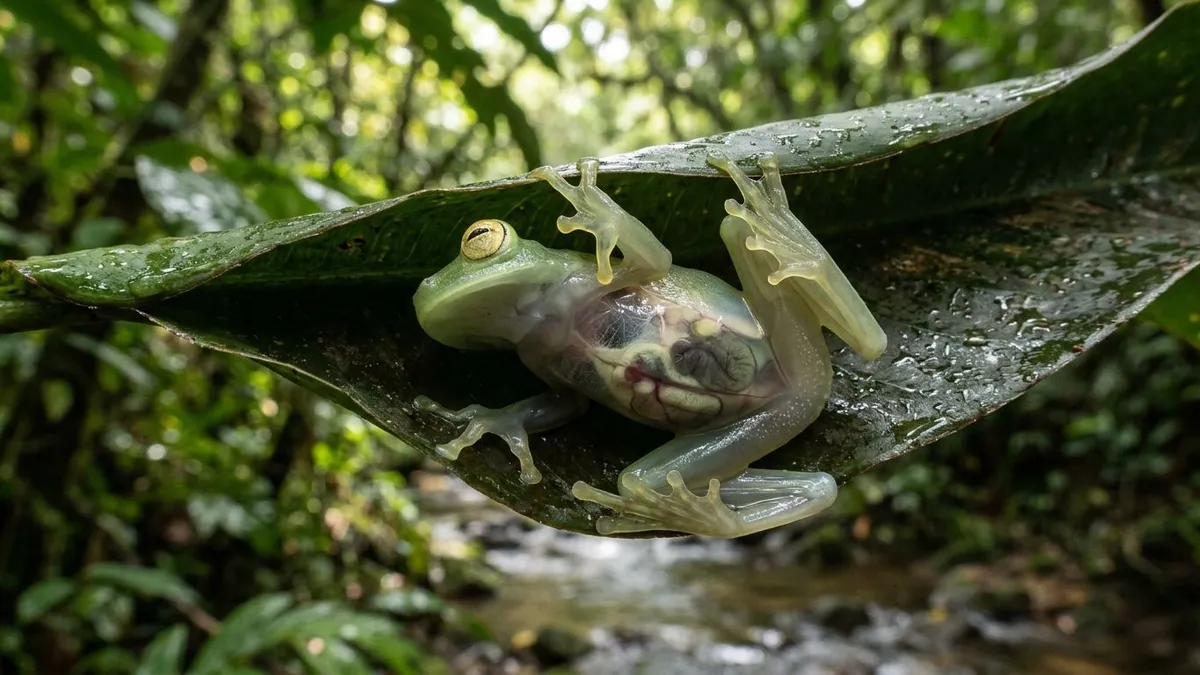
The glass frog carries an unusual feature on its underside. The skin of its abdomen lacks the dark pigment that covers most amphibians, so it is completely translucent. Through that window it is possible to watch, with no invasive method at all, the heart contracting rhythmically, blood moving through the main vessels, a loop of intestine at work and, in females, eggs developing.
The back tells a different story. The dorsal skin stays green, with yellowish tones that match the color of tree leaves. Together, the clear belly and the leaf-colored back make a frog that is easy to study and hard to spot, living beside the clean, fast streams of the Atlantic Forest in Brazil.
A belly that works as a window
Most amphibians have dense layers of pigment cells that block the passage of light. In the glass frog, the pigment-bearing cells are restricted to the back, and the belly is left clear. The result is a body in which some organs can be seen from the outside.
The heart is the most striking of them. Reddish because of the hemoglobin in the blood it carries, it pulses visibly beneath the skin. In some species of the family Centrolenidae, a white, opaque layer wraps the liver and the digestive tract while the outer wall of the abdomen stays fully translucent. The contrast between the pale wrapping and the clear skin gives the body its unusual look.
Because everything happens in plain view, the species offers biologists a rare opportunity. It is possible to follow heart rate and blood flow in a Neotropical amphibian, to track food moving along the digestive system and to watch eggs mature in reproductive females, all without surgery or sedation. That is why the glass frog is treated as a useful model for studies of ecophysiology and developmental biology.
Softening the outline against the leaf
Transparency also has a defensive use. By day the frog rests under foliage, and the idea is that its translucent abdominal margin works as a kind of camouflage known as disruptive illumination, or edge softening. Sunlight crosses the plant tissue and reaches the edge of the body, so the sharp shadow that would reveal the animal’s outline is weakened.
The goal is not invisibility in the strict sense. It is to make the animal’s boundary harder to read. With a green back that matches the leaf and a belly that lets light through, the frog’s shape blurs into the surface where it sits. A predator looking for a clear silhouette has less to work with.
This is what makes the glass frog an example of how camouflage can rely on light rather than on color alone. Matching the hue of a leaf is only part of the solution. Controlling how light behaves at the border between animal and plant finishes the job.
Calling from leaves above running water
The reproductive cycle of the glass frog is closely tied to the vegetation that lines the streams of well-preserved forest. During the rainy season, males set up territories on leaves that stretch out directly over fast-flowing streams. At night they call in a high-pitched chorus to attract females.
Choosing the calling site is a careful matter. The leaf has to sit at a safe height above the water and be sheltered from drying winds. After amplexus, the female lays a mass of eggs wrapped in a clear, gelatinous matrix, placed on a leaf above the stream. The raised position protects the clutch from strictly aquatic predators such as fish and insect larvae during the critical period of incubation.
The male often stays close to the clutch. By keeping the jelly moist with the humidity of his own body, he helps the eggs avoid drying out, and he defends them against attacks by wasps and small predatory bugs. Parental care of this kind is a notable detail in a group better known for its transparent skin.
From the leaf to the stream
Embryos can be seen with the naked eye inside the gelatinous envelope, because the membranes around the eggs are transparent. Over the days, the tadpoles shape their bodies, feeding on yolk reserves until they reach the hatching stage.
When they hatch, the larvae drop straight from the leaf into the stream below. That immediate vertical transition keeps the time the tadpoles spend out of the water to a minimum. Once in the stream, they have an elongated body and tail muscles suited to swimming and to burrowing into submerged leaf litter or between stones on the bed.
In this aquatic phase the tadpoles feed on decomposing organic matter and on algae deposited on the substrate. In doing so they play an active part in the cycling of nutrients in the stream ecosystem, long before they climb back onto the vegetation as adults.
Dependence on moist microclimates
Outside the breeding season, the adult frog hunts small nocturnal insects such as flies, moths and small beetles. Expanded adhesive discs on its toes let it move with precision over leaves wetted by fog. The frogs also serve as food for tree-dwelling snakes, including vine snakes, so they sit in the middle of the food web of the forest.
Their reliance on humid microclimates makes glass frogs vulnerable to changes in the riparian forest. Amphibians exchange gases through the skin, and water regulation depends on the surroundings. When the volume of water in a stream drops, the eggs left on leaves are affected, because without moisture rising from the streambed the jelly masses can dry out before the embryos finish developing.
Removing trees along the protected strip beside a stream cuts directly into the places where males can call and where eggs can be laid. In fragmented areas, that loss has been linked to local population declines. Continuous forest corridors along waterways help connect different subpopulations and maintain genetic variation.
For this reason, seeing a glass frog in a stretch of forest is often read as a sign of good environmental quality: clean stream water, continuous vegetation along the banks and stable moisture conditions. The translucent belly that gives the animal its name is a reminder that its survival depends on small, delicate details of the forest, from the leaf above the water to the stream below it.
Reporting: Natália Santos / Amazonia Mag

Editor · Amazonia Mag
Anne Silva is the editor of Amazonia Mag, the English-language edition of Revista Amazônia. She curates, translates and adapts the outlet's science and environment coverage for an international audience, reporting on Amazon wildlife, flora, rivers, climate and research. Every story she edits is grounded in peer-reviewed studies, official data and on-the-ground reporting from the Revista Amazônia newsroom in Belém, Pará, Brazil. More by Anne Silva →