
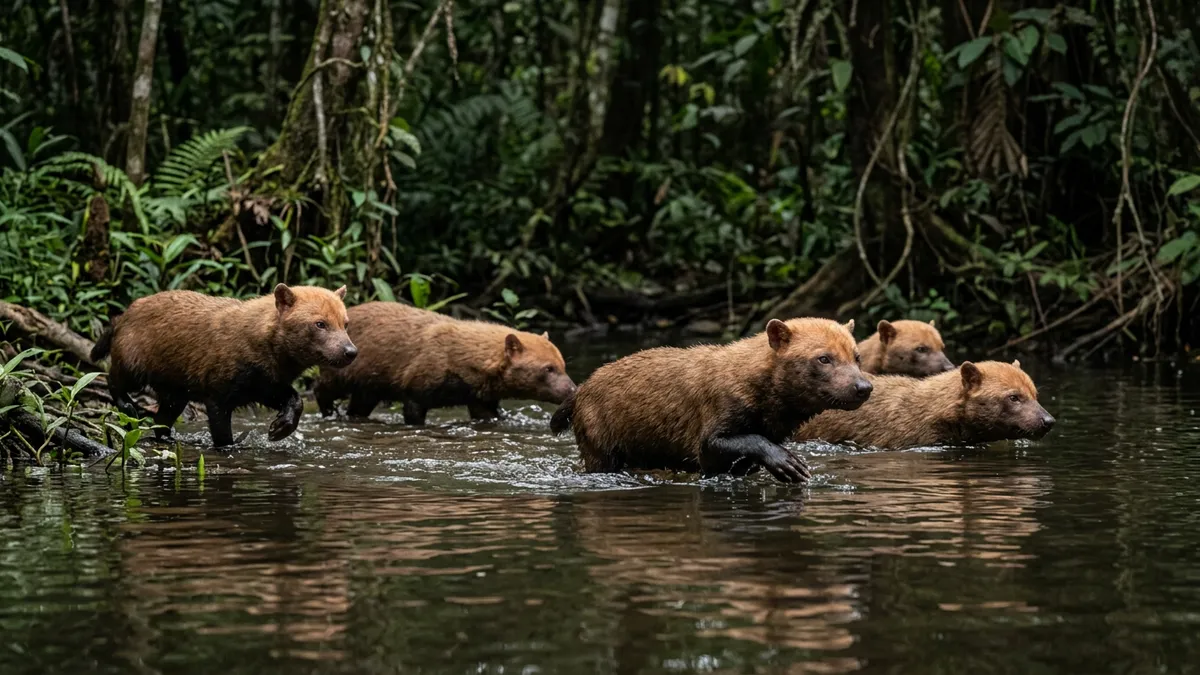
The bush dog (Speothos venaticus) can swim and chase prey through water because it has a membrane between its toes. That structure partly joins the toes of the paws and widens the surface used to push against the water as the animal moves. Instead of merely crossing streams, the bush dog can make that environment part of its hunting strategy.
The method becomes more effective when several animals work together. The pack coordinates the pursuit and can bring down prey larger than any single member’s body, while high-pitched calls keep the animals in contact inside dense forest. The result combines a physical adaptation, a cooperative way of catching prey and a communication system suited to places where vegetation limits visibility.
How webbed toes help the bush dog swim
The membrane between the toes works as an extra area of contact between the paw and the water. When the bush dog moves its toes and pushes water backward, the paw returns a force that helps drive the body forward. The principle is similar to that of a surface that increases resistance against the water with every stroke. Without that partial union between the toes, the paw would have less area to do the work.
This adaptation does not turn the paw into a full flipper, and it does not mean the animal stays in the water all the time. It improves the ability to move through a medium that demands coordination between paws, trunk and head. The bush dog can use the skill to cross water and also to join a chase when its prey is in that environment. The effect is a wider space in which the pack can act during a hunt.
The body works with the paws during the chase
Swimming depends on more than the webbing between the toes. To move forward, the bush dog has to alternate the movements of its paws, keep its body aligned and control its head as it travels. The membrane contributes thrust, but the coordinated movement of the whole body stops the animal from wasting energy by pushing water in directions that do not help the pursuit.
In a chase through water, body organization also helps hold a heading. The muzzle stays pointed at the target while the paws produce successive pushes. The extra surface between the toes can make each stroke more efficient, especially when the animal needs to correct its path. The combination is not an isolated trick of the paws. It is an adaptation that gains value when paired with fast responses and the teamwork of the pack.
Why hunting in a pack raises the chance of a catch
The bush dog does not rely on the strength of one individual. In cooperative hunting, the members of the pack can follow the movement of the prey from different positions and sustain the chase for longer. Having several animals also increases the pressure on the target, which has to react to more than one direction. That coordination lets the group take on prey larger than the body of each bush dog.
Cooperation changes the relationship between size and capacity to catch. Alone, an animal would struggle to hold a larger target. In a group, the movements of the members can complement each other, narrowing the prey’s chances of escape and favoring a takedown. In the water, the membrane between the toes helps the animals keep moving, while the pack adds pressure to the pursuit. The mechanism depends on the sum of a physical adaptation and social behavior.
How calls keep the pack together in dense forest
The high-pitched calls serve a practical purpose: they help the animals stay in contact when vegetation blocks a continuous view of the group. In thick forest, trunks, leaves and other obstacles can hide one individual from the rest. Sound lets pack members follow each other’s relative positions even when they cannot see one another directly.
During a hunt, that contact lowers the risk of the pack scattering. The animals can adjust their movements when they hear their companions call. The calls do not replace watching, moving or chasing, but they add a channel of communication that works where sight is limited. In this way, sound takes part in coordinating a strategy that needs the animals to stay close and respond quickly to whatever the prey does.
Where body, voice and pack meet
The membrane between the toes provides a physical ability, but its value grows when the bush dog hunts with others. A paw adapted to water lets an animal keep moving, yet catching a larger prey depends on the coordinated action of the pack. Swimming puts the group in a position to continue the chase, while cooperation spreads the task across several bodies.
This combination also shows that an anatomical feature does not work apart from behavior. The bush dog uses its body, its voice and its social organization as parts of a single action. The calls keep contact, the membrane favors progress in the water and the pack increases the ability to bring down a target. Each element solves a different limitation, and the three reinforce one another when the hunt takes place in dense forest.
By hunting in a group and using water as part of its route, the bush dog explores a space that would not be open to a predator limited to moving on land. The membrane between the toes widens its options for movement, the voice helps preserve cohesion where visibility is reduced, and the pack allows the group to act on prey bigger than any one animal. A predator able to chase through water and act as a team can influence how other animals use those places.
The bush dog shows that the ability to hunt is not concentrated in a single trait. The webbing between the toes meets the challenge of moving in water, the call keeps contact and the pack turns individual effort into a coordinated action. Watching that combination changes how a small predator is understood: its reach depends less on one isolated advantage than on the way body, sound and company fit together. In dense forest, survival can mean knowing how to advance, how to communicate and how to act as one.
Reporting: Natália Santos / Amazonia Mag

Editor · Amazonia Mag
Anne Silva is the editor of Amazonia Mag, the English-language edition of Revista Amazônia. She curates, translates and adapts the outlet's science and environment coverage for an international audience, reporting on Amazon wildlife, flora, rivers, climate and research. Every story she edits is grounded in peer-reviewed studies, official data and on-the-ground reporting from the Revista Amazônia newsroom in Belém, Pará, Brazil. More by Anne Silva →