
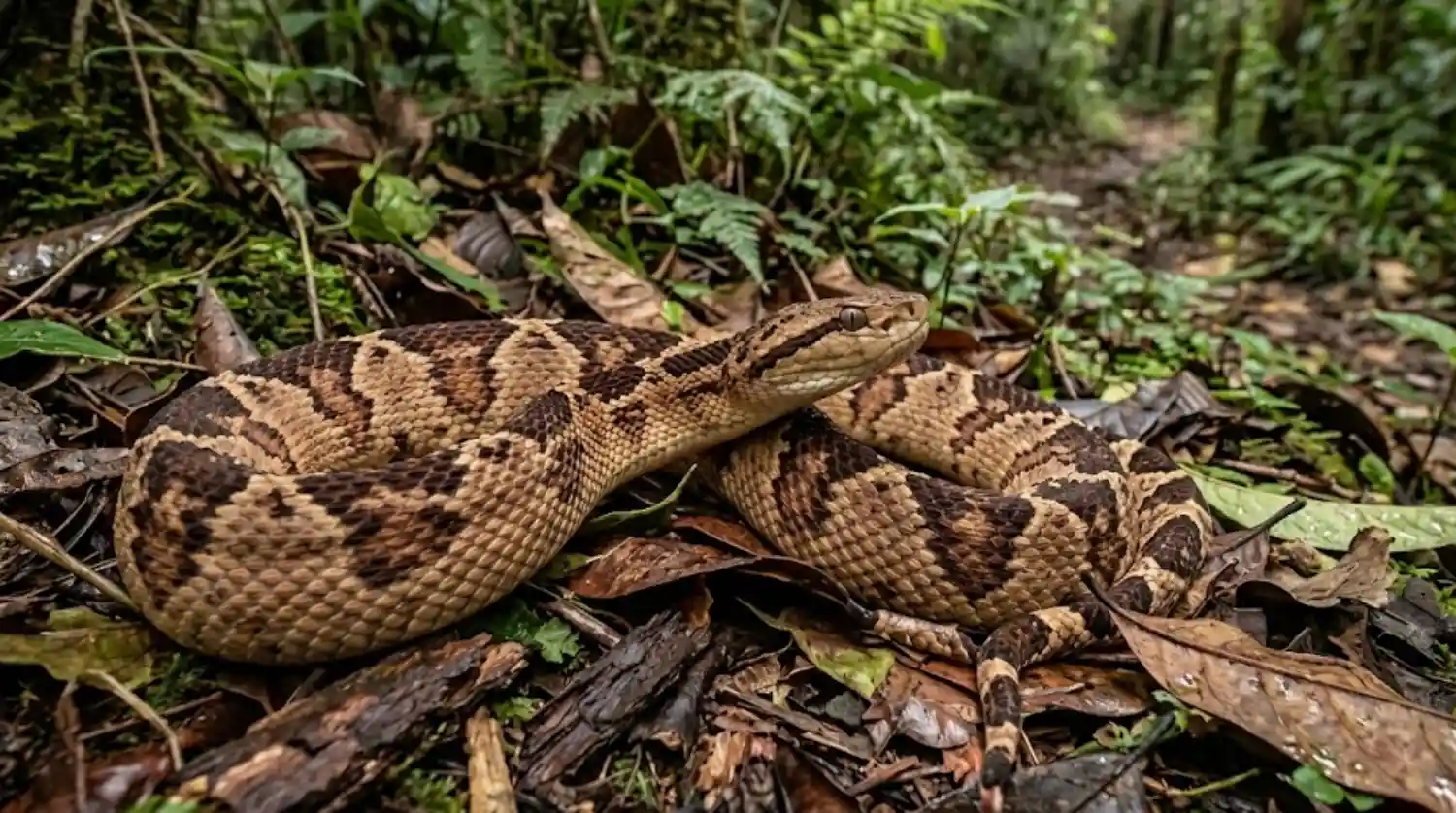
On the floor of the Amazon rainforest lives a predator most people never see, even when they walk within a few metres of it. The Lachesis muta, known in Brazil as surucucu de fogo and in English as the bushmaster, is the largest venomous snake in the Americas and also one of the hardest to spot. It can stay motionless for weeks in a state of active dormancy, its metabolism slowed to a minimum while its heat sensors keep monitoring everything that moves nearby. It does not flee, it does not display itself and it does not give chase. It simply disappears into the landscape.
A pattern built to break an outline
The skin of the bushmaster is not merely a physical barrier, it works as an optical system. The geometric shapes in shades of brown, ochre and black that run along its body follow the principle of disruptive camouflage. Rather than matching the exact colour of the ground, those blocks of contrast fragment the silhouette of the animal and stop the eye, whether human or that of a prey animal, from closing the figure of a snake. What remains visible is a mosaic of patches that blends into the carpet of dead leaves on the forest floor. The body is right there, complete, but the brain of the observer never assembles it.
The finish of the scales completes the disguise. They are rough and keeled, each carrying a small longitudinal ridge that prevents excessive glare under the light filtering through the canopy. In a forest where brightness arrives in shifting patches across the ground, a single reflection would be enough to betray a presence. The matte texture of the bushmaster removes that risk and keeps the deception intact even during the brightest hours of the day, when any smooth surface would turn into a signal visible from a distance.
Patience turned into a hunting method
Choosing the right spot matters as much as the disguise itself. The snake does not settle anywhere at random: it selects specific stretches of forest, usually close to the trails used by small rodents or beside the roots of large trees, and there it merges with the terrain. The strategy is the exact opposite of the hunter that burns energy in frantic pursuits. Here the whole effort goes into spending nothing at all, into letting food walk on its own into the chosen point.
That economy is literal. While other animals search for food every day, the bushmaster can wait months for a single substantial meal. Throughout that interval its body runs on a remarkable energy saving regime, with the metabolism reduced and the animal practically at a standstill. Prolonged stillness is neither laziness nor weakness: it is the central piece of a way of life that trades speed for invisibility, and it only works if the camouflage holds week after week without failing once.
The waiting is not blind either. Research from Instituto Butantan describes the sensory sharpness of these snakes through the loreal pits, thermoreceptor organs that allow them to see the heat of a prey animal even in the total darkness of the understorey. For a creature lying still beneath the leaves, a moonless night stops being an obstacle and becomes an advantage: the predator registers what is approaching long before whatever is approaching registers anything at all.
Why camouflage explains encounters with people
The same mechanism that makes it an efficient hunter is what places it in the path of human beings. A snake that does not run away and does not draw attention cannot be avoided by someone who never sees it. Most risky situations in forest areas do not come from a chase or from a deliberate attack, but from a single step taken in the wrong place on the leaf litter, precisely where the animal had spent days without moving, trusting that nobody would tell it apart from the ground.
Herpetology studies gathered on platforms such as SciELO are consistent on this point: accidents involving humans happen when the animal feels directly cornered. Outside that condition, the default reaction of the bushmaster is to remain still and rely on the disguise evolution handed it. Understanding this changes the reading of risk entirely. This is not an aggressive reptile looking for confrontation, but an animal that stakes everything on going unnoticed and responds only when that resource fails.
The lesson is nothing new for those who live inside the forest. For traditional and Indigenous communities, the bushmaster was never a gratuitous threat but a silent guardian of the secrets of the soil, a being that is respected and whose space is acknowledged. Institutions such as the Museu Paraense Emílio Goeldi keep up steady work cataloguing and studying the behaviour of these reptiles, and that data feeds both the production of more efficient antivenom serums and the environmental education programmes built around coexistence.
A predator that holds the forest up
Often feared, the bushmaster performs an ecological role that sustains the health of the Amazon. By controlling the population of rodents and other small mammals, it prevents the overpopulation of species capable of consuming seeds in excess and damaging the natural regeneration of trees. Without this top predator operating at ground level, the growth cycle of new seedlings of valuable forest species would be drastically altered, and the effect would spread through the entire structure of the forest.
That is why its conservation is tied to the existence of large blocks of primary forest. Unlike more generalist species, the Lachesis muta is extremely sensitive to climate change and deforestation: it needs continuous shade, stable humidity and an intact layer of leaf litter, which serves at once as its pantry and its disguise. Satellite monitoring projects run by INPE help identify the protected areas that still hold the microclimate these animals require to complete their life cycle.
What science still has to uncover
The use of technologies such as genetic sequencing and bioacoustics promises to reveal further detail about the species in the years ahead. The toxins found in bushmaster venom, for instance, carry potential for the development of new drugs aimed at blood pressure control and cardiac treatments, turning into therapeutic promise something that for a long time was read only as danger. Every marking on its skin, seen up close, performs a precise biological function within a system that rewards restraint.
Recognising that function is also a way of valuing the science produced in the region, where the forest works as a living laboratory of biochemical solutions. The catalogues, the field notes and the long term behavioural records built by Brazilian institutions are what allow a snake feared for generations to be described accurately rather than mythologised. Accurate description, in turn, is what makes coexistence possible for the communities that share the same ground with the animal every single day.
The existence of the bushmaster teaches that strength does not always lie in speed, but in the ability to adapt and to wait for the exact moment. Protecting its habitat means protecting water resources, air quality and the genetic diversity of thousands of species that share the same green roof. Looking at that strategic stillness in the heart of the Amazon is an invitation to respect the natural rhythms of a system that only looks chaotic to those who have not learned to read it.
Reporting: Anne Silva / Amazonia Mag. Source: Instituto Butantan, INPE, Museu Paraense Emílio Goeldi and SciELO.

Editor · Amazonia Mag
Anne Silva is the editor of Amazonia Mag, the English-language edition of Revista Amazônia. She curates, translates and adapts the outlet's science and environment coverage for an international audience, reporting on Amazon wildlife, flora, rivers, climate and research. Every story she edits is grounded in peer-reviewed studies, official data and on-the-ground reporting from the Revista Amazônia newsroom in Belém, Pará, Brazil. More by Anne Silva →