
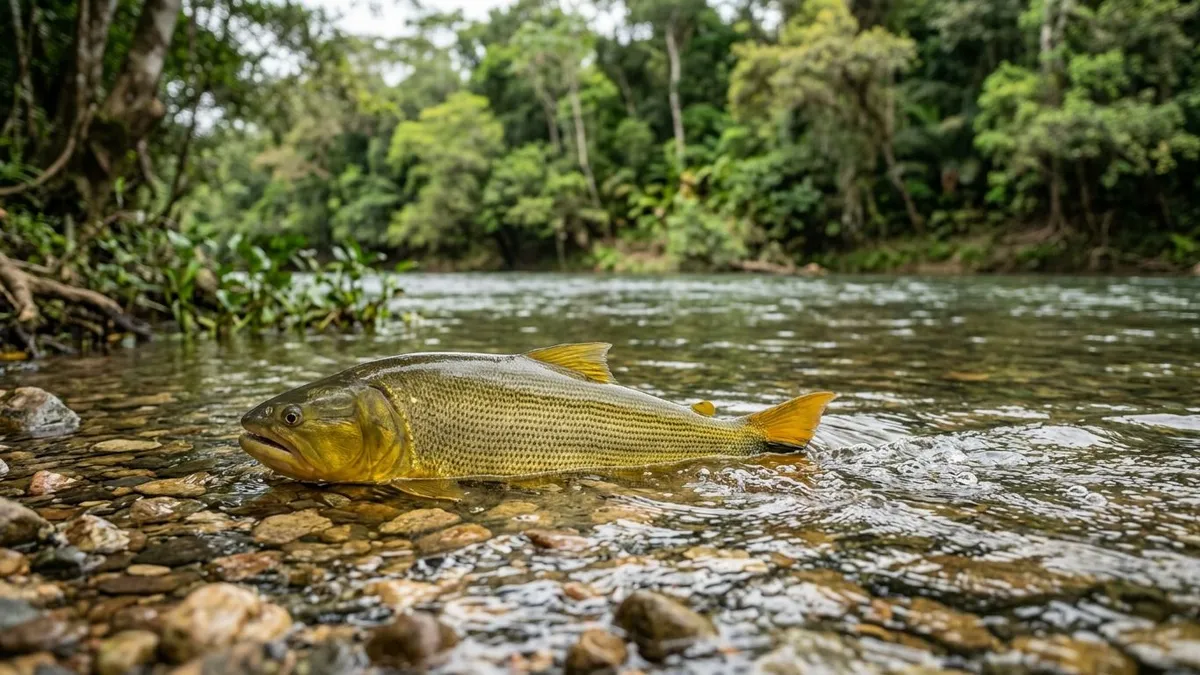
The golden dorado, known scientifically as Salminus brasiliensis, turns its climb upriver into a series of sudden bursts. When it meets a waterfall, it sets its body against the flow, accelerates over a relatively short stretch and leaves the water to clear the drop in a vertical leap. The movement is not an isolated display. It is part of the reproductive migration known as the piracema, the period when fish try to reach places suitable for spawning.
The current raises the cost of travel, but it also guides the path of the shoal. The dorado has to hold its heading, correct its body in the air and return to the water without losing all the ground it has gained. Each obstacle overcome is one stage of the passage to higher parts of the basin.
The leap begins in running water
The dorado’s body contributes to this behavior. The species has an elongated, streamlined shape, with fins that help it stay stable and a tail able to produce strong thrusts. On approach to a waterfall, rapid contraction of the trunk muscles moves the spine and passes force to the tail fin. That burst lets the fish cross the turbulence near the drop and reach the sheet of water above.
The skill does not erase the energy cost of the migration. It simply gathers, in a few seconds, the strength needed to clear an obstacle that slow, continuous swimming could never beat. The leap is therefore the visible part of a physiological preparation that runs through the whole climb.
A journey in which feeding takes a back seat
During much of the reproductive journey, the golden dorado eats less. The priority becomes travel to the spawning areas, not a constant search for prey. This does not necessarily mean that the fish stops catching any food at every moment, but that feeding becomes less important and less frequent during the ascent. The energy spent on swimming and leaping has to be managed with care. Reserves built up before the migration support part of the effort, while the muscles work again and again against the speed of the water.
The strategy is common among animals that make demanding reproductive journeys: put resources into reaching the right place before going back to prioritizing food. The reduction creates a temporary change in the behavior of a predatory fish. Outside the migration, the dorado uses sight and speed to chase other fish, mostly in the upper part of the water column. During the piracema, however, travel against the current moves to the center of its routine.
Hunting stops being the dominant activity, and the animal alternates among stretches of advance, relative rest and fresh acceleration in front of obstacles. This helps explain why a dorado seen swimming upstream should not be read only as a feeding scene. The fish may be focused on completing the route even when prey is available in the river. Migration changes the relationship among energy expenditure, behavior and survival.
Muscle for the current, and hunting at the surface
The dorado’s swimming combines stability and explosive power. In stretches of strong current, the trunk muscles sustain the undulation of the body, while the tail provides the main propulsion. For a leap, the contraction has to be more intense and better coordinated, because the animal no longer has the continuous support of the water. The head and body enter the flow, the tail delivers the last push and the fins help correct the trajectory.
The dorado does not climb a waterfall in one continuous motion. It gains height in successive movements, taking advantage of slower zones, backwaters and passages available along the river. Alternating long swimming with short bursts is part of the functional adaptation of the species to running-water environments.
The same set of traits also supports the dorado’s role as a surface predator. The fish usually works the upper layer of the water, where it can pick out movement, smaller fish and chances to attack. Its elongated body reduces resistance on approach, and acceleration lets it close the distance to prey quickly. This way of hunting differs from that of species that look for food on the bottom, stirring up sediment or using specialized structures to probe the bed. By occupying the surface and the stretches of current, the dorado takes part in controlling the populations of other fish. During migration, however, this predatory role steps back for a while, because the reproductive goal demands a greater physical investment.
Piracema, spawning and what can block the way
The piracema is a migration tied to the reproductive cycle of fish. The dorado swims upriver to reach areas where environmental conditions allow reproduction, and its leaps make it possible to cross rapids and falls that would block a purely aquatic route. Spawning depends on the interplay of behavior, current, water quality and the connection among the different environments of the river.
After the gametes are released, eggs and larvae are carried by the water, and the cycle continues in areas that offer conditions for early development. The presence of barriers, changes in flow and the loss of connectivity can interfere with this trajectory. For that reason, watching a dorado leap shows more than the strength of one individual. It also indicates that a river passage still exists and can still be used.
The piracema is not a single-date event. It happens seasonally, in periods that vary with the river basin, environmental conditions and local protection rules. The height or distance of each leap also cannot be fixed in advance, since performance depends on the size of the fish, the speed of the current, the shape of the fall and the presence of resting points.
What holds across all of this is clear: the dorado eats less during much of the climb, uses powerful muscle to move ahead in running water and relies on vertical leaps to reach spawning sites. In Brazil, this behavior ties science and conservation to a concrete scene. Whether a river stays continuous can decide whether a species is able to complete its life cycle.
Reporting: Natália Santos / Amazonia Mag

Editor · Amazonia Mag
Anne Silva is the editor of Amazonia Mag, the English-language edition of Revista Amazônia. She curates, translates and adapts the outlet's science and environment coverage for an international audience, reporting on Amazon wildlife, flora, rivers, climate and research. Every story she edits is grounded in peer-reviewed studies, official data and on-the-ground reporting from the Revista Amazônia newsroom in Belém, Pará, Brazil. More by Anne Silva →