
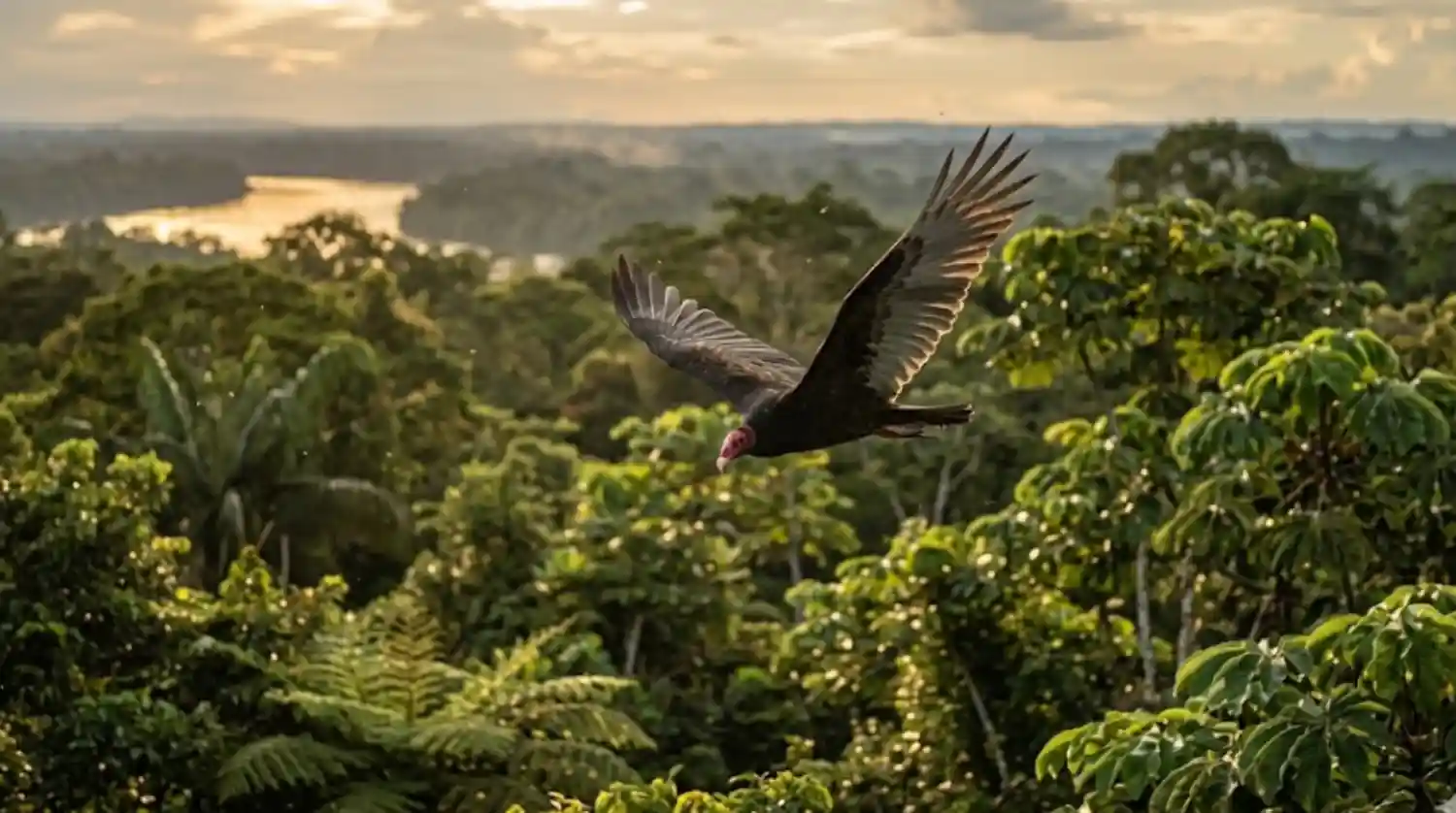
Among all the carrion feeding birds of the Americas, only one solved the problem of finding food without relying on its eyes. The turkey vulture, Cathartes aura, carries an extraordinarily developed olfactory bulb that lets it detect decomposing carcasses even beneath the closed vegetation of the Amazon rainforest. That single sensory capacity separates it from every other vulture on the continent and turns it into a specialist at tracking the smell of gases such as ethanethiol, released in the earliest moments of putrefaction, long before anything at all is visible from the air.
A different species and a different sense
It is worth clearing up a common confusion straight away. This is not the bird that dominates open carcasses through the sheer force of its beak and through eyesight of extremely high definition. That role belongs to the king vulture, Sarcoramphus papa, a distinct species with a distinct natural history. Nor is this the black vulture, Coragyps atratus, the one most often seen in urban areas, which also navigates by vision and by watching the behaviour of the birds around it. The turkey vulture reached the same meal along a different evolutionary road: while the others look, it smells.
Smell ahead of sight
While the black vulture and the imposing king vulture depend on sharp vision to spot carcasses in open country or to monitor the movements of other birds, the turkey vulture developed an alternative strategy. It flies low, barely above the treetops, quite literally sniffing the forest as it goes. Research indicates that its sense of smell is so refined that it can pinpoint a source of odour even when that source is completely hidden by foliage or buried under a thin layer of leaf litter and debris.
This olfactory specialisation is a crucial evolutionary adaptation for survival in dense tropical forest environments such as the Amazon, where visibility is limited and the ground is almost never in view from above. By detecting decomposition in its earliest stages, the turkey vulture gains a competitive advantage and often reaches the food source first. The consequence is revealing, because it exposes the architecture of the whole system: other vulture species frequently follow it, taking advantage of its locating ability in order to feed as well.
A vital role in nutrient recycling
The turkey vulture performs an indispensable ecological role as a decomposer and a recycler of nutrients. By consuming carcasses, these birds accelerate a decomposition process that, in the hot and humid climate of the Amazon, could otherwise lead to the accumulation of organic matter and the proliferation of pathogens. They function as genuine cleaners of the forest, preventing the contamination of soil and of bodies of water, a silent service that almost no accounting system ever registers.
Studies published by respected institutions, including the Instituto Nacional de Pesquisas da Amazônia, underline how efficient these birds are at removing carcasses. The digestive system of the vulture is extremely acidic and is capable of neutralising lethal bacteria and viruses, such as the agents that cause anthrax, botulism and cholera, which could otherwise trigger outbreaks among other wild animals and even among human populations. Its presence, for that reason, works as an indicator of a healthy and balanced ecosystem.
The anatomy of a tracker
Physiologically, the turkey vulture is a machine built for tracking odours. Its olfactory bulb, the part of the brain that processes smell, is proportionally larger than in almost any other known bird. Its nostrils, in addition, are large and perforate, meaning that they are not separated by a septum, which may ease the flow of air and the detection of odour molecules during flight. This is an anatomy assembled entirely around a single question: what lies down there, under the canopy.
Its flight technique is adapted to olfactory searching as well. Unlike the high soaring flight of other vultures, the turkey vulture often traces low circles and rocks its wings in order to catch the air currents that carry the scent of the forest floor upward. That behaviour, sometimes read as hesitation or clumsiness, is in reality a meticulous and efficient sensory sweep, as systematic as the sampling pattern of a measuring instrument.
Why the bird matters to public health
Preserving the turkey vulture and its habitat has direct implications for public health and for regional sustainability. By containing the spread of infectious disease, these birds provide an ecosystem service that is free and impossible to price. The loss of those populations could lead to a significant rise in health and sanitation costs, and it would unbalance local food chains in ways that are difficult to reverse once the process has started.
Promoting the conservation of these birds is fundamental to maintaining Amazonian biodiversity. Environmental education initiatives run by organisations such as WWF Brazil help to dismantle the negative image so often attached to vultures and highlight instead their importance to environmental balance. Recognising their value is an essential step toward guaranteeing a sustainable future for the region and for the communities that live in it.
The chemical defence of the vulture
One of the most striking curiosities about these birds is their defensive strategy. When they feel threatened, especially at the nest, they can regurgitate the contents of their stomach in the direction of the aggressor. The smell of that vomit is extremely foul and its acidity is high, which can cause irritation to the skin and the eyes of a predator, quite apart from driving the intruder away through the sheer unbearable odour. The tactic is repellent to human sensibilities, yet it is an effective survival mechanism with a very low energetic cost.
There is a wider lesson in all of this. A group of birds that is overwhelmingly visual produced, in one lineage, a nose capable of reading the chemistry of the forest floor from the air. That is not a minor curiosity of natural history: it is a working demonstration that evolution finds whatever door happens to be open, and that a rainforest canopy which blocks sight can be answered with a sense that ignores sight altogether.
The story of the turkey vulture shows that nature frequently takes surprising routes in order to achieve efficiency. The development of an exceptional sense of smell in a bird, within a group that is predominantly visual, is a reminder of the remarkable plasticity of evolution and of the intricate complexity of ecosystems. When we value every piece of that biological puzzle, including the pieces that do not strike us at first glance as the most charismatic, we strengthen our connection with the planet and we safeguard the integrity of life in all of its forms.
Reporting: Anne Silva / Amazonia Mag. Source: Revista Amazônia.

Editor · Amazonia Mag
Anne Silva is the editor of Amazonia Mag, the English-language edition of Revista Amazônia. She curates, translates and adapts the outlet's science and environment coverage for an international audience, reporting on Amazon wildlife, flora, rivers, climate and research. Every story she edits is grounded in peer-reviewed studies, official data and on-the-ground reporting from the Revista Amazônia newsroom in Belém, Pará, Brazil. More by Anne Silva →