
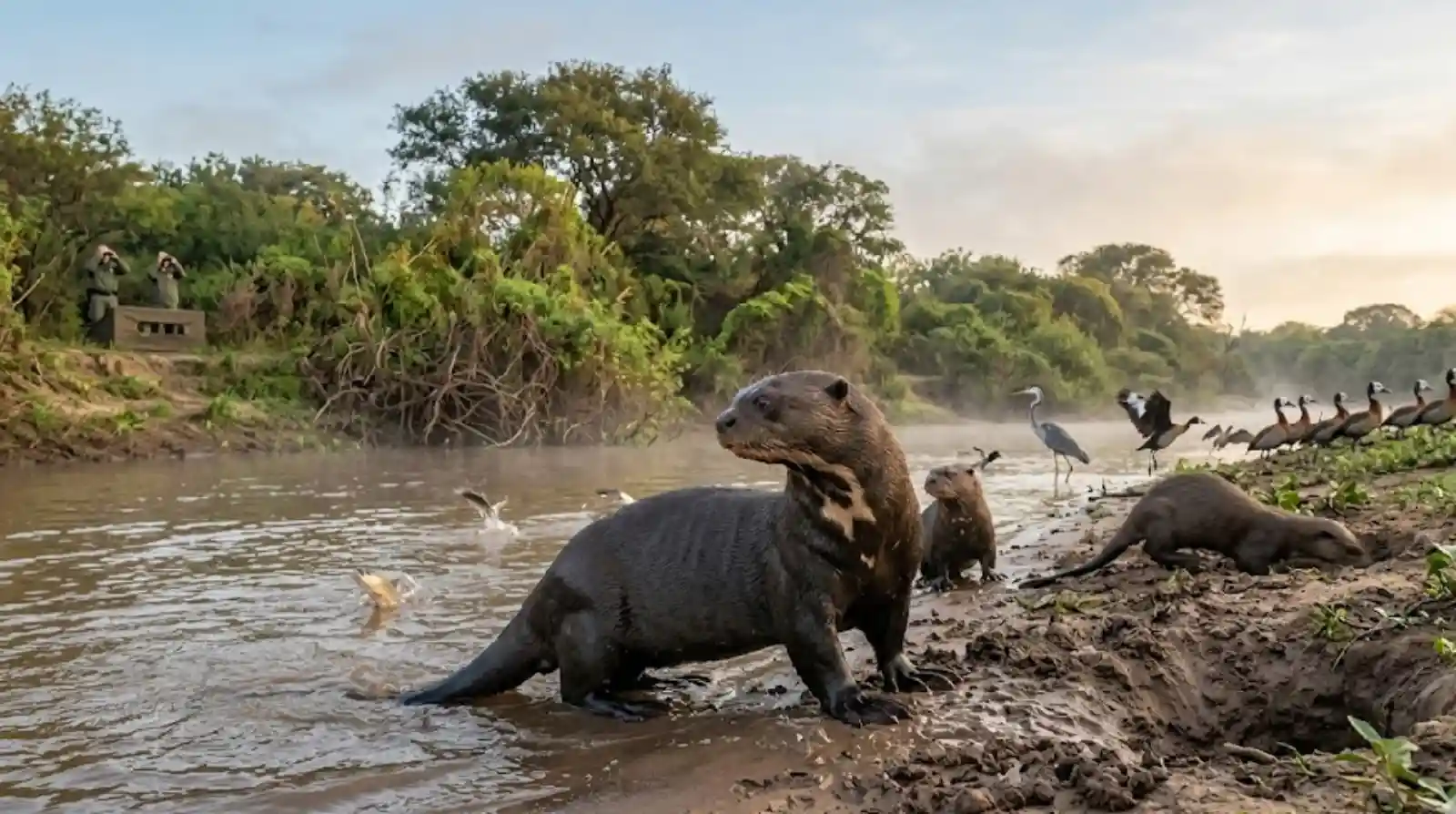
For more than a century, the Bermejo River ran without her. No fresh tracks in the mud along the bank, no splash at dawn, no clamor of an entire family fishing together. The giant otter, Pteronura brasiliensis, one of the most striking predators in South America, had vanished from the Argentine Chaco. After 110 years of complete absence, it came back. And the researcher who watched it glide through the water was not only moved: he was looking at hard evidence.
This is not an isolated record to be celebrated quietly in a laboratory. When a mammal of that size reappears in a river basin, it never arrives alone. It brings a chain reaction that reshapes everything from fish behavior to the physical look of the riverbanks. Nature is showing that, given a genuine chance, it knows exactly how to heal itself. And above all, the animal is delivering a message about the condition of the water.
A century of silence on the Bermejo
The story of the giant otter in northern Argentina was cut short abruptly in the early twentieth century. Predatory hunting driven by the value of its pelt, combined with disorderly expansion into the wetlands, pushed the species into oblivion. For more than a hundred years the Bermejo flowed without it, and the gap left behind was not merely symbolic. It was ecological. A river without its top predator keeps running, but it runs at half capacity, even when it looks untouched.
The current return is the result of an enormous conservation effort led by organizations that have staked their work on rewilding, the restoration of ecosystems by bringing back the species that were wiped out of them. Rewilding Argentina has been documenting the backstage of that nearly impossible mission, which is restoring substance to the neighboring national parks. Reintroducing a predator is not a matter of releasing an animal: it means rebuilding a function the environment had lost.
The otter as an ecosystem engineer
Many people see the giant otter as a charming creature that photographs well. It is far more than that. As an apex predator, it keeps fish populations in balance and prevents a handful of species from dominating the environment and flattening its biodiversity. Without it, the river was like an orchestra without a conductor: the instruments kept playing, but nobody was keeping time or correcting the excesses.
Its influence reaches well beyond diet. Otters are genuine architects of the riverbank. By digging deep dens and carving trails into the slopes, they create microhabitats where there used to be a uniform edge of mud. Small amphibians, insects and even particular plants benefit from those changes in the terrain. Scientists call the phenomenon a trophic cascade: the presence of a single animal produces knock on benefits for hundreds of other living things.
Birds were the first to answer
What impressed researchers most was the sheer speed of the response. Only a few weeks after the first sightings, observers noted a rise in the diversity of water birds in the areas the otters frequented. The explanation is concrete. The movement of these mammals exposes prey and alters the dynamics of the water, and that makes feeding easier for herons and other birds that had previously avoided certain stretches of the river.
That complex interaction suggests the ecosystem is recovering its natural complexity, which is not the same thing as simply holding more animals. A healthy river is not measured only by how many species live in it, but by how many relationships run between them: who eats whom, who digs, who cleans, who disperses. The giant otter has taken back a central knot in that web, and the whole fabric has rearranged itself around it.
A living thermometer for river health
Here is the point that matters most to anyone who studies river basins. The giant otter does not settle just anywhere. It needs clean water, abundant fish, stable banks and shorelines with vegetation. It is a demanding animal, and that demand is exactly what turns it into an indicator. Where it thrives, the river is working. Where it disappears, something broke earlier, even if the damage takes years to become visible to the human eye.
That is why its return to the Argentine Chaco reads as a favorable diagnosis rather than a pleasant piece of wildlife news. If the Bermejo can once again support an apex predator, then the base of the pyramid, the fish, the invertebrates, the riverside vegetation, still has enough strength to hold it up. The animal is the visible part of the story. What it certifies is invisible, and far larger.
There is a second reading, harder to see from the outside. A predator that hunts in family groups and travels long distances needs continuous river, not fragments of river. Its presence therefore says something about the connectivity of the whole basin, not only about the quality of one particular stretch. A watercourse that has been cut, degraded or emptied of fish cannot hold a species with these requirements for long, however good a single isolated pool may look.
The challenges of keeping the recovery alive
Optimism, however, does not license anyone to lower their guard. The long term survival of this population depends on external factors that require constant vigilance. River pollution and illegal hunting are still shadows hanging over the Chaco region. An apex predator accumulates in its own body whatever the water carries, so any deterioration of the basin will eventually show up in the otter itself, usually long after the cheapest moment to act has passed.
Building ecological corridors is just as vital. Without connections between areas, the animals cannot disperse or find new mates, and the genetic health of the species is compromised. An isolated population can look perfectly stable for a while and then collapse without warning. Continuity of habitat, and not merely the number of individuals counted in a survey, is what decides whether a return consolidates or quietly fades away.
The success of the project puts Argentina in the global conservation showcase and proves that recovering what was lost is possible, provided there is political will and support from local communities. The lesson goes well beyond a single species. The rivers of South America can work again. They mainly need us to stop breaking them, and someone willing to put the missing pieces back.
Reporting: Anne Silva / Amazonia Mag. Source: Revista Amazônia and Rewilding Argentina.

Editor · Amazonia Mag
Anne Silva is the editor of Amazonia Mag, the English-language edition of Revista Amazônia. She curates, translates and adapts the outlet's science and environment coverage for an international audience, reporting on Amazon wildlife, flora, rivers, climate and research. Every story she edits is grounded in peer-reviewed studies, official data and on-the-ground reporting from the Revista Amazônia newsroom in Belém, Pará, Brazil. More by Anne Silva →