
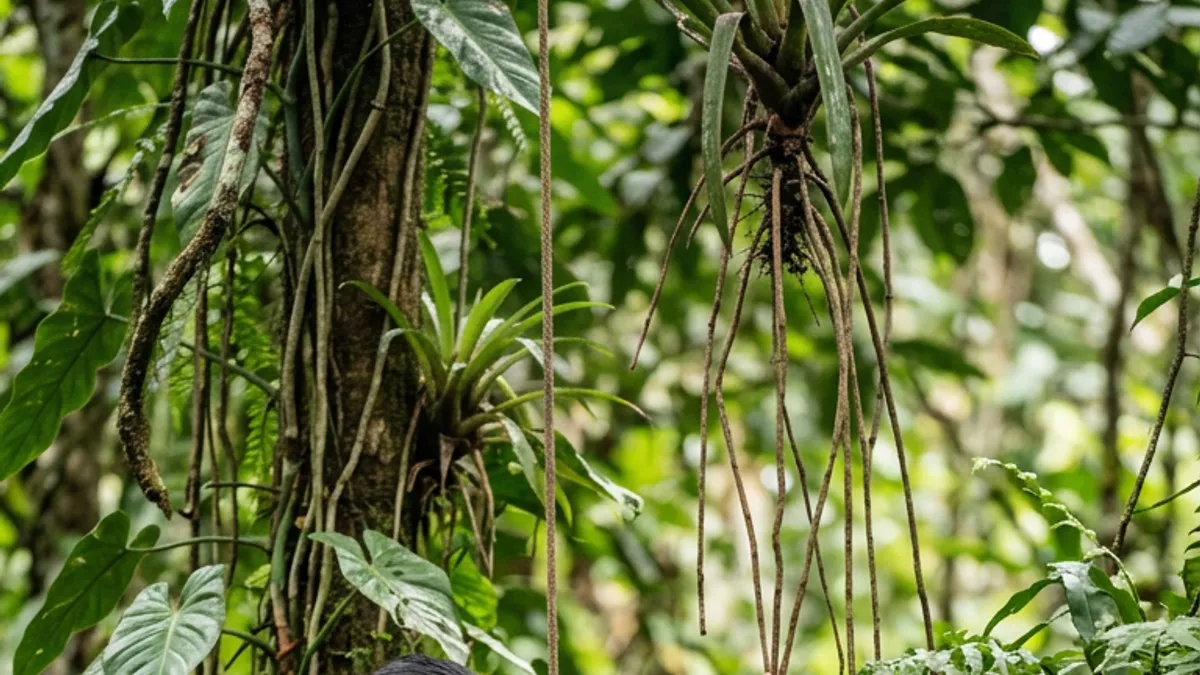
Titica vine (Heteropsis flexuosa), known in Brazil as cipó-titica, is a plant of the arum family, typical of the terra firme forest of the Amazon. What reaches basket workshops and furniture makers is not a climbing stem but the plant’s aerial roots, called strands, which hang from the treetops down to the ground. The description comes from a review published in 2012 in the journal Ambiência by researchers from the Brazilian Forest Service, the Vitória Amazônica Foundation and the National Institute for Amazonian Research (Inpa), which underpins this report along with information from Embrapa, Brazil’s agricultural research corporation.
How those roots are cut decides whether the plant survives.
A plant that starts on the ground and climbs the trees
According to the review, titica vine is a hemiepiphyte. It begins life as a seedling on the soil, looks for a host tree, called a phorophyte, and climbs the trunk with the help of thin fixing roots. As it matures, the plant’s original connection to the ground is lost, and it comes to depend on the feeder roots it sends down. When they reach the ground, those roots become thick, woody, tough and durable, and the commercially valuable fiber is in them.
The genus Heteropsis includes 17 species, restricted to tropical America, and the greatest diversity in Brazil is in the Amazon. The one most exploited for fiber is H. flexuosa, known as cipó-titica. A related species, H. jenmanii, called titicão or timbó-açu, is used mainly to make brooms. According to Embrapa, Amapá is today the main supplier of titica vine in the Amazon.
From root to basket and furniture
According to the Ambiência review, forest peoples use titica roots in furniture, basketry, fish traps and brooms, and as binding material in houses, fences and roofs. But the main purpose is to sell the fiber to other regions, where it becomes furniture. The roots appeal to that industry because the dark bark and the cortex come off easily, leaving a pale, strong and flexible fiber.
The market prefers stretches with few knots and a minimum length of about 4.9 feet (1.5 meters), and buyers tend to discard shorter strands. In studies cited in the review, roots considered commercial are at least 0.14 inch (3.5 millimeters) in diameter. Processing is generally a family activity: the knot is cut with a machete, the strand is twisted to loosen the bark, which is pulled off by hand, and the fiber is arranged in bundles. Five days after harvest, the roots lose about half of their original weight, which matters because they are sold by the kilo.
Why cutting needs rules
The review records that unmanaged exploitation reduced the availability of the resource and led to the decline, or even regional extinction, of vine plants in heavily exploited areas. At the time of publication, only the states of Amazonas and Amapá had specific rules for the activity. Amapá’s Law 631 of 2001 was the first to address the extraction, transport and sale of this type of fiber and to require an environmental license.
The numbers from the experiments help explain why. In Jaú National Park in Amazonas, a study by Durigan and Carvalho recorded 100% mortality within two months in plants that had all their roots removed, and 29.5% mortality after one year in plants that did not lose all their roots. The chances of survival rose considerably when up to 60% of the roots were left intact. In research done in Porto Grande, Amapá, no plant showed apparent damage when 25% of the mature roots were cut, but when all of them were cut, 61% of the plants died.
The state rules start from a distinction between mature strands and green strands. A mature strand is one that has already reached the forest floor, is woody and snaps when bent. A green strand has not yet attached to the soil and is tender. In both Amazonas and Amapá, green or immature strands cannot be collected, nor can those that consistently hug the trunk of the host tree.
In Amapá, resolution 013/2009 of the State Environment Council requires that one third of the mature roots be kept on each plant, sets the harvest between May and December and establishes a three-year cutting cycle. In Amazonas, Normative Instruction 01/2008 determines that no harvest be made from plants with only one mature strand, and that half of the mature strands be kept per tree when there are fewer than 20 strands, or one third when there are more than 20. The cutting cycle is also three years.
How to cut and how long to wait
The review explains that the traditional harvesting method, twisting the strand, is harmful because it can tear the plant from the tree crown and cause its death. The recommendation is to climb the host tree and, with scissors or a telescopic pruner, cut the strand near the point where the root joins the plant’s stem. Each harvested tree should be marked, preferably with a numbered plate, and information on the strands removed and those left behind should be recorded on a field sheet to allow monitoring.
The waiting time between harvests rests on the plant’s biology. In research in Amapá, regenerating roots grew an average of 6.4 feet (1.96 meters) per year, and it would take about 6.6 years for a root to reach the ground at the average height of the area’s mother plants, 42 feet (12.9 meters). The same study found that cuts made in the driest part of the year increased mortality and harmed root regeneration. Carvalho and Queiroz, in a 2010 publication cited in the review, recommend a fallow of four to five years, longer than the three-year minimum set in the rules.
What the finished object does not show
A basket or a piece of furniture made of titica vine brings together two stages that are usually looked at separately. On one side is the work of turning fiber into an object. On the other is the decision made in the forest about how many roots to take and how many to leave. The finished product may come from management that respects those limits or from a harvest that killed the plant, and the difference does not show in the finished piece.
That is why licensing, tree marking and harvest records weigh as much as the skill of the person working the fiber.
Reporting: Natália Santos / Amazonia Mag

Editor · Amazonia Mag
Anne Silva is the editor of Amazonia Mag, the English-language edition of Revista Amazônia. She curates, translates and adapts the outlet's science and environment coverage for an international audience, reporting on Amazon wildlife, flora, rivers, climate and research. Every story she edits is grounded in peer-reviewed studies, official data and on-the-ground reporting from the Revista Amazônia newsroom in Belém, Pará, Brazil. More by Anne Silva →