
In a tropical rainforest such as the Amazon, the ear often reaches farther than the eye. Beneath the canopy, where light barely filters through and dense vegetation blocks almost every line of sight, thousands of species call at the same time, producing one of the most complex natural choruses on Earth. Research gathered by specialists shows that bioacoustics, the science that combines biology and acoustics to study animal communication, has become one of the most powerful tools available for decoding that wall of sound. This is no longer an academic curiosity: the technology allows researchers to detect the presence of cryptic, rare or nocturnal species and to follow their behaviour without ever having to see them.
What bioacoustics actually is
Bioacoustics studies how living organisms produce, transmit and perceive sound. Applied to conservation, it rests on a simple and powerful premise: almost every animal living in a rainforest emits acoustic signals to defend territory, attract a mate, coordinate a group or warn of danger. Each species carries its own sonic signature, a pattern of frequency, duration and rhythm that works like an audible fingerprint. If a scientific team manages to record that signature and recognise it later, it can confirm the animal was there even though nobody ever laid eyes on it.
That distinction matters enormously in the Amazon. Many rainforest animals are nocturnal, live high in the canopy, camouflage themselves with remarkable success or simply flee long before a researcher gets close enough. Traditional methods based on sightings, traps or walking transects leave out a very large share of that fauna. Sound, by contrast, travels through vegetation, does not depend on daylight and does not require a human observer to be present at all times.
Recorders that listen for months
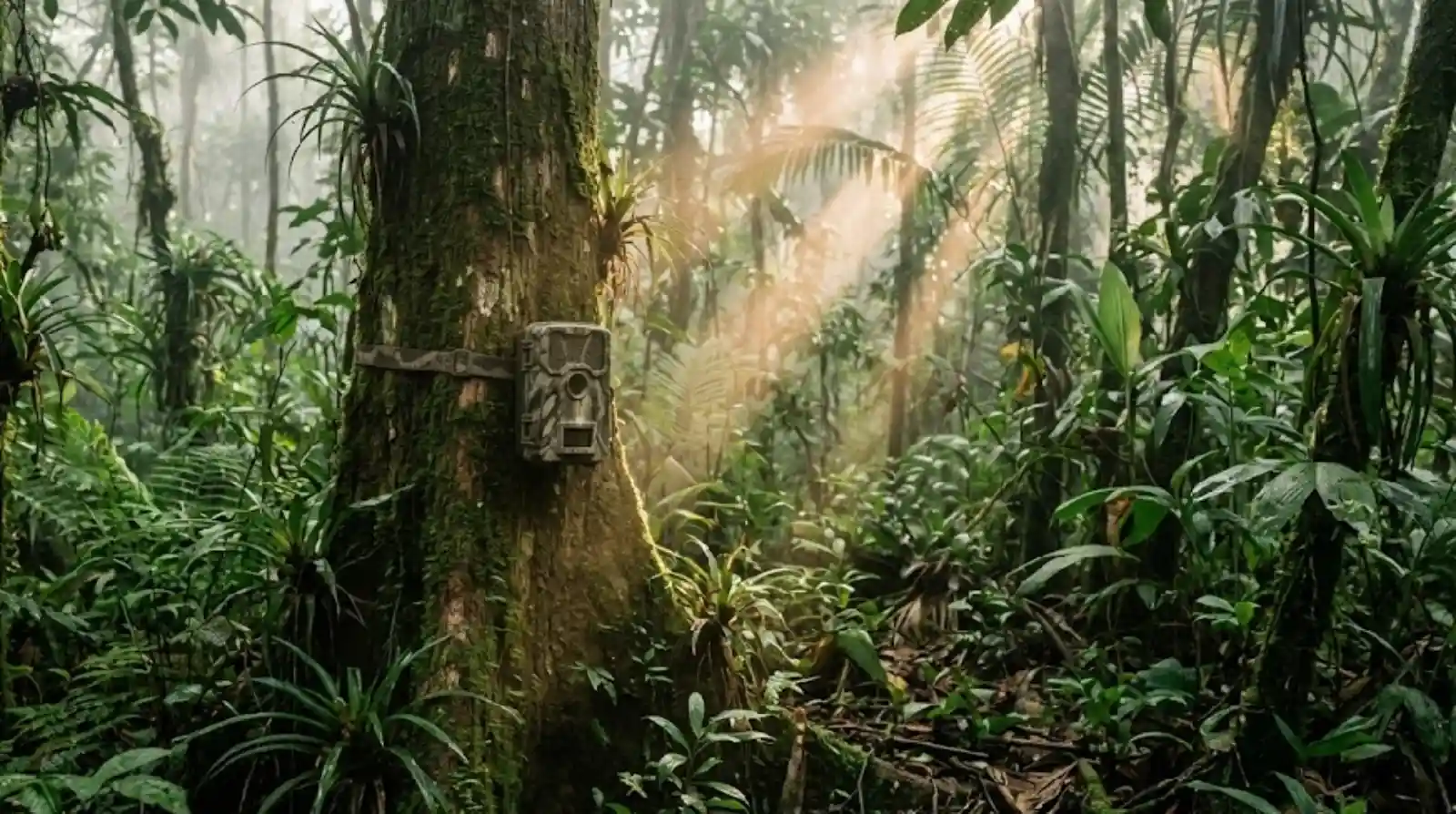
The method behind this shift is called passive acoustic monitoring. It involves installing autonomous field recorders, rugged and programmable devices, at strategic points in the forest, then leaving them to capture the surrounding soundscape for weeks or even months. The units run day and night, in rain or sunshine, without anyone having to return to the site. The word passive captures both the ethical and the methodological advantage of the system: nothing is captured, tagged or disturbed. The forest simply carries on and the device listens.
Amazonian research institutions already use this methodology to build extensive libraries of forest sound. The Instituto Nacional de Pesquisas da Amazônia, known as INPA, is one of the reference centres applying these recordings across Brazilian territory. Every archived file serves two purposes at once: it documents the present and it creates a baseline for the future, for the moment when scientists want to know whether a specific stretch of forest still sounds the way it used to.
The hard part is not recording, it is listening
Capturing audio is the easy step. Analysing it is the bottleneck. A single recorder can generate terabytes of sound, a volume that no team could ever review ear by ear. One person working full time would need years to go through what a handful of devices produces in a single field season. That is why modern bioacoustics is inseparable from computing: automated recognition algorithms and artificial intelligence are trained to scan those recordings and pick out the specific acoustic signatures of each species, separating the signal from rain, wind and background noise.
Those systems are only as good as the reference material behind them. Training a model to recognise a species requires verified recordings of that species, checked by researchers who know the animal well. Building and curating those reference libraries is slow, painstaking work, and it is one of the reasons why collaboration between field biologists and data specialists has become central to the discipline.
The reward is a change of scale. What used to be a list of scattered sightings becomes a continuous stream of data, stamped with time, date and location, capable of showing which hour of the day each group sings, how populations shift between seasons and what happens to an area after a disturbance.
Biophony, geophony and anthropophony
Bioacoustics also introduced the idea of the acoustic landscape, known internationally as the soundscape. Scientists analyse not only the individual sounds made by animals, known as biophony, but also geophysical sounds, or geophony, such as rain and wind, and sounds of human origin, or anthropophony, such as the noise of roads and aircraft. The complexity and the temporal organisation of those soundscapes work as a direct indicator of how intact an ecosystem is.
Healthy forests have rich, structured soundscapes in which different species occupy specific acoustic niches so as not to interfere with one another: some call at dawn, others at dusk, some in low frequencies and others in high ones. Degraded environments, by contrast, tend to show silences or a dominance of human noise. Reading that structure allows researchers to assess the health of a forest without felling, measuring or capturing anything.
Large scale conservation and real time enforcement
The practical advantages are considerable. Passive acoustic monitoring makes surveillance viable in remote areas that are hard to reach, where a traditional expedition would be logistically impossible or extremely expensive. It can detect the presence of threatened species and, above all, track how an ecosystem evolves over time. Changes in the composition or in the intensity of the forest chorus can flag the impact of human activity, including deforestation, hunting and the effects of climate change.
There is also a direct enforcement use. The same recorders can pick up sounds that do not belong in a forest, such as chainsaws or gunshots, and detect them in real time, delivering critical data to environmental authorities. Listening stops being purely a scientific exercise and becomes a tool for protecting territory.
A symphony that must not fall silent
The future of conservation depends more and more on this fusion of ecology and technology. Bioacoustics is not only about counting species: it is about hearing the stories the forest has to tell. It teaches that protecting biodiversity is not only a matter of what we see, but also of what we hear, a vital symphony whose loss would be irreparable for humanity and for the planet.
Paying attention to the subtlest sounds of the forest makes one thing clear: technology, used wisely, can be the bridge that brings us back to nature, and every call and every song is part of a fragile balance we have a duty to preserve. In its 25 years of history, Revista Amazônia celebrates these digital ears that help protect what we still do not fully know.
Reporting: Anne Silva / Amazonia Mag. Source: Revista Amazônia.

Editor · Amazonia Mag
Anne Silva is the editor of Amazonia Mag, the English-language edition of Revista Amazônia. She curates, translates and adapts the outlet's science and environment coverage for an international audience, reporting on Amazon wildlife, flora, rivers, climate and research. Every story she edits is grounded in peer-reviewed studies, official data and on-the-ground reporting from the Revista Amazônia newsroom in Belém, Pará, Brazil. More by Anne Silva →