
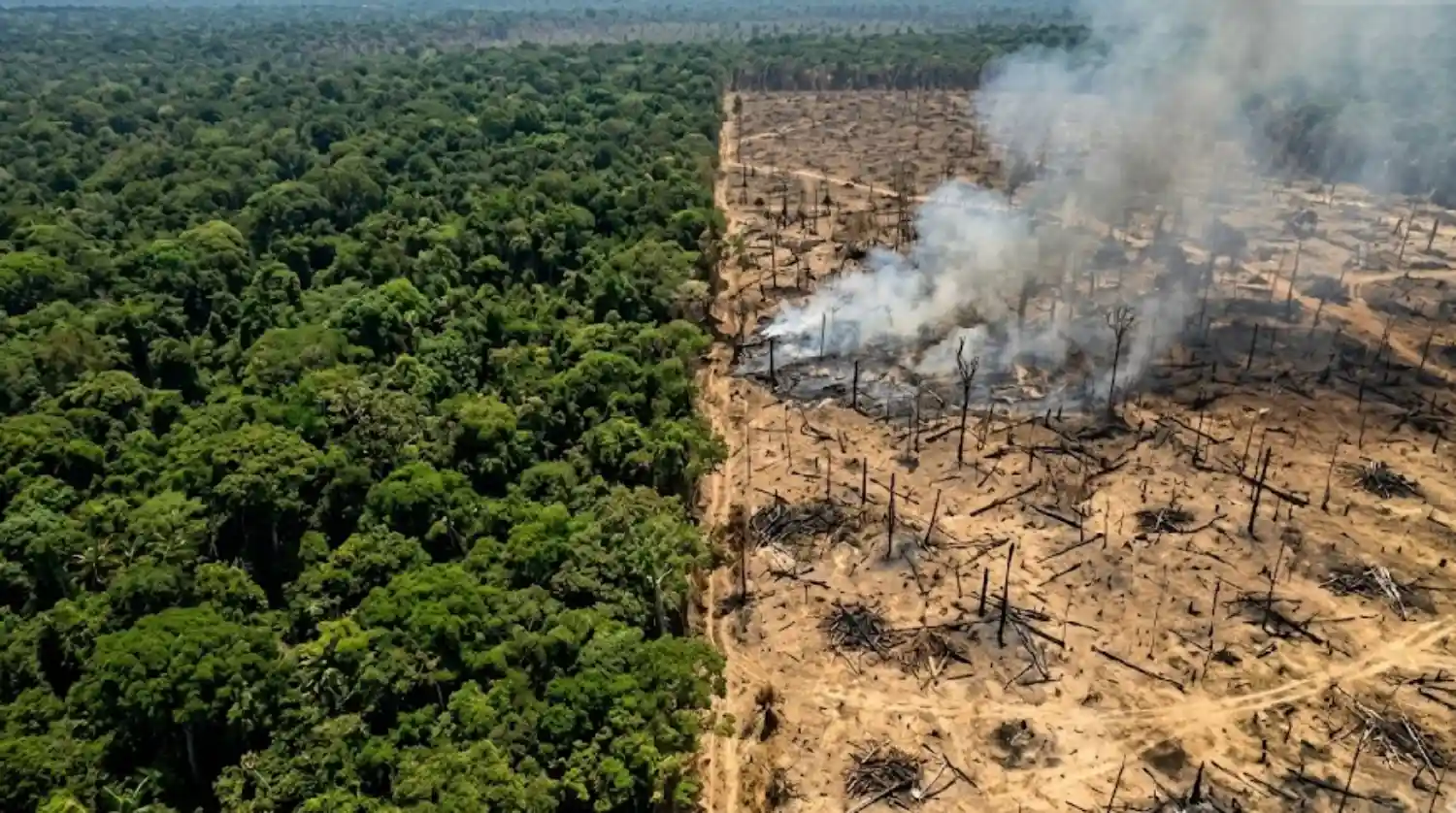
For decades the Amazon was described as the “lungs of the world”, a simple metaphor for something science had already measured with precision: a healthy, humid tropical forest works as a planetary carbon sink, pulling gigatonnes of CO2 out of the atmosphere through photosynthesis. That service, delivered quietly and free of charge, propped up a large share of global climate stability for generations. Recent scientific research, however, points to an unsettling shift. Parts of the Amazon, particularly in the southeast, are already emitting more carbon than they manage to absorb. The forest is still standing. What has changed is which side of the ledger it sits on.
A carbon sink that flipped
Turning from a sink into a source is not an accounting footnote. It is an inflection point. Studies tie the shift to two processes that travel together: outright deforestation and forest degradation. When a tree is felled, or dies under extreme climate conditions, the carbon it locked away over decades goes back into the air. That part is intuitive enough. The genuinely worrying finding is different: even stretches of forest that remain standing, green and apparently intact, are losing their capacity to take up CO2.
The researchers who analysed carbon exchange across the region reached a conclusion that forces a different reading of the map. In areas where deforestation passed a certain threshold, the forest loses its climate resilience. Vegetation dries out, tree mortality climbs, and the decomposition of organic matter in the soil speeds up. Everything pushes in the same direction, toward more emissions. And almost none of it is visible. There is no smoke, no black column on the horizon, no photograph that reads instantly as disaster. It is a silent collapse with global consequences.
Extreme drought and the erosion of resilience
Extreme drought sits at the centre of this story. The Amazon depends on a complex hydrological cycle in which the trees themselves recycle moisture through evapotranspiration and, quite literally, manufacture their own rainfall. Every leaf is part of that machinery. Studies show that deforestation fragments the cycle: the less forest remains, the less moisture circulates, and the forest that is left becomes more exposed to prolonged dry spells. That vulnerability is not spread evenly either. It concentrates along the edges and in the regions hit hardest by the advance of the agricultural frontier.
Rising global temperatures intensify those droughts. When the forest is water stressed, it throttles back photosynthesis to conserve resources, and absorbs less CO2 as a result. Mortality and decomposition, meanwhile, carry on regardless, so the balance ends up positive on the wrong side of the equation: more emissions than uptake. Researchers describe a positive feedback loop in which drought drives mortality, mortality drives emissions, emissions drive further warming, and warming drives fresh drought. Turn that mechanism enough times, they warn, and the Amazon could be pushed toward a point of no return, with large stretches of forest converting into a kind of degraded savanna.
The tipping point, in numbers
The reversal of the Amazon’s role in the carbon cycle works as an early warning that the forest is approaching its tipping point. Scientists estimate that if deforestation reaches somewhere between 20% and 25% of the total forest area, the hydrological cycle could collapse irreversibly. More than 17% of the Amazon has already been cleared, and forest degradation affects an even wider area on top of that. The distance between where the region stands today and the estimated threshold is narrow, and nothing guarantees it will hold.
It is worth being precise about what that number means, because the nuance matters. This is not a switch that flips on a fixed date, nor a prophecy of total destruction. It is an estimated threshold, carrying real scientific uncertainty, beyond which the system would lose the ability to regenerate on its own. Neither denying the risk nor inflating it helps anyone understand the problem. What the evidence supports is narrower and harder: the margin is real, it is measurable, and it is shrinking.
The consequences of an Amazonian collapse would be global. Releasing the gigatonnes of carbon stored in the forest would significantly accelerate planetary warming and make it nearly impossible to hold the temperature rise to levels considered safe. Beyond that, losing the Amazon would rearrange rainfall regimes across the whole of South America, with direct effects on agriculture and water supply in countries that do not even think of themselves as Amazonian.
The hidden cost of degradation
One part of the problem escapes the most quoted statistics. Forest degradation, caused by illegal logging and low intensity fires, often goes unnoticed by monitoring satellites. Unlike full clearance, degradation leaves the forest standing but in precarious condition: an opened canopy, soil exposed to direct sun, weakened trees. Academic studies indicate that degraded areas can emit as much carbon as fully deforested land, or more, because of high tree mortality and the burning of biomass.
Those silent emissions are a crucial and frequently underestimated component of the Amazon’s carbon footprint. Recognising and confronting degradation is therefore a precondition for any conservation or climate mitigation strategy to actually work in the region. Counting only the hectares that were cleared outright leaves a substantial share of the bill off the page.
What acting in time would look like
Against that backdrop, protecting the Amazon has stopped being purely a biodiversity agenda and become a strategic requirement for global climate stability. Studies point to two measures as fundamental for reversing the emissions trend and restoring the forest’s resilience: restoring degraded areas and reaching zero deforestation. The two are complementary rather than interchangeable. One stops the bleeding, the other repairs what was already lost.
Brazil, as guardian of most of the biome, carries a decisive responsibility. Consistent public policy, enforcement against illegal deforestation and support for sustainable development models all appear as essential pieces of any serious response. But the challenge crosses borders and demands collaboration between governments, companies and civil society, inside Brazil and well beyond it. Protecting the Amazon also means protecting the intellectual capital accumulated over millennia along the banks of Amazonian rivers.
There is a version of this story that reads as fatalism, and it would be the wrong one. The science does not say the forest is finished. It says a threshold exists, that the region is closer to it than it was, and that the drivers pushing it there are known, measurable and, in principle, reversible by human decision. That is precisely what makes the window meaningful. The time to act is now, before the silent collapse becomes irreversible.
Reporting: Anne Silva / Amazonia Mag. Source: scientific research on the Amazon carbon cycle, with monitoring data from Brazil’s National Institute for Space Research (INPE) and the Observatório do Clima.

Editor · Amazonia Mag
Anne Silva is the editor of Amazonia Mag, the English-language edition of Revista Amazônia. She curates, translates and adapts the outlet's science and environment coverage for an international audience, reporting on Amazon wildlife, flora, rivers, climate and research. Every story she edits is grounded in peer-reviewed studies, official data and on-the-ground reporting from the Revista Amazônia newsroom in Belém, Pará, Brazil. More by Anne Silva →