
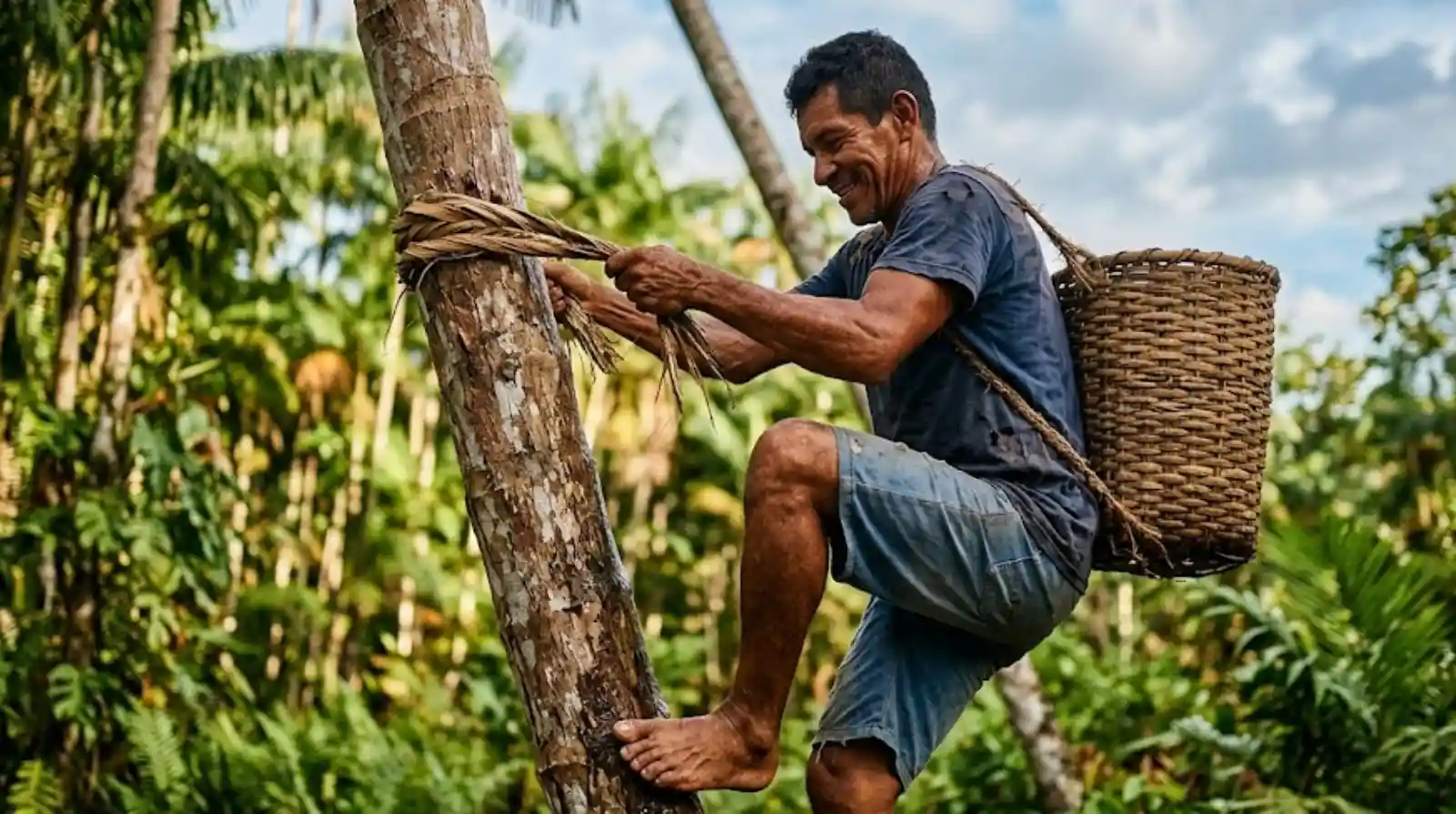
On Labour Day, tributes tend to gather around city jobs. Deep in the Amazon, though, a group of workers holds up one of the region’s most profitable supply chains by climbing to the top of a palm tree every morning. They are the peconheiros, the men who harvest açaí by scaling trunks that can reach 20 metres in height. They use no scaffolding and no safety harness. They go up with their bodies, often barefoot for grip, helped by a single piece of equipment: a length of rope or braided straw known as a peconha. That climb sustains thousands of riverside families and feeds a market that is now global.
What a peconha is
The word peconha names the object that gives the job its title. It is a short rope, sometimes a braided plant fibre, that the worker sets around the trunk of the palm to recover the grip that the smooth bark denies him. The peconha does two things at once: it holds, and it pushes, because the worker slides it upward and uses the tension to lift himself another stretch. Whoever climbs with a peconha is a peconheiro. It is important to be precise about what it is not. The peconha is not fall protection. It does not stop a fall, it only makes the climb possible. The technique is ancestral, handed down from one generation to the next, and it demands strength, agility and balance built over years of practice.
The technique and the daily shift
Harvesting açaí requires deep knowledge of the forest and of the biology of the Euterpe oleracea palm. The peconheiro starts climbing early, while the sun is still low. He fixes the peconha to the trunk and, with coordinated, rhythmic movements, drives himself upward, resetting the rope with every metre gained. At the crown he holds on to the palm with one hand while the other cuts the açaí bunch loose with a terçado, the working machete of the region. The bunch goes into a paneiro, the straw basket he carries on his back. Then he comes down and starts again on the next palm. The routine repeats dozens of times across a single morning, and the load on his back grows heavier with each tree.
The risk is constant, and it is not a figure of speech. The palm can snap during the climb. The worker can lose his balance and fall from a height that can be fatal. On top of that comes the encounter with venomous animals, snakes and spiders that live in the crowns and turn up exactly where a hand reaches for support. There is no net, no harness and, in most cases, nobody on the ground trained to respond to an accident. Every shift is a test of physical endurance carried out without a single one of the protections that would be mandatory for any work at height outside the forest.
The first link in a billion-real economy
Açaí, known as the purple gold of the Amazon, has become a global product, with rising demand in both domestic and international markets. That bioeconomy is the main source of income for thousands of riverside families and small producers across the state of Pará, the largest producer of the fruit. According to figures from the State Secretariat of Agricultural Development and Fisheries (SEDAP), açaí production generates billions in revenue for the state, drives the local economy and creates direct and indirect jobs. The peconheiro’s work is the first link in that chain, the foundation the whole industry rests on. Without the climb there is no pulp, no export and no açaí bowl in any shop window anywhere in the world.
Working conditions and rights still owed
Despite that central position, working conditions are frequently precarious. Adequate safety equipment is missing, and so is formal training in how to handle the palms safely, which raises the chance of accidents. Informality is another structural problem. It restricts access to social benefits and labour rights, and it leaves the worker uncovered in precisely the activity where a fall can cut off a family’s income overnight. The answer lies in investment in training programmes and in safety technology that lowers the probability of falls and other accidents, rather than in relying on the individual skill of each peconheiro to keep him alive on the way up.
There is also a route that runs straight through the consumer. Promoting certification and recognition for açaí produced sustainably and fairly allows the buyer to know that the fruit respects the rights and the dignity of the person who picked it. Recognising the peconheiro as an essential worker, and not as a picturesque detail of the Amazon landscape, is a concrete step toward a fairer and more prosperous region, one where the wealth generated by açaí is shared more evenly with the communities that keep the forest standing.
Sustainable management and the future of the harvest
Açaí picking is a traditional activity that can and should be carried out sustainably, protecting the forest and keeping the bioeconomy alive for future generations. Correct management of the açaí groves, avoiding deforestation and encouraging the regeneration of degraded areas, is the basis of that sustainability. Valuing the traditional knowledge of the peconheiros and supporting local communities are pillars of any model of use that respects the limits of the ecosystem. With investment in science, technology and sound public policy it is possible to build a scenario in which the worker is protected and the harvest remains a source of livelihood for the region rather than a source of injury.
A fruit that is also identity
Açaí is not only food. It is a symbol of Amazonian cultural identity, present in the cuisine, in the music, in the literature and in local traditions. In Belém, eating it is a daily ritual, served with fried fish, tapioca flour or dried shrimp, a meal that gathers families and strengthens community ties. Behind every plate there is a 20 metre climb made by someone whose name almost never appears on the label, and whose working day began before the sun was high enough to reach the canopy.
The story of the peconheiro is a legacy of resilience and knowledge passed from one generation to the next. These workers are the keepers of an expertise that lets them live off the forest without destroying it. In faces marked by the sun and in calloused hands you can read the determination of a people who refuse to be forgotten. Celebrating the peconheiros on Labour Day means demanding for them what is demanded for any other worker at height: safety, training, rights, and a fair share of the wealth their work produces.
Reporting: Anne Silva / Amazonia Mag. Source: Revista Amazônia; Pará State Secretariat of Agricultural Development and Fisheries (SEDAP).

Editor · Amazonia Mag
Anne Silva is the editor of Amazonia Mag, the English-language edition of Revista Amazônia. She curates, translates and adapts the outlet's science and environment coverage for an international audience, reporting on Amazon wildlife, flora, rivers, climate and research. Every story she edits is grounded in peer-reviewed studies, official data and on-the-ground reporting from the Revista Amazônia newsroom in Belém, Pará, Brazil. More by Anne Silva →