
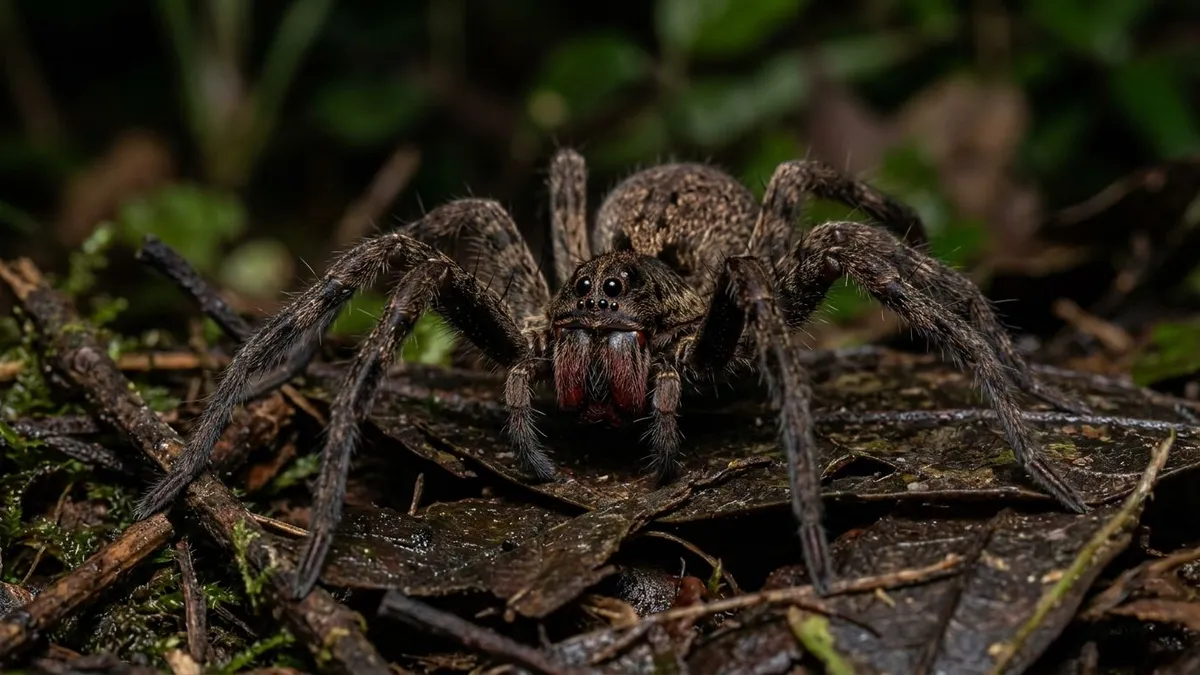
The Brazilian wandering spider, the armadeira in Portuguese and a member of the genus Phoneutria, does not use a web to catch its prey. It moves actively through the leaf litter at night in search of food. When it meets a possible predator or threat on the forest floor, it reacts at once. It raises its front legs, rests its weight on the rear pairs and shows its chelicerae, the structures that carry the fangs, in a bright reddish color.
This warning posture comes before the injection of a neurotoxic venom, considered one of the most potent among the arachnids of the Americas. The animal combines a visual signal with a chemical weapon of high complexity. The strategy reduces needless confrontations and saves venom for moments of hunting or extreme defense.
The mechanics of the defensive rise
Rearing up is a highly coordinated neuromuscular response that changes the center of gravity of the spider. By lifting the front part of the body and stretching the first two pairs of legs upward, the spider looks larger to its opponent. The rear legs carry the pressure of the body weight against the ground, which keeps the animal stable and ready to move quickly if the first warning is ignored.
This synchronized movement exposes the underside of the animal and places the chelicerae at a threatening angle toward the target. Unlike web-building spiders, which rely on silk to handle their prey, the wandering spider depends on the strength of its legs to keep its balance. The display works as a clear limit set before any direct fight.
Red chelicerae as a warning color
The intense red on the chelicerae acts as a clear warning signal, known in biology as aposematism, in a nocturnal and twilight setting. The pattern contrasts with the brown and gray tones of the rest of the body, which keeps it visible even in the dim light of the leaf litter. When the spider spreads its chelicerae during the threat posture, it reveals a striking color that signals danger to would-be attackers such as mammals and birds.
Visual warning is a defensive tool that cuts down on harmful physical contact for both sides. Small mammals and birds with color vision can read the reddish contrast as a sign of danger and tend to back away. This communication spares the spider from wear and tear and from spending venom in encounters that are not about hunting, which makes the visual warning its first line of defense in the undergrowth.
How the venom acts on the nervous system
The venom injected through the chelicerae is a complex mixture of peptides and neurotoxins that act on the sodium channels of the nervous system of vertebrates. By disturbing the transmission of nerve impulses, the venom depolarizes cell membranes and triggers a massive release of neurotransmitters such as acetylcholine and noradrenaline. This chemical flood causes immediate intense pain and involuntary muscle contractions at the site of the bite.
In people, the systemic action of the neurotoxins affects the autonomic nervous system and produces specific symptoms such as heavy sweating, salivation and changes in blood pressure. Priapism can also occur in male patients, caused by the uncontrolled release of nitric oxide and neurotransmitters in the cavernous tissue. In evolutionary terms, the venom is built to paralyze invertebrate prey quickly, so that the spider can subdue larger prey without being hurt.
Active hunting without a web
Unlike most spiders, which wait for prey caught in silk structures, the genus Phoneutria hunts actively and wanders at night. The spider walks directly over the dry leaves that cover the forest floor and uses highly specialized sensory hairs on its legs to detect tiny vibrations and chemical changes in its surroundings. This sense of touch lets it notice crickets, cockroaches and small vertebrates approaching from a distance.
Without a fixed web, the wandering spider has to be extremely agile in the final approach and the strike. Once it locates prey on the ground, it rushes forward without any silk to hold the target, using its legs to immobilize the animal while it injects the venom with precision. This roaming way of life means the spider looks for temporary shelter during the day, often hiding under fallen logs, dense foliage and holes in the wood.
Ecological role and life near people
The wandering spider plays an important role in controlling populations of insects and small vertebrates in the terrestrial ecosystem. As a top predator in the microfauna of the leaf litter, it helps regulate the density of herbivorous and detritus-feeding insects, which keeps the soil in balance and prevents population explosions of opportunistic species. Its predation is part of a complex food web in the Atlantic Forest and the Amazon.
From an epidemiological point of view, the ability of the wandering spider to live in altered environments brings the species close to human settlements near forested areas. The search for dark and humid shelter leads the spider into shoes, rubble and cracks in houses, which raises the rate of encounters with people. Knowing its warning behavior and its night habits is essential to cut down on bites and to allow safe coexistence with native wildlife.
The union of a bold visual signal and a neurotoxic venom in the wandering spider shows how sophisticated the adaptations are that evolved for survival on the floor of Brazilian forests. Far from being an unprovoked attack, the threat posture is a mechanism of ecological communication designed to avoid direct conflict and to save vital biological resources. Preserving these predators supports the stability of forest microecosystems and underlines the value of understanding wildlife.
Reporting: Natália Santos / Amazonia Mag

Editor · Amazonia Mag
Anne Silva is the editor of Amazonia Mag, the English-language edition of Revista Amazônia. She curates, translates and adapts the outlet's science and environment coverage for an international audience, reporting on Amazon wildlife, flora, rivers, climate and research. Every story she edits is grounded in peer-reviewed studies, official data and on-the-ground reporting from the Revista Amazônia newsroom in Belém, Pará, Brazil. More by Anne Silva →