
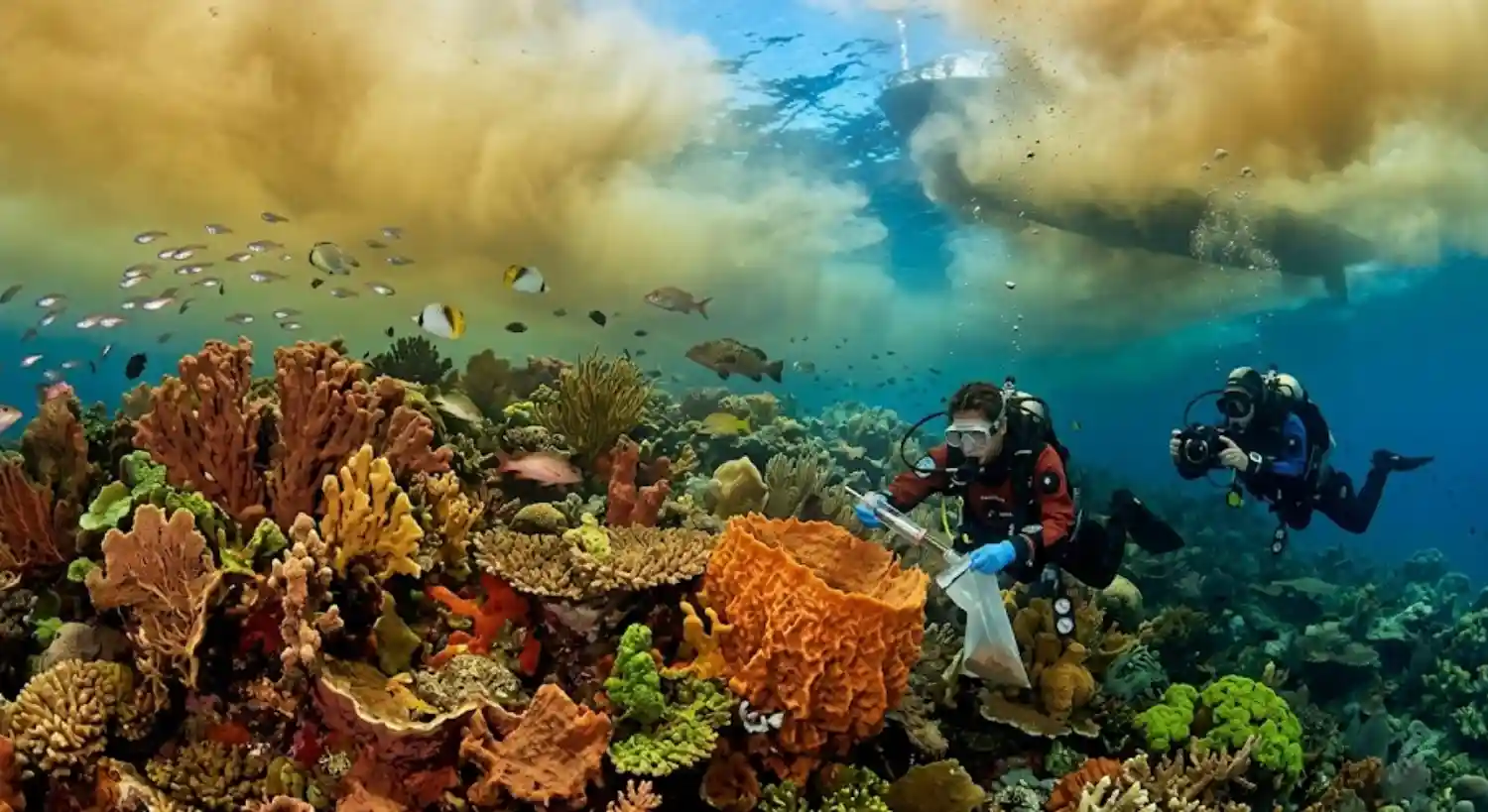
For decades, textbook oceanography held a rule that looked unbreakable: coral reefs cannot grow beneath the Amazon plume. Then scientists found one. At the mouth of the largest river on the planet, researchers confirmed an extensive reef system stretching across more than 9,500 square kilometres, sitting exactly where the ocean receives the greatest freshwater flow on Earth. It is one of the most disruptive findings in marine science of the past decade, and the reason it startled specialists says as much about our assumptions as it does about the reef itself.
Everything researchers thought they knew about reef building pointed the other way. Corals are classically associated with clear, warm, salty and well lit water, because reef systems in the tropics are built around photosynthesis. That is the image of a reef most people carry: the shallow, transparent gardens of the Caribbean. Under those rules, the waters off the mouth of the Amazon were disqualified before anyone went looking.
The reason is the Amazon plume, a vast layer of turbid, sediment loaded water that blocks sunlight and alters the salinity of the sea for hundreds of kilometres offshore. Classical oceanography treated the area as a biological desert precisely because of that turbidity. What was eventually mapped there is the opposite of a desert: a corridor of marine life adapted to low light and to an extremely variable water chemistry, thriving in conditions that had been considered impossible.
The biology of living in the dark
Unlike the shallow, crystalline reefs of the Caribbean, the Amazonian corals are predominantly mesophotic, sitting at depths between 30 and 120 metres. Sunlight there is scarce, particularly in the months when the river’s sediment discharge is most intense. Photosynthesis, the engine of a conventional tropical reef, stops being the main source of energy.
According to marine biology studies, these organisms compensate through chemosynthesis and a diet rich in organic particles carried by the river itself. The same flow that takes their light delivers their food. The plume, which ought to be a death sentence, doubles as a pantry.
The reef structure is a singular mix of corals, giant sponges and calcareous algae. The sponges in particular show vivid colours ranging from intense orange to deep purple, and they anchor a complex food chain. Research describes the whole system as an oasis of biodiversity: shelter, nursery and feeding ground for dozens of species of fish, lobsters and starfish that nobody expected to find at that latitude.
The paradox of the plume
The Amazon plume is a force of nature, pouring roughly 200,000 cubic metres of fresh water into the Atlantic Ocean every second. That water carries nutrients that fertilise the ocean, and at the same time raises a physical barrier to the light traditional corals require. The result is a system that is not static: it rearranges itself as the plume moves.
In the areas most affected by river mud, sponges dominate, because they do not depend on light. Along the edges, where clear salt water pushes in, true corals appear. That shifting mosaic reveals a striking ecological plasticity. The reef does not so much resist the plume as negotiate with it.
A corridor between the Caribbean and Brazil
Oceanographic research suggests the Great Amazon Reef may work as a biological corridor linking the reefs of the Caribbean to the reefs of the Brazilian coast. That connection matters for the genetic variability of Atlantic marine species: it allows fish and coral larvae to travel thousands of kilometres, underpinning the resilience of the oceans in the face of global climate change. A reef that was absent from the maps until recently may in practice be a structural piece of the tropical Atlantic.
Oil at the edge of the discovery
Despite its newly recognised ecological importance, the Amazonian reef faces an immediate and existential threat: oil and gas exploration in the Foz do Amazonas basin. The region is viewed as a new energy frontier, and several companies have applied for drilling licences in areas very close to, or overlapping with, the confirmed reefs. Specialists consider the risk of a spill there catastrophic, because the marine currents at the mouth of the Amazon are extremely strong and unpredictable, which would hamper any containment attempt.
Beyond the oil itself, drilling activity generates drilling mud and residues capable of burying the delicate structures of sponges and corals. Environmental activists and scientists argue that the precautionary principle should apply, and defend the creation of exclusion zones for the fossil fuel industry until the entire ecosystem is properly mapped. Their case rests on a concrete number: less than 5% of the reef has been explored in detail, and endemic species still unknown to science are likely to be there.
A living laboratory for the climate crisis
Amazonian corals already live in water that is naturally more acidic and lower in oxygen than the open ocean, because of the organic matter delivered by the river. That turns them into a living laboratory for understanding how the corals of the future may react to ocean acidification driven by excess CO2 in the atmosphere. If these organisms can already build calcareous skeletons under acidic conditions today, they may hold genetic clues to the survival of reefs elsewhere in the world.
Global warming still reaches them. Rising water temperatures can trigger coral bleaching, the process in which corals expel the symbiotic algae that give them colour and nutrition. Mesophotic reefs are better protected from surface heat, but shifting current patterns can drive warmer water into the depths and destabilise a system that took millennia to settle beneath the river mouth.
Brazilian science and the fishermen who knew first
Studying these reefs is also a matter of scientific sovereignty. Large Brazilian expeditions, using research vessels and remotely operated vehicles (ROVs), have led the discoveries. Documenting the system is essential if Brazil is to argue for the protection of these waters in international biodiversity forums, and it places the country at the forefront of deep water biology.
Local knowledge came first, though. Fishermen in Amapá and Pará already knew about the pedrais, the spots where their nets snagged on solid structures on the seabed. What academic research added was the scale and the biological nature of those areas. Valuing this submerged heritage is part of protecting the Amazon in all its dimensions, from the forest canopy to the depths of the ocean.
What is at stake
The reefs at the mouth of the Amazon show that life is far more persistent and adaptable than science had predicted. They are proof that unknown frontiers still exist, close to shore, capable of changing how we read the planet. Protecting them is not only about corals and fish: it is about keeping alive the capacity for discovery and the climate balance of one of the richest regions on Earth. The open question is whether the immediate economic value of oil outweighs the incalculable value of a unique ecosystem that may hold a key to the future of the oceans.
Reporting: Anne Silva / Amazonia Mag. Source: Revista Amazônia · Greenpeace Brasil, Defenda os Corais da Amazônia campaign · Portal de Geologia e Geofísica Marinha, Brazilian Navy.

Editor · Amazonia Mag
Anne Silva is the editor of Amazonia Mag, the English-language edition of Revista Amazônia. She curates, translates and adapts the outlet's science and environment coverage for an international audience, reporting on Amazon wildlife, flora, rivers, climate and research. Every story she edits is grounded in peer-reviewed studies, official data and on-the-ground reporting from the Revista Amazônia newsroom in Belém, Pará, Brazil. More by Anne Silva →