
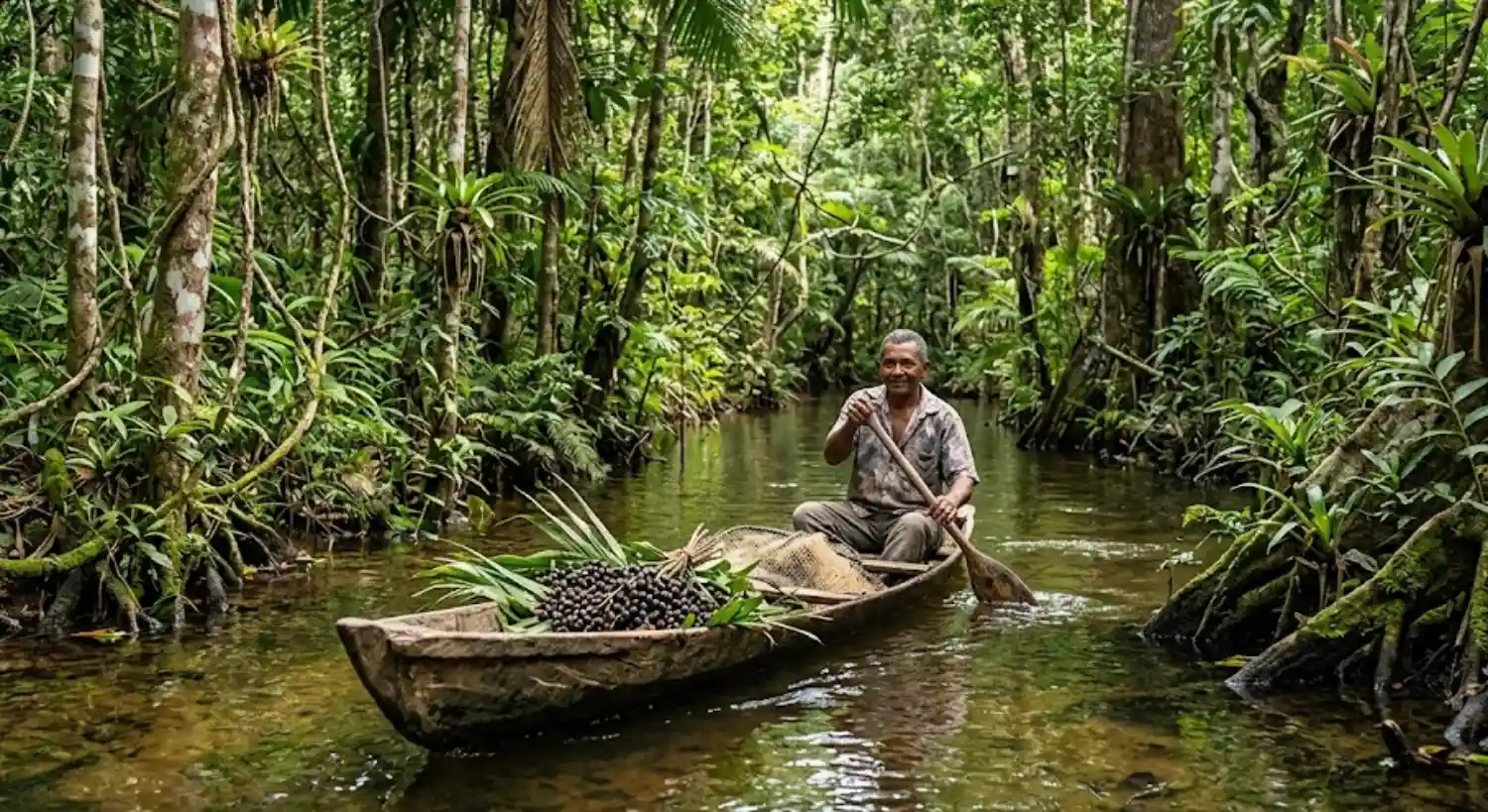
There is a category of land in the Brazilian Amazon that does not fit either of the two boxes outsiders usually reach for. It is not private property where an owner decides what to clear, and it is not a fenced park where human presence counts as a problem. It is called an extractive reserve, or RESEX in its Portuguese abbreviation, and in the state of Para that legal arrangement supports whole communities who make a living gathering, fishing and managing what the forest yields without cutting it down.
What an extractive reserve actually is
An extractive reserve is a protected area in the sustainable use category of Brazilian conservation law. The State remains the formal owner of the land, but the families already living there receive a legal instrument known as the Concession of Real Right of Use, abbreviated in Portuguese as CDRU. With that document in hand, the territory cannot be sold or carved up for agribusiness or for predatory logging. Day to day management sits with the Chico Mendes Institute for Biodiversity Conservation, the federal agency known as ICMBio, working alongside local community associations.
The model was not drafted in a ministry office. It grew out of an organised demand by Amazonian forest workers for a different kind of land reform: instead of individual plots for intensive farming, collective tenure for the sustainable use of standing forest. Brazil turned that demand into a legal category, and Para became one of the states where the largest and most productive of these reserves were consolidated.
The contrast with a national park matters. Where a park restricts human occupation, a RESEX assumes the opposite: the river dwellers, seed collectors and fishing families are the ones guarding the area, because their livelihood depends on it staying intact. Socio-environmental research shows these reserves record significantly lower deforestation rates than private holdings and than public land with no designated purpose. In practice the arrangement works as a legal and cultural belt against the advancing agricultural frontier.
What the forest sends to market
The economy inside these reserves has a technical name in Brazil: the socio-biodiversity economy. In Para the leading products are acai (Euterpe oleracea), the Brazil nut (Bertholletia excelsa), rubber, and seed oils such as andiroba (Carapa guianensis) and copaiba (Copaifera). All of them follow natural biological cycles, which means harvesting does not exhaust the species and the forest keeps working as a carbon sink.
Native acai management in the floodplain reserves shows the logic well. Harvesters carry out what is called ralamento, a selective thinning of the palm clumps, and plant enrichment seedlings to raise yield without removing the surrounding trees. The result matters commercially too. Field research indicates that acai produced inside extractive reserves commands higher added value on the international market, because it reaches the buyer labelled as free of deforestation and of labour exploitation.
The lake agreements
The second productive pillar is managed fishing, above all of pirarucu (Arapaima gigas) and tambaqui (Colossoma macropomum). In areas such as the Tapajos-Arapiuns reserve, communities sign fishing agreements that sort every lake into three categories: use, maintenance or preservation. The rotation lets fish stocks rebuild on their own and secures the food supply of local families without anyone having to police each canoe.
Where pirarucu management was introduced in the floodplain lakes of Para, monitored populations of the fish grew exponentially. That biological success converts into cash: sales of meat and hide generate revenue that associations reinvest in community infrastructure such as schools and health posts. The fisher stops being an opportunistic hunter and becomes an environmental manager, pairing traditional knowledge with modern biology to read the health of the river.
Who holds the chain together
One under-reported feature of the model is how much of it rests on women. They largely lead the production of essential oils, the craftwork, and the processing of Brazil nuts and acai. Organised into cooperatives, they keep household income from depending on a single product and make sure knowledge about medicinal plants and harvesting technique passes to the next generation.
For young people, the reserve offers an alternative to rural exodus. With sustainable technology arriving and schooling adapted to the Amazonian context, many are choosing to stay on the territory, working in satellite based environmental monitoring or in community run ecotourism. That generational handover is not a sentimental detail. Without young people willing to live from extractivism, outside pressure to convert forest into pasture would become impossible to hold back.
Where the model is fragile
The arrangement works, but it is not invulnerable. Reserves in Para live with invasion by illegal miners, theft of high value timber and repeated attempts at fraudulent land seizure. Large infrastructure projects, roads and hydroelectric dams among them, alter river flows and fragment collecting areas, with consequences no single community can absorb on its own.
Research points to two fronts. The first is continuous investment in enforcement, both remote and on the ground. The second is commercial: public policy has to connect these producers to consumer markets and cut out the middlemen who capture most of the margin. Payment for environmental services appears as a promising route to compensate, in money, families who deliver a global climate service simply by living off the forest.
A compass, not a relic
The extractive reserves of Para are an argument against two equally comfortable ideas: that the Amazon is an untouched sanctuary, and that it only generates wealth once it has been cleared. They are an inhabited garden, and the most efficient conservation technology available remains the accumulated knowledge of the people who live there. Buying what these reserves produce is one of the most direct ways an urban consumer takes part in that arithmetic.
Anyone wanting to check the numbers can consult the ICMBio portal, which manages Brazilian conservation units, and the deforestation maps of the PRODES project run by the National Institute for Space Research, INPE. The data is open, and year after year it shows where the forest is still standing and who is keeping it that way.
Reporting: Anne Silva / Amazonia Mag. Source: Revista Amazônia, ICMBio, INPE/PRODES.

Editor, English Edition — Amazonia Mag
Anne Silva is the editor of Amazonia Mag, the English-language edition of Revista Amazônia. She curates, translates and adapts the outlet's science and environment coverage for an international audience, reporting on Amazon wildlife, flora, rivers, climate and research. Every story she edits is grounded in peer-reviewed studies, official data and on-the-ground reporting from the Revista Amazônia newsroom in Belém, Pará, Brazil. More by Anne Silva →