
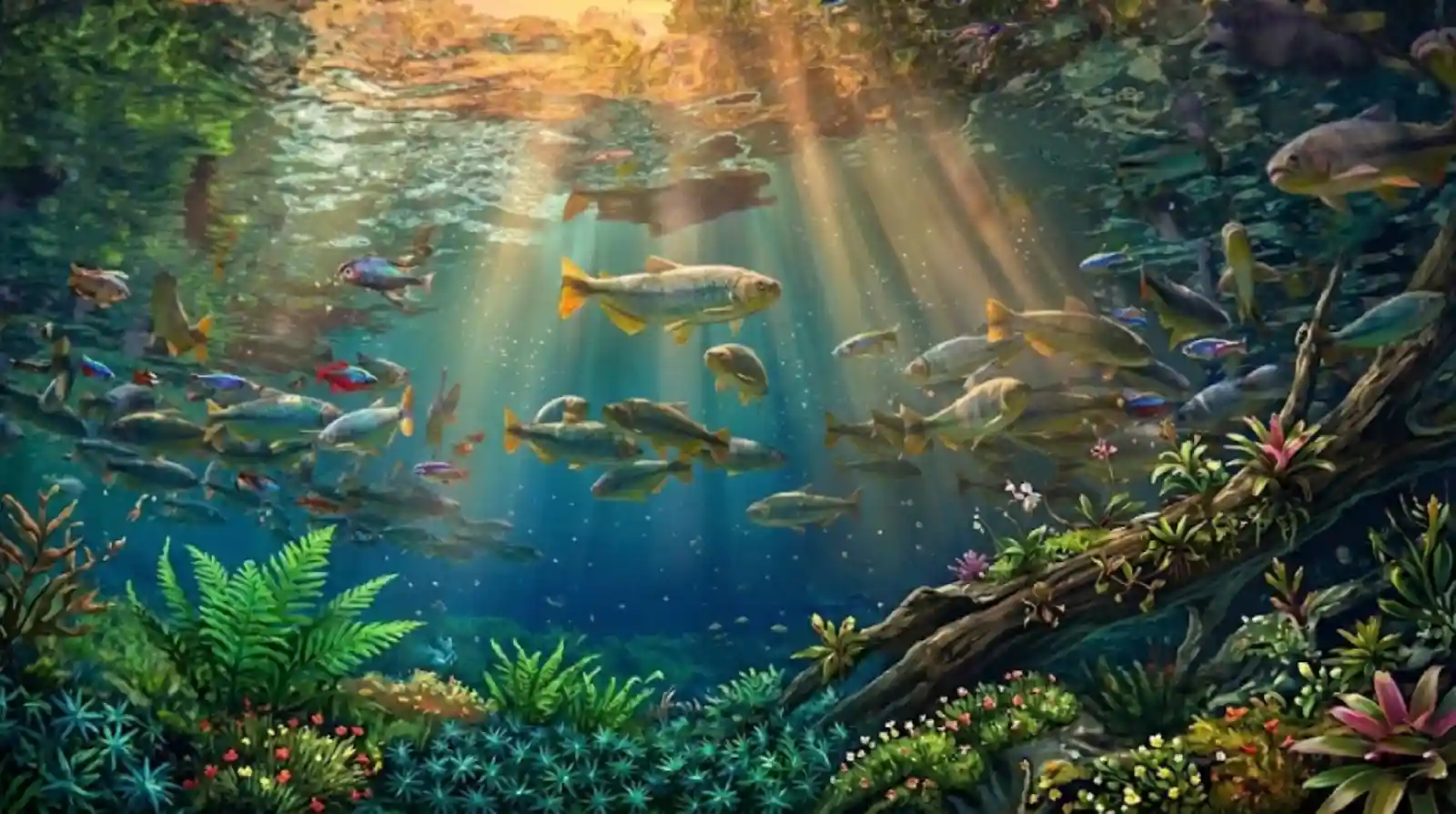
In parts of the Amazon the river stops being an opaque surface and starts working like a window. Along the Tapajos basin and in the headwaters of rivers in Mato Grosso and Rondonia, underwater visibility can exceed ten metres, a condition rare enough to let plants photosynthesise at depths where sunlight would barely reach in most river systems. Visitors call the result a natural aquarium, and the description is accurate: aquatic life plays out in full view, without the curtain of suspended sediment that hides the bottom of most Amazonian tributaries.
Three kinds of water in one forest
The Amazon does not have one river, it has families of rivers. Whitewater rivers carry Andean sediment and move with the clay coloured load that defines the classic image of the basin. Blackwater rivers owe their dark tone and their acidity to leaf decomposition on the forest floor. Clearwater rivers carry little sediment and few minerals, so light passes straight through them. The difference is not decorative. It is the chemical and geological signature of the terrain each river drains.
Science attributes that transparency to old, well drained soils that behave like natural filters before water reaches the riverbed. Rain moves down through layers that hold impurities back, and what finally arrives in the channel is already close to clean. Microorganisms add a further stage of purification. When the filter works, the river behaves like a glass container. When it breaks down, the same river turns into a channel of mud.
Alter do Chao, the Tapajos showcase
One of the best documented places for water clarity is Alter do Chao, in the state of Para, on the Tapajos river. During the low water season, white sand beaches emerge and the water shifts between turquoise blue and emerald green. No specialised gear is required to watch what happens below: shoals of peacock bass, from the genus Cichla, and rays half buried in the sandy bottom stay visible from the surface with unusual sharpness.
The decisive factor behind that clarity sits on the bank rather than in the channel. Riparian forest, the strip of vegetation that follows the watercourse, is what sustains transparency, because tree roots stop soil from being washed into the river during tropical rains. Every tree left standing along the margin is, in practical terms, a working component of the filtration system that keeps the window open.
Nobres and the submerged gardens
In the transition zone between the Cerrado and the Amazon, the municipality of Nobres holds one of the most striking sets of natural aquariums in Brazil. Rivers such as the Salobra and the Estivado carry water rich in limestone, which speeds up the settling of impurities and produces an almost unreal transparency. Floating at the surface, visitors look down on shoals of piraputanga, Brycon hilarii, and dourado, Salminus brasiliensis, lit by sunbeams that cut through the water column.
What holds the scene together is botanical. Algae and higher plants form genuine submerged gardens that oxygenate the water and feed a range of species. These structures are fragile and easily damaged by trampling on the riverbed, which is why controlled tourism functions here as a technical requirement rather than a polite suggestion: protecting the river floor and its roots means protecting the clarity itself. For biologists, these systems work as living laboratories for studying how geographic isolation and specific water chemistry shape endemic species. On the banks, tapirs, Tapirus terrestris, cross the channel and macaws pass over the treeline.
The flooded forest that turns clear
The phenomenon also has a seasonal version. When clean water rises and spreads into dense forest, terrestrial trees end up partly submerged and the whole woodland becomes an aquatic environment. Light filtered first by the canopy and then by the water enters in beams that reach the bottom and expose an architecture invisible for the rest of the year: fish moving between trunks and branches inside a temporary refuge of considerable complexity.
Species that depend directly on abundant vegetation and on water quality to reproduce appear in these flooded stretches, among them the electric eel, Electrophorus electricus, and the Amazonian manatee, Trichechus inunguis. They rank among the most productive environments in the region and act as dispersal hubs for nutrients and seeds. The underlying logic is blunt: the health of the forest on dry land dictates the purity of the aquatic environment beside it.
How the aquarium goes dark
Transparency is not a permanent property. Where protection is weak, pollution and silting act quickly, and rivers that lost their riparian forest lost their clarity along with it, turning a natural aquarium into a bed of mud. The process rarely begins in the water. It begins with the clearing of the margins and the erosion that follows, and by the time the change is obvious from the surface the damage upstream is usually substantial.
The encouraging part is that the damage can be reversed. Environmental restoration projects, built around recovering springs and replanting native species along the banks, have delivered positive results and returned part of the original clarity to degraded stretches. Nature shows a remarkable capacity for regeneration when it receives adequate management and sustained backing from public policy.
Clean water as an economic asset
Observation tourism has turned that transparency into an income source for local populations, well away from predatory extraction. Divers and wildlife enthusiasts support regional economies while learning why the underwater sanctuaries are worth keeping intact. The argument is economic as much as environmental: a clean river full of life pays more, and for far longer, than any short lived, high impact activity. Success in these locations has become a working example for other parts of the Amazon.
That is the wider lesson these rivers offer. Clean water is emerging as one of the most valuable assets of the twenty first century, essential for climate regulation and for sustaining complex food chains, and the clearwater rivers of the Amazon make the point visible in a way statistics rarely manage. Each metre of visibility is evidence of a functioning filter of soil, roots and forest cover somewhere upstream, and a reminder of how quickly that filter can be dismantled.
Reporting: Anne Silva / Amazonia Mag. Source: Revista Amazônia.

Editor · Amazonia Mag
Anne Silva is the editor of Amazonia Mag, the English-language edition of Revista Amazônia. She curates, translates and adapts the outlet's science and environment coverage for an international audience, reporting on Amazon wildlife, flora, rivers, climate and research. Every story she edits is grounded in peer-reviewed studies, official data and on-the-ground reporting from the Revista Amazônia newsroom in Belém, Pará, Brazil. More by Anne Silva →