
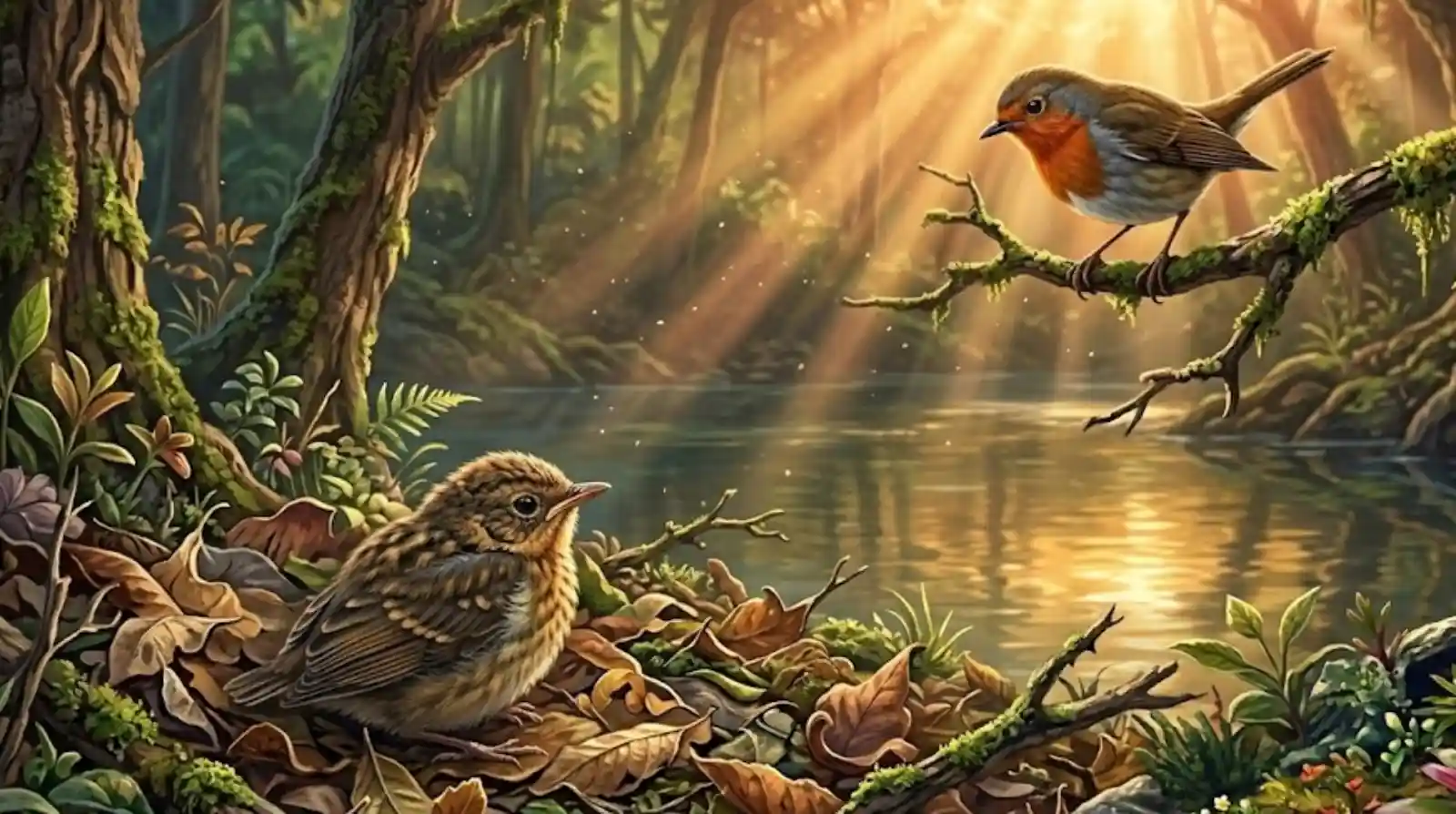
Most baby birds found on the ground are not abandoned. They are going through a natural biological stage known as the fledgling phase, the moment when young birds begin to explore the world outside the nest. During that period the parents stay nearby, watching over and feeding the youngster, even when they are not visible to human eyes. Taking the animal away in the belief that it is being saved can actually interrupt the vital learning of survival and social behavior that only parents of the same species are able to pass on. Science recognizes that parental care among wild birds is complex, and that human intervention must be the last resort, limited to cases of visible injury or imminent danger.
The correct response when finding a lone chick is silent observation from a distance. Guidance consolidated by environmental agencies indicates that the first step is to check whether the bird has feathers and whether it can hop or make short flights. If the chick is in a dangerous spot, such as the middle of a road or within reach of pets, the recommendation is to move it to a shrub or a high branch as close as possible to the original point. Contrary to popular myth, a bird’s sense of smell is not developed enough for it to reject a chick simply because a human briefly touched it to put it out of harm’s way.
What the fledgling stage really does
Leaving the nest is a critical milestone in the development of wild birds. During the fledgling stage the young strengthen their wing muscles and learn to identify predators and food sources. Studies indicate that chicks raised in captivity by human hands, however well intentioned, face severe rehabilitation difficulties, because they lose the acoustic and behavioral reference of their own species. That phenomenon, known as imprint, makes the bird identify with humans, leaving it unable to interact with other members of its lineage or to defend itself against natural threats in the forest or in the city.
This is the point where a badly executed rescue turns into harm dressed up as help. A bird that has lost the reference of its own kind never receives what only parents of its species teach: where to look for food, how to read a threat and how to behave among its peers. A gesture that begins in empathy ends up producing an animal that no longer fully belongs to the wild and cannot live there without permanent assistance.
The distinction that matters most is between a chick already in the fledgling stage and a nestling. A young bird covered in feathers, hopping on the ground and capable of short flights, is doing exactly what its biology asks of it at that age. A featherless bird that fell too early is a different case, and it is the one that official guidance treats as a genuine emergency. Confusing the two is what turns a well meaning gesture into the removal of a healthy bird from the wild.
When rescue is genuinely necessary
Ibama, Brazil’s federal environmental institute, and other protection bodies stress that a rescue should only be carried out when the chick is visibly injured, with drooping wings or bleeding, or when it is a nest bird, meaning one that has no feathers yet and fell prematurely. In those cases the ideal action is to try to locate the nest and return the bird to it. If that is not possible, contacting the environmental authorities is the standard procedure. Keeping wild birds at home without authorization, besides being harmful to the animal, is an offense under Brazilian law, which aims to protect native fauna against trafficking and inappropriate domestication.
There are specific situations in which human hands do play a positive role in conservation. If the environment where the chick was found has been destroyed, or if there is clear evidence that the parents have died, a technical rescue becomes necessary. In those circumstances the animal must be taken to the Centros de Triagem de Animais Silvestres, the CETAS, Brazil’s official wildlife screening centers. There, specialists use techniques that minimize human contact and focus on rehabilitation for release. In every scenario the decision belongs to the competent environmental agency, not to the well meaning neighbor.
Never offer water or food
Official guidance is never to offer water or food, such as bread or milk, because they are foreign to a bird’s diet and can cause choking or fatal digestive disorders. It is one of the most ignored recommendations and also one of the most lethal, since inadequate diets kill faster than a short term lack of food. Anyone who finds an injured chick should limit themselves to contacting the competent environmental agency and following the technical guidance they receive.
Sharing the city with wild birds
Coexistence between people and wild birds in urban areas calls for a more attentive and less anxious approach. As cities expand over green areas, it is common for backyards and parks to turn into nurseries. Keeping dogs and cats supervised or indoors during the bird breeding months, generally spring and summer, is the most effective way to help without interfering. Science recognizes that predation by pets is one of the leading causes of chick mortality in inhabited areas, often surpassing the natural causes of brood loss.
Educating the public about the life cycle of birds is fundamental to the sustainability of biodiversity. The urge to help is often born of empathy, but a lack of information turns that help into an ecological problem. Public information campaigns based on Ibama guidance help build a culture of respect for the autonomy of wild animals. Understanding that a chick on the ground is part of the natural balance allows people to appreciate nature without the need for possession or direct intervention, strengthening a conscious bond with the environment.
Urban biodiversity depends on our ability to share space with other species. The presence of thrushes (Turdus rufiventris), great kiskadees (Pitangus sulphuratus) and other native birds indicates that the local ecosystem still holds resilience. Protecting chicks means ensuring that future generations of those birds keep performing their ecological roles, such as seed dispersal and insect control. Technical rescue should be the exception, while habitat preservation and respectful distance should be the rule for anyone who wants Brazilian wildlife to thrive.
Step by step if you find a chick
If you find a chick, follow these steps. 1. Observe for one hour to see whether the parents appear. 2. Check for injuries or blood. 3. If it is in danger, place it on a high branch nearby. 4. If it is injured, contact Ibama or the local Environmental Police. Never try to feed the animal with human products, because inadequate diets kill faster than a short term lack of food. Outside Brazil, the contact should always be with the competent environmental agency for the region where the bird was found.
When we come across a small and vulnerable life, the greatest act of love we can offer is the freedom to leave it in the care of nature itself.
Reporting: Anne Silva / Amazonia Mag. Source: guidance from Ibama and from Brazil’s Centros de Triagem de Animais Silvestres (CETAS).

Editor · Amazonia Mag
Anne Silva is the editor of Amazonia Mag, the English-language edition of Revista Amazônia. She curates, translates and adapts the outlet's science and environment coverage for an international audience, reporting on Amazon wildlife, flora, rivers, climate and research. Every story she edits is grounded in peer-reviewed studies, official data and on-the-ground reporting from the Revista Amazônia newsroom in Belém, Pará, Brazil. More by Anne Silva →