
The Amazon that Europe once described as an empty green desert never existed. Long before the first Portuguese ships reached the coast of Brazil, the largest tropical forest on the planet already held complex urban networks, with thousands of inhabitants, roads linking settlements that were centuries or millennia old, and earthworks raised by societies able to organise collective labour on a very large scale. The claim is verifiable and now well established by modern archaeology: the region was not waiting to be discovered, it was inhabited, managed and reshaped. Accepting that fact forces a rewriting of much of the continent’s history, and it dismantles an idea still repeated in school textbooks and in public debate, the notion of a virgin rainforest with no human memory until the sixteenth century.
The evidence does not come from a single spectacular find. It comes from decades of accumulated fieldwork across different parts of the Pan-Amazon region. Using technologies such as Lidar, which reads the shape of the ground beneath a closed canopy, research teams have been uncovering complex urban structures, some of them thousands of years old. Science now recognises that in areas such as the upper Xingu and the state of Acre, on Brazil’s western frontier, pre-colonial societies developed a distinctive form of urbanism with no exact parallel elsewhere in the world: villages arranged around plazas, joined by radial roads and framed by systems of ditches and earthen embankments.
Plazas, ditches and radial roads
The word city, applied to the ancient Amazon, does not describe stone towers or defensive walls. It describes something else: a dispersed but coordinated pattern of occupation, in which each settlement worked as one piece of a wider regional network. These structures were never isolated. They formed extensive regional systems that point to significant population density and to a social organisation that was highly stratified and closely interconnected. The roads did not wander out of a village at random, they followed precise geometric rules, a sign that communities shared standards of layout, hierarchies and lasting agreements about how territory should be used.
That model changes how the present-day forest should be read. If the Amazonian landscape hosted a diffuse urban life for centuries, then the vegetation we see today is not a natural backdrop frozen in time, but the product of a long partnership between forest and society. Archaeology also records bridges and artificial canals, which suggests sophisticated control of water resources and of movement by river and by land. Indigenous populations did not merely adapt to their environment, they actively transformed it, producing anthropic landscapes whose mark still shapes the biodiversity of the forest today.
The geoglyphs of Acre, engineering in earth
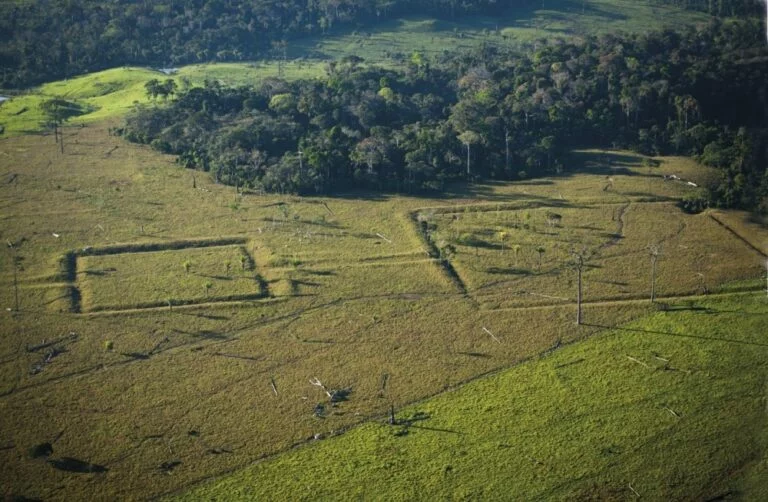
The most striking visual proof of that ancient presence is found in the geoglyphs of Acre, colossal geometric figures, circles, squares and octagons, carved into the ground by shifting tonnes of soil. Science has already catalogued hundreds of these structures, many of them visible only from the air and revealed, with bitter irony, by the deforestation that stripped away the vegetation hiding them. Their discovery in such numbers redrew the mental map of the western Amazon and forced researchers to revise long-standing assumptions about how many people once lived there.
The exact purpose of these formations remains under discussion. Some studies point to ritual functions, others suggest residential use or the management of water resources, and no single hypothesis yet accounts for the full range of sizes and designs. Whatever the answer, the scale of the work settles one question beyond argument: moving that volume of earth demands planning, food surplus, coordination and an organised workforce sustained across generations. Many of those structures were also connected by ancient roads, likewise built from earthen embankments, which served as regional routes of circulation.
Cultivated forests, not untouched wilderness
The most tangible legacy of these populations lies underfoot. Terra preta, the dark and extremely fertile soil found at many points across the basin, is a human creation, the result of centuries of management and of the deposition of organic and inorganic residues by pre-colonial societies. Rich in nutrients and microorganisms, it works as a direct marker of old and long-lasting settlements, frequently associated with dense and productive forest orchards. Its very existence confirms that occupation here was stable, extended in time and demographically substantial.
Beyond the soil, the signature is written into the species themselves. Science recognises that the archaeological Amazon was a mosaic of cultivated forests, where plants such as açaí, peach palm and the Brazil nut were domesticated and spread on a large scale. That ancestral form of forest management influenced the composition of the rainforest and its biodiversity, which means that a good share of what we now call wild nature still carries the imprint of human decisions taken centuries ago. The relationship between Amazonian peoples and their territory is ancient and co-evolutionary, not a recent encounter.
A memory that guides the future
Amazonian urbanism, with its networks of villages and roads, represents a singular model of occupation, adapted to tropical conditions and grounded in biodiversity. Recovering that historical memory is not an exercise in academic nostalgia. It is the precondition for recognising the role of Indigenous peoples in shaping the forest, and for designing sustainable development models that can work in the region today. Knowledge of these ancestral practices can offer valuable insight for the bioeconomy and for the responsible management of natural resources, with direct benefit for local communities.
There is an unmistakable political dimension as well. For centuries, the idea of an empty Amazon served to justify occupation, dispossession and projects imposed from outside, on the assumption that nobody had ever built anything worth respecting there. Archaeology, by documenting geoglyphs, embankments, roads and manufactured soils, removes that argument from the table. The legacy of pre-colonial societies stands as evidence of human resilience and ingenuity in dialogue with nature, and acknowledging it is a necessary step toward a future in which sustainability rests on respect for biodiversity and on the value of traditional knowledge.
It also reframes what conservation is protecting. A forest understood as a thousand-year-old home, shaped by generations of caretakers, is not only a carbon reservoir or a catalogue of species. It is a historical archive, and every hectare cleared destroys pages of it that no laboratory can reconstruct. The same deforestation that exposed the geoglyphs of Acre is erasing evidence elsewhere before anyone has had the chance to record it.
Looking at the roots of the Amazon is, in the end, like looking into a mirror. The plazas of the upper Xingu, the earth figures of Acre and the road networks still traceable beneath the canopy describe a complex and durable social order, and they refute once and for all the fable of an untouched wilderness before Cabral arrived. The forest was never empty, and its defence today is inseparable from the memory of the people who made it what it is.
Reporting: Anne Silva / Amazonia Mag. Source: original Revista Amazônia report on Pan-Amazonian archaeology.

Editor · Amazonia Mag
Anne Silva is the editor of Amazonia Mag, the English-language edition of Revista Amazônia. She curates, translates and adapts the outlet's science and environment coverage for an international audience, reporting on Amazon wildlife, flora, rivers, climate and research. Every story she edits is grounded in peer-reviewed studies, official data and on-the-ground reporting from the Revista Amazônia newsroom in Belém, Pará, Brazil. More by Anne Silva →