
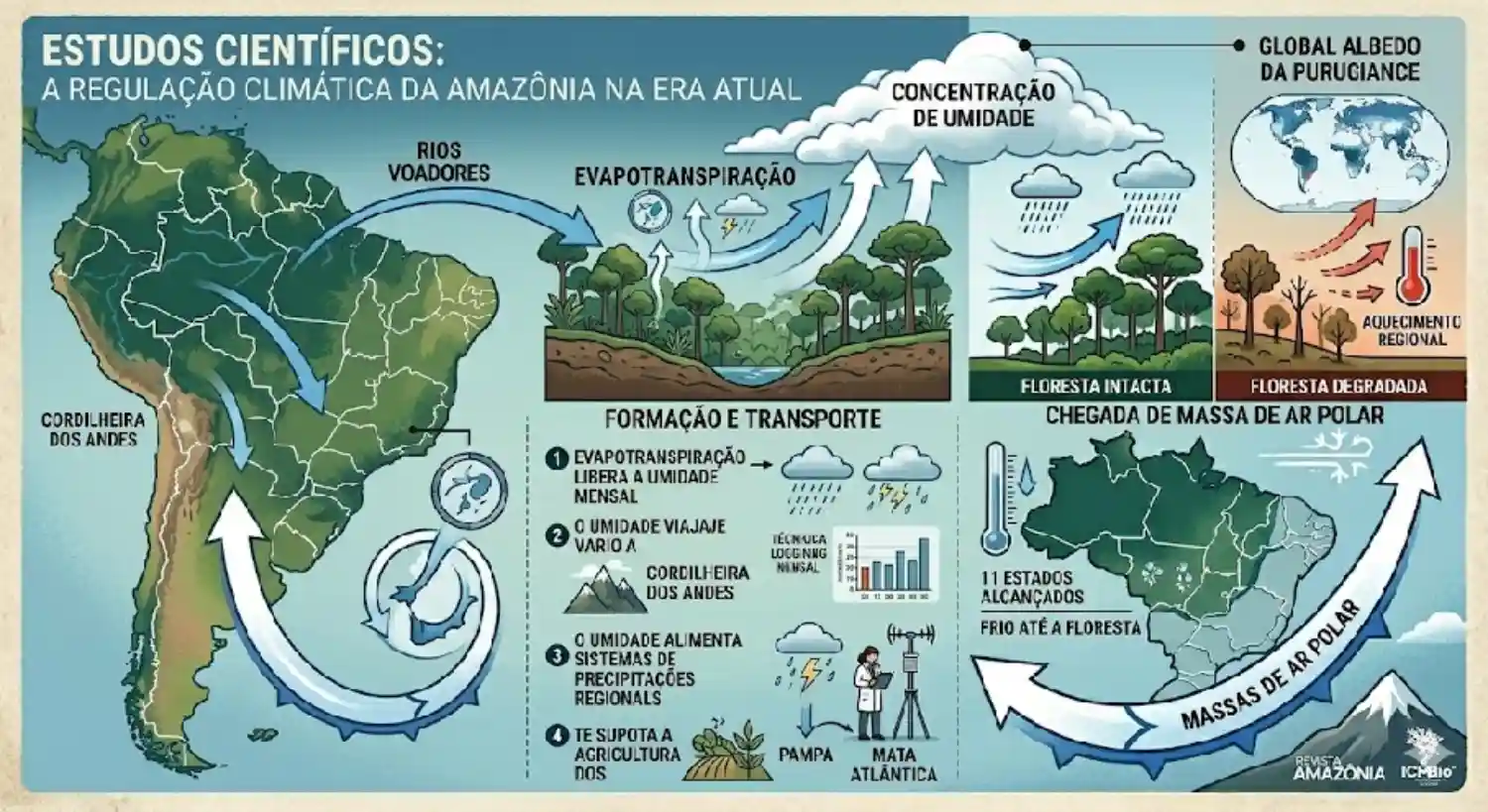
Every day, the Amazon rainforest sends roughly 20 billion tonnes of water into the atmosphere, a volume greater than the flow the Amazon River itself discharges into the ocean. The figure is often filed away as a regional curiosity, yet it describes a component of the climate system that operates on a planetary scale. The evapotranspiration of Amazonian trees does not stop at the Brazilian border: it feeds currents of moisture and heat that end up altering temperature and rainfall patterns in places as distant as southern Argentina and the midwestern United States. Understanding that link explains why a tropical forest keeps appearing in the climate models of countries whose citizens have never seen an Amazonian tree.
A hydrological engine with intercontinental reach
The mechanism begins with solar energy. The vegetation absorbs that heat and uses it to turn liquid water into vapour through the leaves of the canopy. A large tree, with a crown twenty metres in diameter, can release more than a thousand litres of water into the air in a single day. That vapour condenses into clouds and is carried westward by the trade winds until it meets the physical barrier of the Andes, which deflects it southward and delivers it to the food producing regions of Brazil, Paraguay and Uruguay.
What matters for the global climate is what that deflection implies. The Amazon does not merely receive rain: it actively manufactures the conditions for precipitation on a continental scale. Research indicates that keeping this flow alive depends on the integrity of the forest, because fragmenting the biome lowers vapour pressure and weakens moisture transport. The likely outcome is prolonged drought in areas that have historically relied on that natural irrigation. And since those areas export grain, meat and vegetable oils to Asia, Europe and Africa, an atmospheric disturbance born under the Amazonian canopy eventually turns up in the food prices of other continents.
When polar air climbs into the rainforest
The Amazon is usually associated with steady tropical heat, yet its dynamics are vulnerable to intrusions arriving from the south. The phenomenon known in Brazil as friagem occurs when unusually intense polar air masses break through pressure barriers and advance across the interior of the continent, climbing the river valleys until they reach the heart of the forest. Studies indicate that these incursions can push temperatures down in states such as Acre, Rondônia and Amazonas by more than 15°C in a matter of hours.
The recent observation of polar air masses reaching as many as 11 Brazilian states simultaneously showed how sensitive atmospheric connectivity across the hemisphere really is. When cold, dry southern air meets the warm and humid atmosphere of the forest, a temporary stabilisation follows that can suppress the formation of local rain clouds. At the same time, the forest acts as a thermal regulator: its dense biomass retains residual heat and prevents the frosts that are common at higher latitudes from destroying cold sensitive vegetation. That cushioning is decisive for species that carry no biological adaptation to freezing.
Clouds that send sunlight back into space
There is a second channel through which the forest shapes the energy balance of the planet, and it is optical rather than hydrological. Trees release volatile organic compounds that function as biogenic aerosols, meaning they serve as the condensation nuclei on which raindrops form. The low, bright clouds produced by that process reflect a significant share of incoming solar radiation back into space, an effect known as an increase in albedo.
That reflection is not a local benefit. Energy the Amazon returns to space is energy that stays out of everyone’s climate system. Without the forest, dark soil would absorb more solar energy, raising surface temperature and worsening regional warming in a feedback loop that is dangerous for biodiversity. On the chemical side, large scale photosynthesis also removes carbon dioxide from the air and converts it into wood and organic matter, although recent research warns that some areas under water and heat stress are already emitting more carbon than they manage to absorb.
A two way street with the oceans
The relationship between the forest and the air masses runs in both directions. While the Amazon supplies the moisture that moderates the climate of the southern part of the continent, global climate conditions determine the health of the forest itself. Warming oceans shift the path of the trade winds and can push Amazonian moisture off its traditional route. That instability, decided in large part by sea surface temperatures measured thousands of kilometres away, affects agriculture, hydroelectric generation and also the ability of the forest to recover from fires and pest outbreaks, which become more frequent in an altered climate.
The physical structure of the canopy plays a mechanical role as well. Its roughness dissipates the energy of strong winds and storms. When a polar air mass advances over deforested ground, it travels faster and with fewer obstacles, which can intensify the abrupt temperature drop and the drying of soils in neighbouring regions. A continuous forest, in that sense, is meteorological infrastructure rather than scenery.
Why the stakes reach beyond South America
The balance between warm equatorial air and cold polar air is what holds the seasons of central Brazil in place. Should the hydrological cycle lose strength, the polar masses rising from the south would meet a far more hostile and far less resilient environment, producing more erratic winters and summers with unpredictable rainfall. That mismatch would threaten the food and water security of millions of people inside and outside the continent, because atmospheric flows recognise no customs border.
There is an uncomfortable asymmetry built into this arrangement. The decisions that determine how much forest stands are taken inside a handful of countries, while the consequences of those decisions register in growing seasons, energy grids and heat records spread across the planet. A moisture flow deflected by the Andes and a polar mass climbing a river valley are physical events with no political address, and yet the planning that depends on them, from harvest forecasts to reservoir management, is done in offices thousands of kilometres apart. That gap between where the mechanism lives and where its effects land is precisely what makes the forest a climate question rather than a purely national one.
Continuous satellite monitoring, combined with ground weather stations installed inside the rainforest, allows scientists to refine climate models and anticipate how the Amazon will respond to future heatwaves or to more frequent polar intrusions. Large scale forest restoration and the protection of biological corridors emerge as essential measures to strengthen the ability of the biome to withstand the changes already under way.
Seen this way, the forest stops being a national asset and becomes a shared instrument of climate policy. The case for protecting it rests not only on the beauty of its landscapes or the richness of its species, but on the need to keep an invisible infrastructure working, one that sustains the economy and the daily life of a portion of the planet far larger than the biome itself. The future of rainfall, of temperature and of agriculture is tied to the ability of Amazonian trees to keep talking to the air masses that cross the sky above them.
Reporting: Anne Silva / Amazonia Mag. Source: Revista Amazônia.

Editor · Amazonia Mag
Anne Silva is the editor of Amazonia Mag, the English-language edition of Revista Amazônia. She curates, translates and adapts the outlet's science and environment coverage for an international audience, reporting on Amazon wildlife, flora, rivers, climate and research. Every story she edits is grounded in peer-reviewed studies, official data and on-the-ground reporting from the Revista Amazônia newsroom in Belém, Pará, Brazil. More by Anne Silva →