
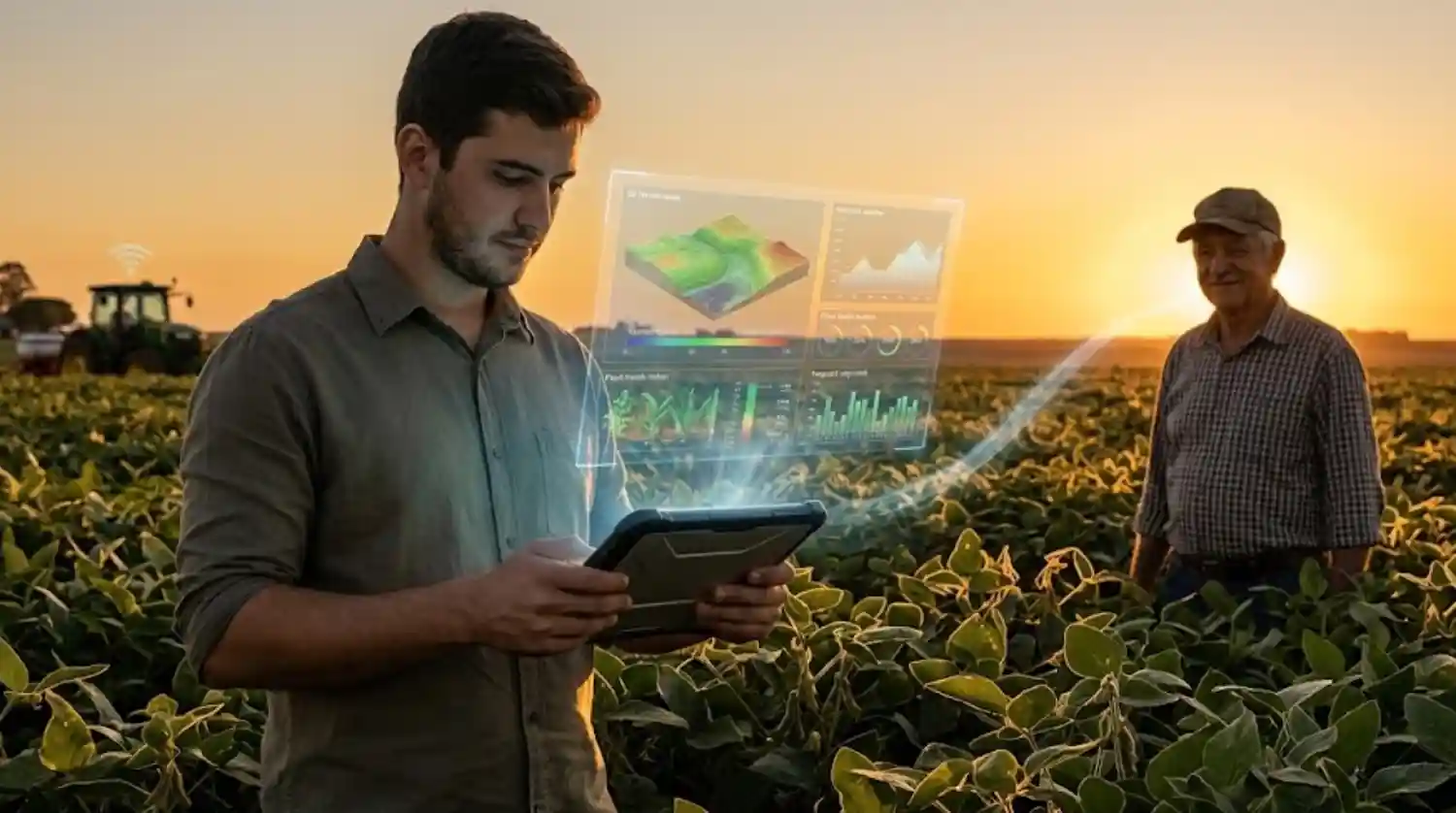
Plants carry biological memory mechanisms that let them adapt to severe environmental stress and pass genetic and epigenetic information on to the generations that follow. Among the angiosperms, for instance, the ability to “remember” a season of drought or intense cold changes how genes are expressed in future seeds, giving the lineage a better chance of surviving hostile conditions. That natural transfer of lived biological experience now has a technological parallel in the way people manage knowledge on the land. Artificial intelligence has begun to work as a kind of digital DNA, encoding decades of intuition and farming practice so that a family legacy is not lost in the handover between generations.
Turning farming intuition into structured data
Brazilian agribusiness has always run on a mixture of rigorous science and the almost instinctive sensitivity of veteran producers. The close reading of a leaf colour, the feel of humidity in the air before a storm, the exact knowledge of every hectare of a property: these are valuable assets that historically took decades to move from parent to child. Yet the exodus of young people from rural areas and the growing complexity of environmental regulation opened a dangerous gap in that chain of transmission. Innovation in the sector is now aimed at turning that tacit knowledge into structured data, without the knowledge ceasing to belong to the people who built it in the field.
Artificial intelligence systems are being trained to act as repositories of operational memory. Picture a platform that does not merely log harvest productivity, but correlates decisions a manager took twenty years ago with the results visible today. By processing large volumes of historical soil, climate and management data, the tool can simulate the reasoning of experienced producers and give successors a decision base that once depended entirely on physical presence and on the oral memory of the patriarchs and matriarchs of the countryside. The family still decides; the machine only arranges what the family already learned.
A bridge over the generational gap
Family succession is one of the biggest challenges facing Brazil’s productive sector. Many young people come home from university with degrees in technology or management and struggle to apply modern methods on properties run in a traditional way. Technology can act as a bridge for that conversation. When the management of experience runs through digital tools, the clash between “we have always done it this way” and “we need to innovate” is softened by statistical evidence, and neither side has to give up what it knows.
Integrated management software and machine learning algorithms allow the successor to see the full history of the farm, from the recovery of degraded areas to the behaviour of pests across specific cycles. According to market research, properties that adopt digital governance systems go through a far smoother leadership transition, because the assets of the farm stop being only land and machinery and start to include intellectual capital that is properly organised and accessible.
That shift also changes the shape of the conversation at the kitchen table. Instead of arguing from memory about which year the rains failed or which plot never responded to a given treatment, both generations can look at the same record and argue from the same evidence. The older producer is not being audited by a machine: the record is the one they created, season after season, and the technology simply keeps it from evaporating.
AI and the preservation of productive biodiversity
Sustainability is the central pillar of this new phase in farming. Using artificial intelligence to manage accumulated experience allows conservation practices to be repeated with mathematical precision. Variable rate application of crop protection products, intelligent management of water resources and the monitoring of permanent preservation areas all improve when the system learns from the regeneration history of that particular piece of land.
Studies indicate that satellite monitoring combined with soil sensors delivers a real time diagnosis that avoids wasting inputs. For a new producer, having access to a system that knows the nuances of local biodiversity on their own property means producing more with less impact. The technology does not replace the person: it amplifies their capacity to care for the ecosystem. Family succession therefore gains a layer of technical environmental responsibility, in which the heir becomes a guardian of the land and of the data at the same time.
Brazilian startups and tropical solutions
Brazil has become fertile ground for agtechs building solutions designed specifically for a tropical climate. Unlike imported technology, Brazilian innovations take the diversity of biomes into account, including the Cerrado and the Atlantic Forest. These tools are designed to understand local rainfall patterns and the particular acidity of the country’s soils. By focusing on national cases, the management of experience becomes far more accurate and avoids the common mistake of applying models built for temperate zones to tropical land.
Connectivity in rural areas, still expanding, already allows a constant flow of information. Private networks and low orbit satellites mean that even the most remote farms can feed their own data clouds. This innovation ecosystem turns succession planning into something more than an administrative matter: it becomes a continuous technological evolution that keeps Brazil among the world leaders in productivity with a focus on sustainability.
Risk management and climate resilience
One of the most delicate points in any succession is crisis management. Older producers survived countless economic plans and extreme swings in weather. That muscle of resilience is hard to hand over in a manual. Here artificial intelligence plays the role of scenario simulation: by analysing decades of climate events, it can identify patterns and suggest mitigation strategies that worked in the past, adapted to the tools available in the present.
A safe family succession depends on the ability to anticipate the unpredictable. When a successor uses systems that integrate predictive analysis, they are not simply planting seeds: they are managing risk with a safety net built out of real experience lived by their own family. The technology turns fear of the unknown into a strategic management of probabilities and helps keep the property economically viable for the generations to come.
The digital legacy of the countryside
The very idea of a legacy is being redefined. In the near future, handing over the keys to a farm will also mean handing over the credentials to a robust, personalised artificial intelligence system. That system will act as a silent adviser to the new generation, holding the record of successful harvests and the lessons of difficult years. Succession will stop being a stressful transfer of power and become a continuous process of data evolution.
According to sector research, around 70% of family businesses in agribusiness do not survive the transition to the second generation, often because critical knowledge is lost and processes were never structured. Putting digital governance and artificial intelligence systems in place helps mitigate that risk: it organises the flow of information and allows decisions to be made on the basis of historical and predictive data. That professionalises management and protects the value of the family estate over the long term.
The challenge now is making sure the technology reaches small and medium producers, democratising access to knowledge and strengthening the social fabric of the Brazilian countryside. The integration between the human mind and algorithms is the path towards a more ethical and efficient farming sector. The invitation to rural families is to embrace digitalisation not as a break with the past, but as the safest way to honour it and carry it forward. Knowledge is the one fertiliser that never runs out, and the preservation of biodiversity and food security depend on how succession in the countryside is handled today.
Reporting: Anne Silva / Amazonia Mag. Source: Revista Amazônia.

Editor · Amazonia Mag
Anne Silva is the editor of Amazonia Mag, the English-language edition of Revista Amazônia. She curates, translates and adapts the outlet's science and environment coverage for an international audience, reporting on Amazon wildlife, flora, rivers, climate and research. Every story she edits is grounded in peer-reviewed studies, official data and on-the-ground reporting from the Revista Amazônia newsroom in Belém, Pará, Brazil. More by Anne Silva →