
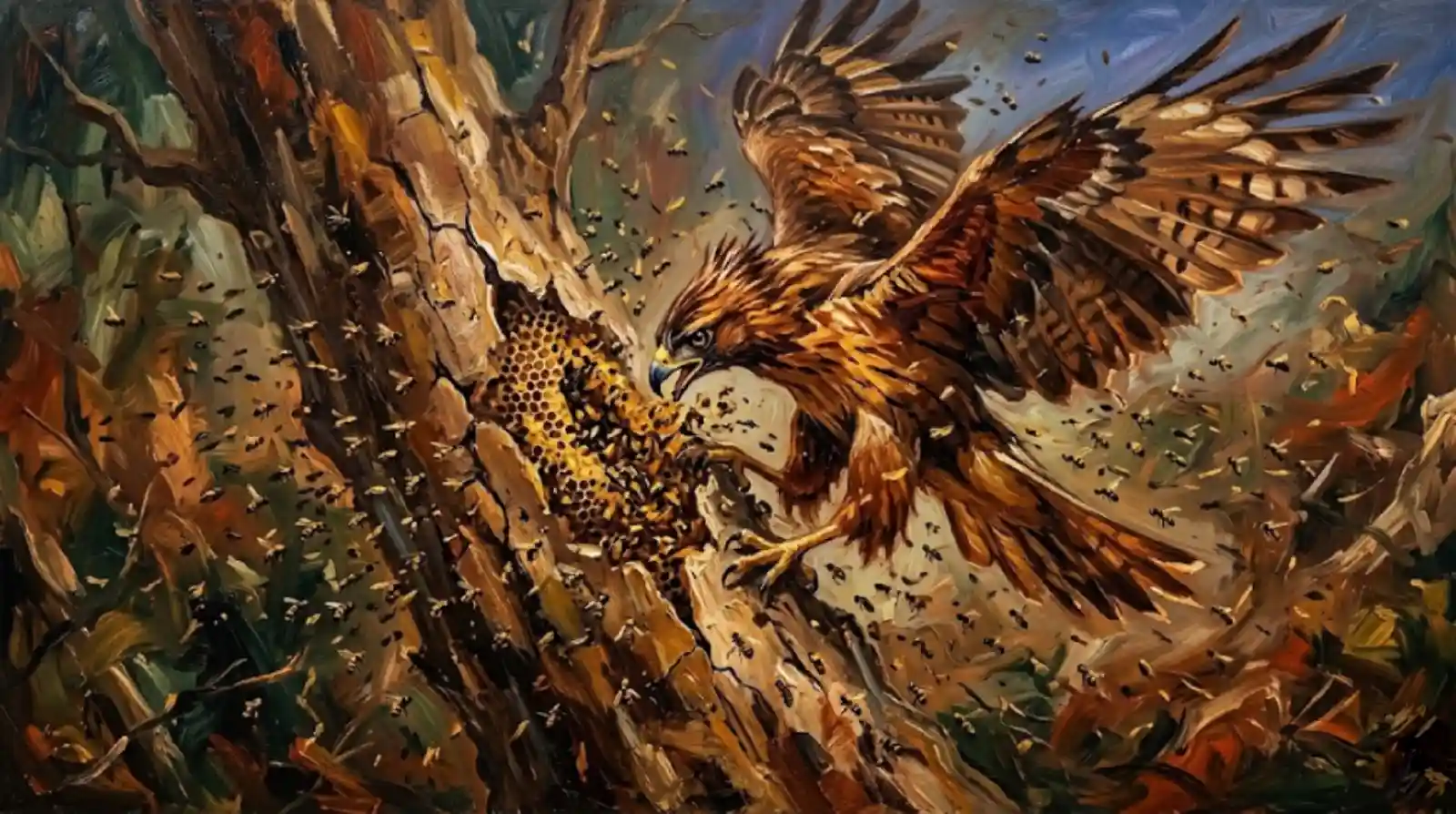
Some birds of prey have a remarkable biological feature that allows them to enter nests packed with insects without suffering serious damage from stings. They developed extremely dense plumage around the head and neck, creating a natural suit of armor that keeps stingers from reaching the animal’s sensitive skin.
This evolutionary adaptation is crucial for certain Falconiformes that specialize in eating bee and wasp larvae and adults. The food is rich in protein, but it is protected by colonies that can respond immediately to an intruder. While most animals keep away from an angry swarm, these hawks use their biological armor to exploit a very restricted ecological niche.
Feathers that block defensive stingers
The feathers of these birds are compact and overlap one another. Because they are packed so closely together, they create an almost impassable physical barrier for the stingers of defensive insects. Protection is especially important around the head and neck, the areas most exposed when the bird pushes into a nest.
Studies indicate that, in some of these specialized birds, the feathers are so stiff and tightly arranged that the hawk can attack a beehive with complete confidence, focused only on obtaining food. The plumage is not simply a covering used for flight or warmth. It also serves as a specialized defense against social insects.
The area around the eyes and the base of the bill, usually more vulnerable in other birds, is protected by modified feathers that resemble scales. This arrangement allows the bird to enter the nest without exposing its skin directly to the colony’s defensive stingers.
Science recognizes this natural armor as a notable example of ecological specialization. The predator develops defenses aimed at the specific defense mechanisms of its prey. In this case, the feather barrier opens access to a food source hidden behind one of the most coordinated forms of defense found among social insects.
A fast attack that also requires strategy
Physical protection is only one part of the technique. Reaching the inside of a beehive also demands agility and strategy. The attack is fast and precise. The bird approaches the hive and often raises its feathers, making the protective barrier even denser.
With sharp talons and a powerful bill, it breaks through the structure of the hive in search of combs rich in larvae and pupae. The operation combines strength, accuracy and a body adapted to the colony’s response.
When the bird attacks, the bees react immediately, forming a defensive cloud around the intruder. They try to find any opening in the plumage through which they can reach the skin. Yet the bird, protected by its specialized sting-resistant plumage, remains unperturbed throughout the operation.
The dense covering seen in certain birds of prey is so effective that bee and wasp stings cannot pierce the animal’s skin. As a result, the hawk can feed safely inside hives filled with defensive insects. The encounter is a concise display of evolutionary conflict between collective defense in bees and individual protection in the predator.
A role in the Cerrado food web
This predatory interaction plays an important ecological role in regulating wild bee populations. By preying on larvae and adults, hawks act as natural controllers. They keep a single insect species from becoming overly abundant and monopolizing floral resources.
If one species dominated those resources, the diversity of other pollinators could suffer. Science recognizes predation as a fundamental mechanism for maintaining ecosystem health and balance. Although an attack on a hive may look aggressive, it is part of the set of relationships that keeps environmental dynamics in motion.
In the Cerrado biome, the diversity of native bees is extremely high. Many species build their nests in tree trunks or termite mounds, creating a wide range of nesting sites and food resources across the Brazilian savanna.
The presence of these hawks is an indicator of environmental health. The Cerrado bee hawk is a key element in the complex food web of this savanna, where predators and prey depend on native vegetation and on the continued availability of bee nests.
Protecting the predator and its relationships
Conserving these birds of prey is closely tied to preserving large areas of native vegetation. The hawks need broad territories in which to hunt and find enough bee nests. The sustainability of this process depends on balanced ecosystems where predators and prey coexist in a dynamic form of harmony.
The coexistence of the hawk and the bees demonstrates the sophistication of natural evolution. Bees developed powerful collective defense mechanisms, while the hawk evolved a feather armor that allows it to get around those defenses without wiping out the prey species.
That balance enables both evolutionary lineages to continue changing. The relationship does not eliminate bees from the environment, nor does it turn the hawk into a force capable of destroying all of its prey. Predation belongs to a broader system in which food, nesting sites and native vegetation sustain the continuity of populations.
Understanding these dynamics is essential for conservation strategies. Protecting one species often means protecting the complex interactions it maintains with its entire environment. In this case, safeguarding the hawk means preserving the territories where it hunts, while protecting bees depends on keeping their nests and floral resources available.
For 25 years of covering Brazilian biodiversity, Amazonia Mag has consistently highlighted that these dynamics, even when they appear aggressive, are essential to long-term environmental sustainability. The image of a hawk challenging a swarm behind a shield of feathers expresses life in its fullest form, seeking balance and continuity across the vast Brazilian biomes.
The feather armor is not an isolated detail. It is the visible result of a long relationship between a specialized raptor and prey that defend their colonies with force. In the Cerrado, that relationship shows how evolution connects the body of a predator, the defenses of a hive and the health of an entire ecosystem.
The dense plumage found on the head and neck of certain raptors therefore carries ecological meaning beyond protection from stings. It allows the bird to reach larvae, pupae and adult insects while participating in the regulation of wild bee populations. The hive, the hawk and the native vegetation are all parts of the same living network.
Reporting: Anne Silva / Amazonia Mag

Editor, English Edition — Amazonia Mag
Anne Silva is the editor of Amazonia Mag, the English-language edition of Revista Amazônia. She curates, translates and adapts the outlet's science and environment coverage for an international audience, reporting on Amazon wildlife, flora, rivers, climate and research. Every story she edits is grounded in peer-reviewed studies, official data and on-the-ground reporting from the Revista Amazônia newsroom in Belém, Pará, Brazil. More by Anne Silva →