
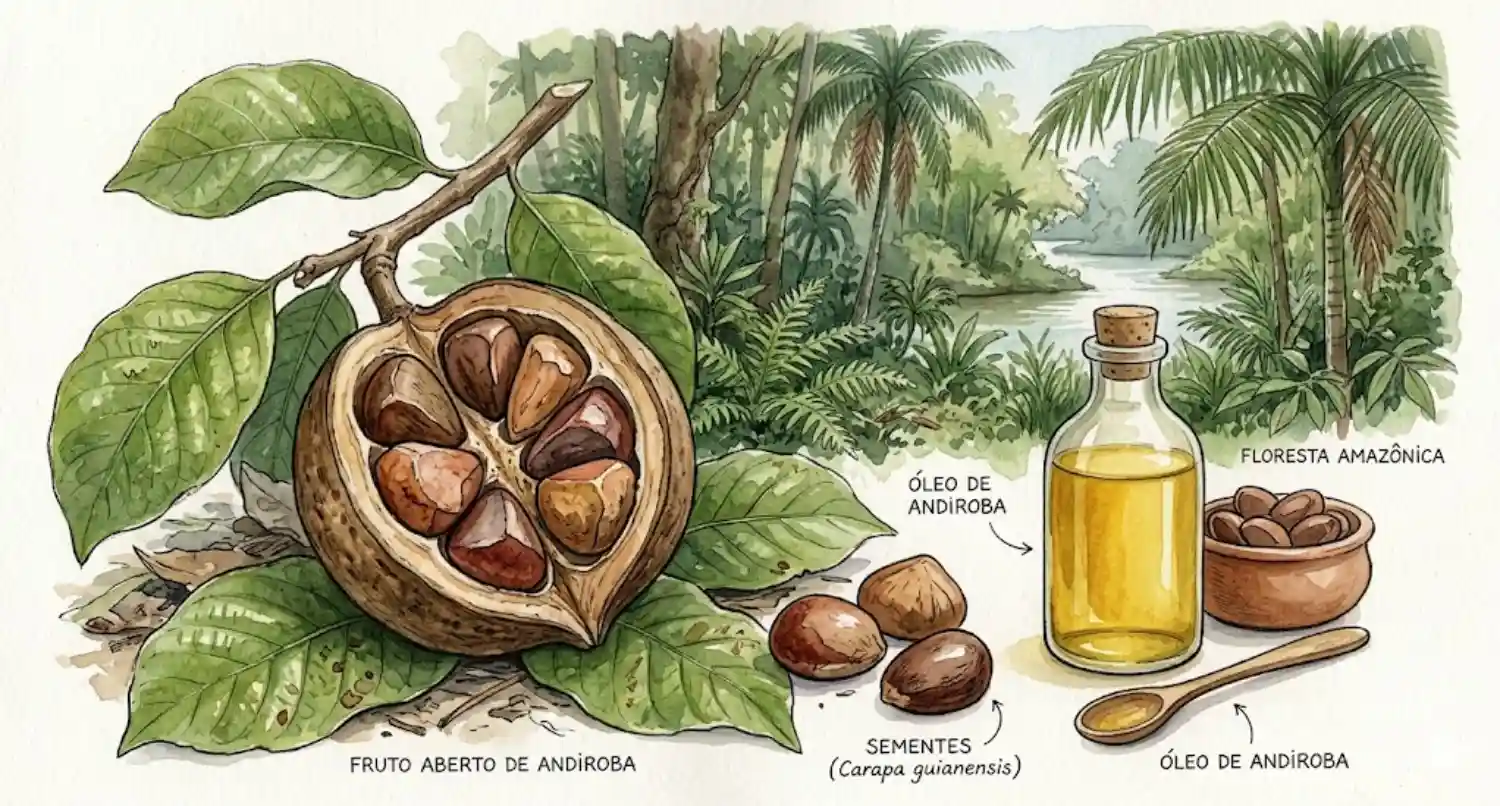
The Amazon rainforest holds biological knowledge that Western science is only beginning to decode. One of its most striking examples is the andiroba seed, whose oil has been used for generations by Indigenous peoples and river communities to ease inflammation and keep mosquitoes away.
Recent research confirmed that oil extracted from the seed can cross the human skin barrier and act directly to reduce edema and muscle pain within minutes. According to the pharmacological studies described in the research, this ability is not magic. It is applied biochemistry.
The seed’s journey from the forest floor to laboratories reveals two sides of andiroba. It has potential for pharmaceutical and cosmetic applications, while its collection provides a sustainable source of income that does not require trees to be cut down.
A 131-foot tree of várzeas and igapós
Andiroba, scientifically known as Carapa guianensis, is a large tree that can reach up to 131 feet (40 meters) in height. It prefers the rich, wet soils of várzeas and igapós, Amazonian environments shaped by the natural rhythm of water.
The species belongs to the same family as mahogany, but its traditional value is not centered on its timber. Instead, it stands out for its fruits, brown, woody capsules that contain several angular seeds.
When the mature fruits fall onto the ground or into the water between January and May, an important cycle begins for the economies of hundreds of extractive communities. Gathering the seeds follows the forest’s timing and does not require felling or damaging the tree.
That approach allows the species to regenerate and helps preserve the local ecosystem. The seeds collected in the forest contain the resource that communities turn into one of the Amazon’s best-known products: andiroba oil.
Limonóids and the action against inflammation
Andiroba oil is yellowish and extremely bitter. Its composition includes a complex mixture of fatty acids and bioactive compounds known as limonóids and triterpenes.
According to the pharmacological studies described, limonóids are responsible for the oil’s documented anti-inflammatory properties. These compounds act by inhibiting enzymes involved in the inflammatory process, including cyclooxygenase and lipoxygenase.
The research describes this action as comparable to that of synthetic anti-inflammatory medicines. It also emphasizes that the oil is a natural and renewable resource, with minimal side effects when correctly used on the skin.
The effect is linked to the ability of limonóids to block the production of substances that cause pain and swelling in the human body. In this way, a traditional practice gains an explanation through biochemical mechanisms observed by modern science.
Research into Carapa guianensis does not replace the knowledge held by communities. Instead, it complements and validates experience passed down through generations in Amazonian territories.
A natural repellent for mosquitoes and pium flies
Along with its action against pain and inflammation, Carapa guianensis oil has another important property for life in tropical regions: its effect on insects.
Studies of Carapa guianensis oil and its limonóids found that these substances have natural insecticidal and repellent properties. The compounds interfere with the hormonal and nervous systems of insects, affecting their feeding, growth and reproduction.
For that reason, Amazonian populations have historically used andiroba oil to repel mosquitoes, ticks, ants and the feared pium. This small black fly, identified in the source as a simulid, causes intense itching and allergic reactions when it bites.
Unlike synthetic repellents based on DEET, natural andiroba repellent is biodegradable, safe for continuous use and also moisturizes the skin. The combination of repellent action and hydration helps explain its place in locally made products.
The oil’s use goes beyond direct application to the skin. In river communities, people commonly burn the residual cake left after oil extraction. The resulting smoke has a characteristic smell and works as a natural fumigant to drive insects away from homes.
The traditional knowledge behind extraction
Oil production preserves traditional knowledge that river communities maintain with pride. First, the collected seeds are selected, washed and boiled in water to soften their shells.
They are then left to rest for several days so the pulp can mature. The most traditional extraction method uses tipitís, a type of press made from woven plant fibers. Simple hydraulic presses operated by local cooperatives are also used.
This cold-extraction method is essential for preserving the quality of the final product. As explained in the studies about the species, its anti-inflammatory and repellent properties remain because the limonóids and essential fatty acids stay intact.
The oil’s intense bitterness is, curiously, an indicator of its purity and concentration of active compounds. The product is also used in aromatic candles and soaps that are widely made and used in local communities.
These products are valued for their repellent action and for their healing and emollient properties. Together, the practices show how Amazonian communities develop effective, sustainable responses to the everyday challenges of forest life.
A supply chain that keeps the rainforest standing
Strengthening the andiroba supply chain is a key pillar of the Amazon bioeconomy. By increasing the value of the oil and seeds, it creates a viable economic alternative for extractive families.
That alternative can discourage predatory activities such as deforestation or selling land for farming and cattle ranching. When a community understands that a living andiroba tree is worth more than its cut timber, the tree becomes a direct reason to protect the forest.
Fair trade in andiroba oil, supported by origin and sustainability certification, can ensure that economic benefits reach the people who protect the ecosystem. In this way, the product connects social development, biodiversity conservation and the continued presence of communities in their territories.
Andiroba shows how the Amazon rainforest can provide solutions for human health and well-being when its resources are used with respect and wisdom. Research into the limonóids of Carapa guianensis does not invalidate traditional knowledge. It complements and strengthens it.
The dual action of these compounds, anti-inflammatory and insecticidal, makes andiroba oil an unusual natural resource. Limonóids block substances connected to pain and swelling, while interfering with the nervous and hormonal systems of insects and preventing them from feeding and reproducing.
This sophistication in the Amazon’s natural pharmacy opens possibilities for new markets and applications in the global pharmaceutical and cosmetics industries. Valuing andiroba and the communities that depend on it is a concrete way to keep this liquid treasure flowing and to recognize the wealth the rainforest already offers before any clearing takes place.
Reporting: Anne Silva / Amazonia Mag

Editor, English Edition — Amazonia Mag
Anne Silva is the editor of Amazonia Mag, the English-language edition of Revista Amazônia. She curates, translates and adapts the outlet's science and environment coverage for an international audience, reporting on Amazon wildlife, flora, rivers, climate and research. Every story she edits is grounded in peer-reviewed studies, official data and on-the-ground reporting from the Revista Amazônia newsroom in Belém, Pará, Brazil. More by Anne Silva →