
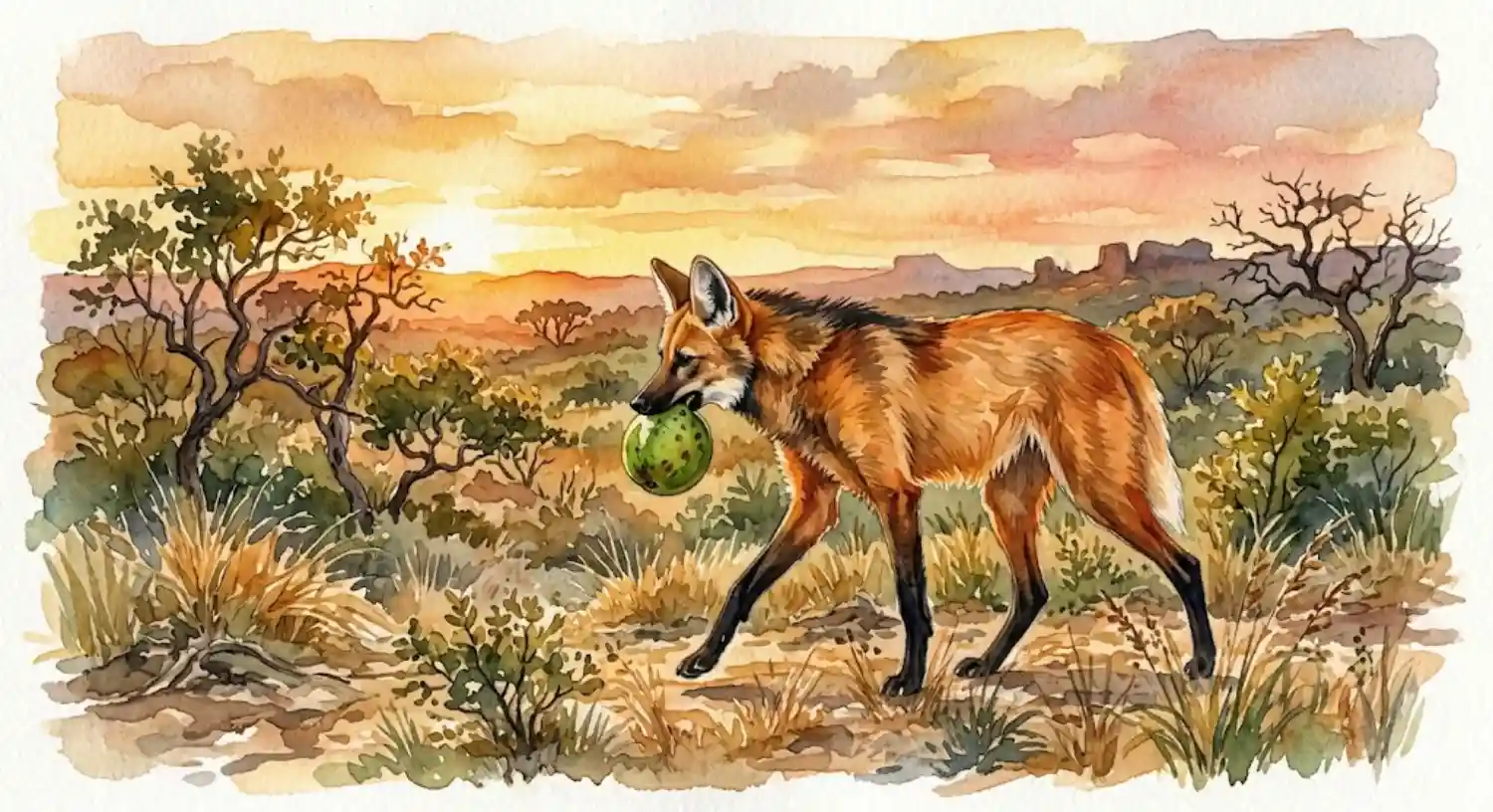
Across the vast and ancient landscape of Brazil’s Cerrado, a biome shaped by dry and rainy seasons and a long history of adaptation to fire, one of nature’s most important partnerships is taking place. It is a quiet relationship of mutual dependence that helps sustain the resilience of the entire ecosystem.
The maned wolf, Chrysocyon brachyurus, is South America’s largest canid and an iconic figure of the central savannas. Although it is often seen as a solitary predator of woodlands and grasslands, a surprisingly large part of its diet consists of wild fruit and plant matter.
Among the foods offered by the biome, the fruit of the lobeira, Solanum lycocarpum, is the animal’s favorite and one of its most important resources. By eating it, the wolf receives nutritional and medicinal benefits, while also setting in motion a process essential to the recovery and biodiversity of large native areas.
A partnership built around seeds
The relationship between the maned wolf and the lobeira is a classic example of what ecology calls mutualism. The lobeira is a hardy shrub that can grow up to 16 feet (5 meters) tall and produces large green fruits.
As the fruits ripen, they fall to the ground and release a sweet scent that is irresistible to the canid. According to established biological studies, the wolf eats the fruits in large quantities and, because of its nomadic behavior and long legs, travels miles across fields and high plateaus.
During those journeys, it defecates the seeds intact in places far from the plant that produced the fruit. The animal does not merely carry the seeds. It leaves them in new parts of the landscape, where they can begin a crucial stage of natural regeneration.
Distance is important, but it does not fully explain the efficiency of this process. The seeds also undergo a transformation inside the maned wolf’s body, and digestion appears to help break their dormancy.
The biological treatment that helps germination
Science recognizes that passing through the maned wolf’s gastrointestinal tract can support seed germination. This phenomenon is known as chemical scarification, a biological treatment that changes a seed’s ability to begin developing.
Without that stage, lobeira seeds would face great difficulty breaking through their outer covering and germinating in the Cerrado’s often compact, dry soil. Digestion, therefore, is not a minor detail of the animal’s feeding habits. It is a central part of the relationship between the two species.
The value of this partnership becomes especially visible after periodic fires move through the landscape. The Cerrado evolved with natural burning, but the frequency and intensity of fires have increased over the last several decades.
When flames consume low vegetation and leave the ground black with ash, exposed to strong sunlight, life can appear to have retreated. Yet it is precisely during this moment of apparent devastation that a new stage of regeneration may begin beneath the soil.
The first plant to return after disturbance
Ecologists classify the lobeira as a quintessential pioneer plant. That means it is among the first species able to colonize an area that has suffered severe disturbance, such as a recent burn scar.
Soil enriched by nutrients from ash, though lacking shade and protection from erosion, provides suitable conditions for the lobeira. In this setting, the maned wolf’s role becomes irreplaceable for spreading seeds across the Cerrado.
The animal’s droppings, deposited in open areas, act as a complete biological survival kit. They contain seeds already prepared and activated by digestion, along with a generous amount of organic fertilizer rich in nitrogen and phosphorus.
Those nutrients support seedlings during their first and most vulnerable days of life. The establishment and rapid growth of the lobeira are the first steps, and some of the most decisive ones, in the recovery of the ecosystem through a process biologists call ecological succession.
Shade that makes room for other species
When it sprouts vigorously in degraded areas, the lobeira produces broad, gray-green leaves. They act as a natural sun umbrella over hot, exposed soil and help create less extreme conditions around the plant.
The shade helps retain soil moisture and protects the ground from excessive sunlight. As a result, other native plants, many of them more sensitive and demanding, find a favorable microclimate in which to germinate and grow beneath the protection of the pioneer shrub.
Over time, an area that seemed burned and lifeless can become a complex, biodiverse habitat again. The lobeira offers more than shade. It also attracts a wide range of native wildlife.
Pollinating insects, small birds that shelter among its branches and other mammals that eat its fruits or feed on animals living nearby use the plant as a refuge and an essential source of resources. Everything begins with the maned wolf’s quiet work of spreading seeds across the landscape.
When an essential seed disperser disappears
Understanding this dynamic reveals how fragile ecological balance can be. Biodiversity loss is not simply a statistic or the isolated disappearance of an iconic species. It can also mean the collapse of fundamental interactions that sustain life on the planet.
If the maned wolf disappeared from the Cerrado because of hunting, vehicle collisions or habitat loss for agriculture and pasture, the impact on the biome’s recovery after fire would be drastic and long-lasting.
The lobeira’s efficient dispersal, which depends almost exclusively on the canid, would become severely limited in both space and time. Burned areas would have much more difficulty recovering their native plant cover and would be more exposed to erosion, invasive exotic species and permanent soil degradation.
The absence of one key element would trigger a cascading effect across plants, associated wildlife and even the region’s hydrological regulation. Native vegetation is crucial for allowing water to infiltrate the underground soil.
Current conservation efforts in the Cerrado seek to protect not only the animal but also the integrity of ecological corridors and the large territories required for its long daily dispersal journeys. The challenge calls for advanced scientific knowledge, effective public environmental-protection policies and genuine engagement from local communities.
Protecting the maned wolf and ensuring that it can continue to move freely means protecting the future of Brazil’s broad savannas and their rich biodiversity. When a wolf moves silently across the horizon at dusk, its long legs outlined against the golden sky, it is not simply looking for its next meal.
Step by step, it is planting the seeds of future forests and grasslands. Its movements help preserve the resilience of one of the world’s oldest and most biodiverse biomes in the face of climate and fire.
The Cerrado breathes through these dispersal journeys and remains alive through a biological partnership that has endured for millennia. In every lobeira fruit eaten by the maned wolf lies the promise that life can find a way to return and thrive, even after the deepest ashes.
Science knows the maned wolf as Chrysocyon brachyurus, a name that means “golden dog with a short tail.” The lobeira is Solanum lycocarpum, translated as “wolf nightshade.”
These Latin names reflect the deep biological connection observed in the field and the mutual importance of both species to survival in the Cerrado biome.
Reporting: Anne Silva / Amazonia Mag

Editor, English Edition — Amazonia Mag
Anne Silva is the editor of Amazonia Mag, the English-language edition of Revista Amazônia. She curates, translates and adapts the outlet's science and environment coverage for an international audience, reporting on Amazon wildlife, flora, rivers, climate and research. Every story she edits is grounded in peer-reviewed studies, official data and on-the-ground reporting from the Revista Amazônia newsroom in Belém, Pará, Brazil. More by Anne Silva →