
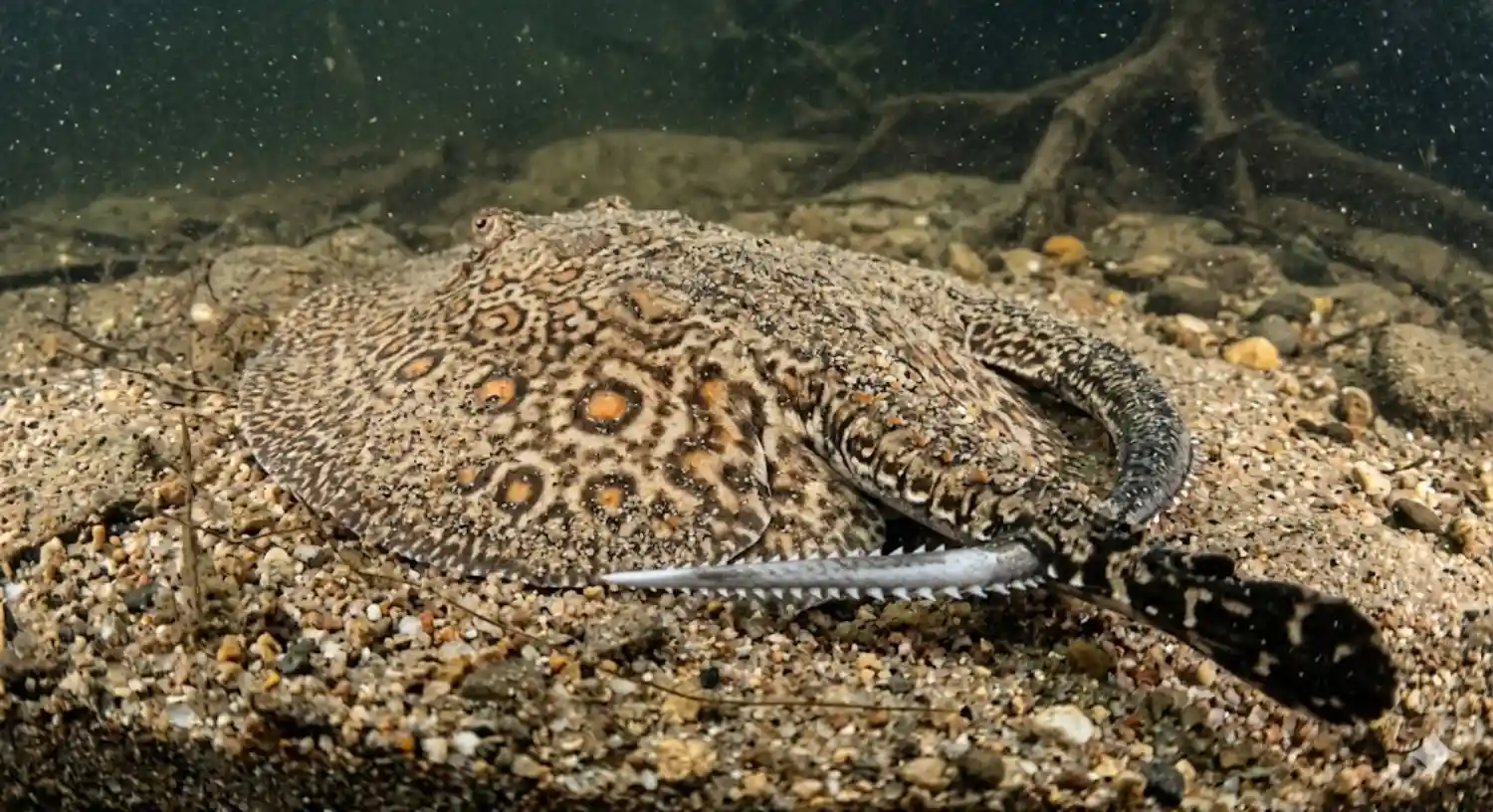
In the murky waters of rivers winding through the vast Amazonian plain lives a close relative of sharks. Millions of years ago, this group exchanged the oceans for freshwater. The Amazonian freshwater stingray belongs to the genus Potamotrygon, and it combines an elegant circular body with one of the most striking concealment strategies found on sandy riverbeds.
This cartilaginous fish can partially bury itself in sand until it becomes almost invisible to predators and prey. That ability is more than a feature of its appearance. It is an evolutionary adaptation that plays a fundamental role in survival. In Amazonian rivers, where water may be murky and the bottom may be sandy, the stingray can disappear while remaining in the place where it rests or hunts.
Its disc-shaped body blends into the riverbed. The stingray stays still, uses the sediment as cover and waits for other animals to approach. Its camouflage therefore serves two purposes: it makes detection less likely and supports a passive hunting strategy based on surprise.
A body adapted to the river bottom
The dorsal coloration of these animals is generally brown, gray or beige. It is often marked with spots or ocelli that closely imitate the surface of a sandy riverbed. Seen from above, the combination of colors, patterns and sediment can make the animal merge with the bottom.
The stingray also takes an active part in its own concealment. By moving the edges of its body, it stirs up a cloud of sediment. As the sand settles, it covers most of the animal, leaving mainly its protruding eyes and spiracles visible.
The result is an animal that can be difficult to distinguish even when it is close by. The stingray’s camouflage in river sand is therefore an example of adaptation to Amazonian environmental conditions. It depends not only on coloration, but also on the way the body interacts with the riverbed.
A hunter that waits unseen
This concealment strategy allows the stingray to catch small fish, crustaceans and mollusks that approach without noticing it. Instead of constantly pursuing prey, it remains partly covered and takes advantage of the moment when those animals come near. Surprise becomes an important advantage for feeding along the river bottom.
The behavior also shows why the species is part of the ecological balance of Amazonian environments. By occupying a niche in the food chain and interacting with small fish, crustaceans and mollusks, the stingray participates in the life of the riverbed. Its presence should not be understood only through the fear caused by its barb.
The animal’s best-known and most feared feature is at the rear of its body. Yet the defensive structure is not located at the very tip of the tail, as many people believe. The venomous barb is actually positioned on the dorsal, middle portion of a muscular and sturdy tail.
The barb and defense against large predators
Depending on the species and the animal’s size, the barb may measure from a few inches (a few centimeters) to considerable dimensions. It is made of dentin, an extremely hard and resistant material similar to the material in vertebrate teeth. Its structure allows it to serve as an effective defense when the stingray feels pressured or threatened.
The barb of Potamotrygon has backward-facing lateral serrations. This shape makes it easier for the barb to penetrate skin while making removal extremely difficult. As a result, an impact can cause severe lacerations and may leave fragments in the wound.
The barb is covered by epithelial tissue. When an impact breaks that tissue, a protein-based venom is released. Studies indicate that this venom is complex and contains enzymes and toxins that cause intense, immediate pain, localized necrosis and severe inflammation at the site of injury.
Science recognizes that the pain reported in stingray accidents is among the most excruciating known in toxicological medicine. Even so, the main purpose of the venom is not gratuitous aggression. Its primary role is defense against large predators, particularly when the stingray is trapped or pressed against the bottom.
Living alongside river communities
The relationship between river communities and freshwater stingrays is ancestral. On beaches and in quiet stretches of Amazonian rivers, places where these animals prefer to rest or hunt, local residents have developed specific practices to reduce the risk of accidents.
One of them is the “nissei step,” which means dragging the feet across the sand instead of lifting them while walking. As the foot slides forward, it gently touches the edge of the stingray. Startled, the animal generally swims away quickly, and the contact does not create the pressure that triggers its defensive response.
An accident happens when someone steps directly on the center of the disc. The pressure pushes the animal against the bottom and activates a defensive reflex. The stingray then drives its tail upward and forward in a whip-like movement, embedding the barb in the foot or ankle of the person in the water.
Understanding this sequence helps replace indiscriminate fear with respect and caution. The stingray is not seeking to attack people who enter the river. Risk generally arises when the animal is directly pressed and cannot move away.
Precautions and care after an injury
Extra care is important when entering an Amazonian river during the dry season, when beaches form. It is best to avoid very shallow, still water in isolated beaches, especially at dawn or dusk, periods when the animal is more active.
Wearing suitable footwear, whenever possible, also greatly reduces the risk of accidents. These measures do not remove stingrays from the river or change their behavior. They reduce the chance of stepping on one and support a safer coexistence with river biodiversity.
If a sting occurs, the first step is to remain calm and leave the water. Submerging the injured area in hot, but tolerable, water for 30 to 90 minutes helps deactivate the venom’s proteins and relieves pain.
Do not apply a tourniquet or cut the wound. Seek medical care immediately so that possible barb fragments can be safely removed, the injury can be cleaned and appropriate medication can be provided to prevent secondary infections.
Environmental education is essential to harmonious coexistence. Stingrays are important components of the Amazonian ecosystem and occupy significant niches in the food chain. Respecting their space, just as people must respect the space of others who share the river, helps protect environments that remain sources of life and beauty for generations to come.
Reporting: Anne Silva / Amazonia Mag

Editor, English Edition — Amazonia Mag
Anne Silva is the editor of Amazonia Mag, the English-language edition of Revista Amazônia. She curates, translates and adapts the outlet's science and environment coverage for an international audience, reporting on Amazon wildlife, flora, rivers, climate and research. Every story she edits is grounded in peer-reviewed studies, official data and on-the-ground reporting from the Revista Amazônia newsroom in Belém, Pará, Brazil. More by Anne Silva →