
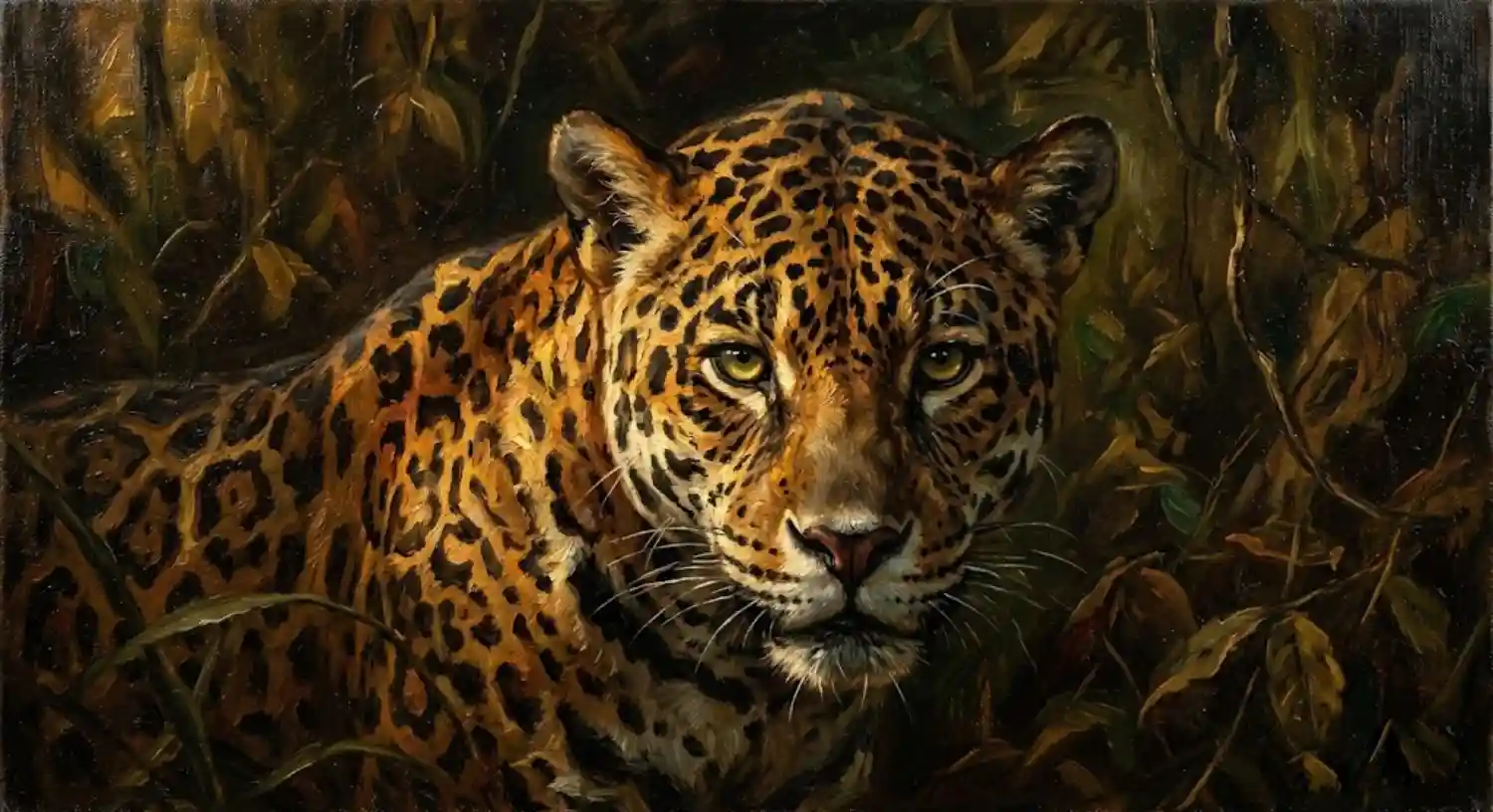
The jaguar has the most powerful bite relative to body size of any cat on the planet. Proportionally, it surpasses even the tiger and the lion. This is more than an evolutionary curiosity: it is a precision tool that helps the largest cat in the Americas remain at the top of the food chain across several ecosystems.
The jaguar’s bite pressure is estimated at about 1,500 to 2,000 pounds per square inch, or PSI, roughly 10,300 to 13,800 kilopascals. That is nearly twice the force of a lion’s bite. According to animal biomechanics studies, this adaptation lets the jaguar break extremely resistant surfaces, including the shells of large reptiles and the tough shells of turtles.
A different way to kill
The jaguar’s hunting method sets it apart from its African and Asian relatives. Lions and tigers generally seek to suffocate prey with a throat bite. The jaguar, by contrast, developed a distinctive and lethal technique: driving its canines directly through the temporal bones of the victim’s skull.
This strategy turns jaw strength into a surgical instrument. The animal does not rely on force alone, but on placing that force precisely against a vulnerable part of the prey. For that reason, the jaguar is the only big cat that uses cranial puncture as its main method of killing prey.
Its canine teeth are shorter and thicker than those of other cats. That shape reduces the risk of breakage when the teeth strike solid bone, an important advantage when the jaguar attacks animals protected by hard structures. Strong muscles and durable canines work together, allowing the cat to use food sources that other predators cannot reach as easily.
The anatomy behind the pressure
The power begins with the structure of the head. The skull of Panthera onca is robust and has an extremely wide zygomatic arch. That broad arch creates room for massive masseter muscles, which are responsible for the pressure produced when the jaw closes.
Each part of the system supports the others. A strong skull absorbs the impact, the masseter muscles generate pressure, and the canines focus that energy on a small area. The result is a bite capable of breaking resistant materials, from the bony plates of large reptiles to the tough shells of turtles.
Animal biomechanics studies indicate that this adaptation broadens the jaguar’s feeding options. Instead of depending only on soft-bodied or unprotected prey, the cat can exploit animals whose natural armor limits other hunters. The specialized jaw therefore has a direct role in the jaguar’s ecology.
A river predator
The jaguar’s encounters with rivers reveal the efficiency of this mechanism. When it attacks a caiman, the reptile is protected by armor made of bony scales. That defense can still be overcome by the cat’s strategy, because the jaguar may dive or attack from the riverbank and direct its bite toward a vulnerable point.
The canines can sink into the base of the caiman’s skull or into its cervical spine. This move neutralizes the prey’s central nervous system almost instantly. The attack shows that the jaguar’s strength is not simply brute force, but a refined survival solution shaped over thousands of years of evolution in dense, flooded environments.
In the Pantanal and the Amazon, the cat moves between terrestrial and aquatic worlds. It encounters abundant prey in vegetation, rivers and wetlands. Its ability to hunt in both settings allows it to respond to the availability of food while maintaining its position as a top predator.
A broad and flexible diet
The jaguar has one of the broadest diets among terrestrial carnivores, covering more than 85 different species. That variety reflects its physical abilities. The menu ranges from small mammals and birds to large animals such as tapirs and capybaras.
The powerful bite is central to this flexibility. The jaguar is the only cat able to feed regularly on prey with hard armor, reducing direct competition with smaller predators. Within the same landscape, it can make use of resources that remain inaccessible to other hunters.
In regions such as the Pantanal and the Amazon, the abundance of aquatic and terrestrial prey requires the cat to move between different domains with equal agility. Its ability to cross rivers, attack from the water or pursue prey on land combines with a specialized jaw. The jaguar’s diet is therefore evidence of adaptability, not merely a list of animals it can capture.
A sign of ecosystem health
The hunting technique of Panthera onca also influences territorial behavior and the species’ dispersal. As a top predator, the jaguar needs large amounts of protein and a vast territory to maintain its dominance. By regulating prey populations, it acts as an essential force in the ecosystem.
The presence of a jaguar in a protected area is an indicator of ecosystem health because the cat depends on the integrity of the entire food pyramid beneath it. A predator at this level requires sufficient prey, vegetation cover and conditions that can support its movements.
Young males often travel hundreds of miles in search of new territories. These movements provide the genetic variability needed for the species to continue in tropical forests and wetlands. Such mobility, however, depends on landscapes remaining connected.
Conserving the jaguar therefore means more than protecting individual animals. It also means maintaining ecological corridors that allow them to move freely. Science recognizes habitat fragmentation as the main long-term challenge facing the survival of these animals.
Protecting the jaguar indirectly protects thousands of other plant and animal species that share the same green canopy. Its bite may be powerful and intimidating, but it is also part of a wider network that sustains the delicate balance of Brazilian forests. Every rosette in its coat and every muscle fiber in its jaw tells a story of adaptation.
When this magnificent cat crosses the waters of a Brazilian river, nature’s true strength appears as more than the power of an attack. It lies in the harmony between predator and the vital balance of the natural world. The jaguar is not merely a symbol of brute force, but an example of how biology shapes specialists capable of meeting the greatest challenges of their environment.
Reporting: Anne Silva / Amazonia Mag

Editor, English Edition — Amazonia Mag
Anne Silva is the editor of Amazonia Mag, the English-language edition of Revista Amazônia. She curates, translates and adapts the outlet's science and environment coverage for an international audience, reporting on Amazon wildlife, flora, rivers, climate and research. Every story she edits is grounded in peer-reviewed studies, official data and on-the-ground reporting from the Revista Amazônia newsroom in Belém, Pará, Brazil. More by Anne Silva →